
Many thanks to my astro-mentor Rab Wilkie for prodding me to focus on Regulus.
2025 is the 80th anniversary of the so-called Nuclear Age, brought about by the development and use of nuclear weapons by the USA.
So terrifying were nuclear weapons that some nations came together to form an institution that would promote atomic science for peaceful purposes. The International Atomic Energy Agency – IAEA was created after being put forth by USA president Eisenhower, even as the scale of nuclear weaponry production in the USA was increasing a rapid rate.
Without boring you to death with the history, because we’re only here to see if (freemasonic?) ritual astrology was in play, the organization finally came into being with Eisenhower’s pen on July 29, 1957, during a brief ceremony at the White House:
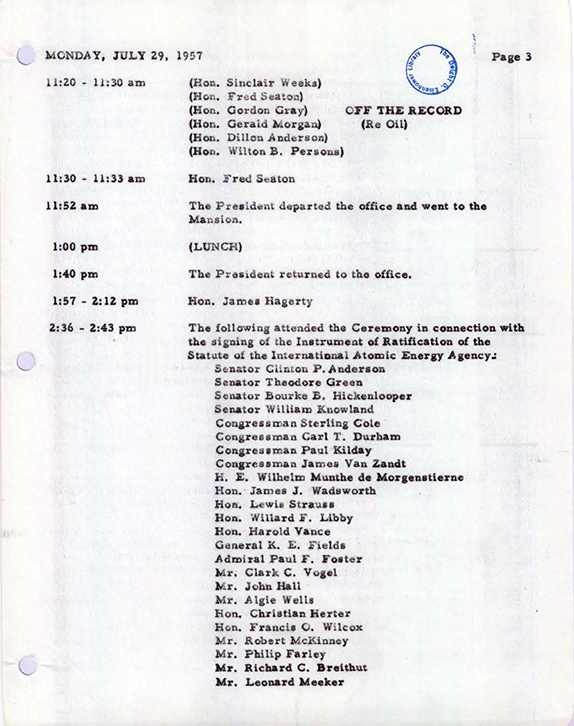
I settled on 2:40 pm for the radix, and the MC could be moved a degree forward or backward during the 8 minute-long signing ceremony:
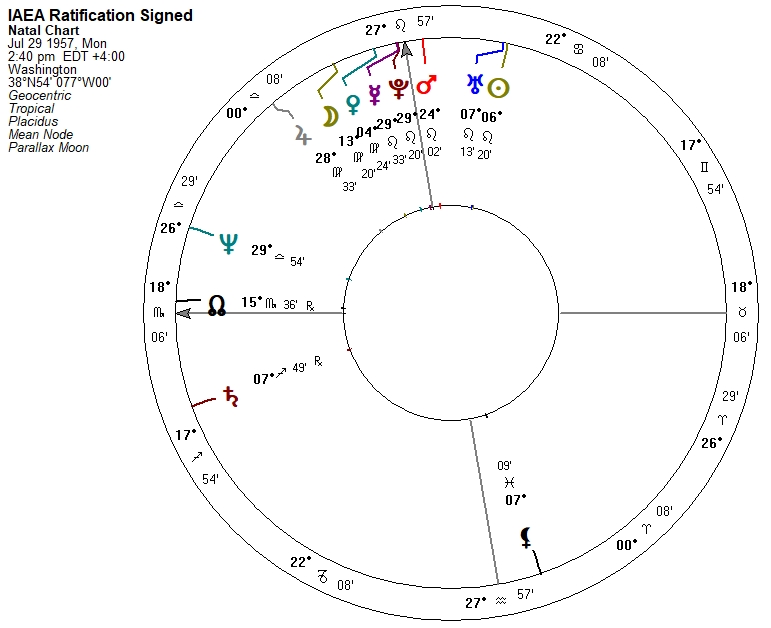
As one chart standing alone, we find a highly dynamic astrology at play. Yet, the story of one chart should always be assessed through how it interfaces with other charts. For instance, your own personal natus may show you things, but when compared to the charts of your parents or guardians, the story of who you are takes on new dimensions.
Mundane charts are no different — all of them are based on something that happened befrore.
But, we have to start somewhere. In astrological delineation, we like to look at conjunctions first and foremost, and the IAEA signing ceremony chart has two:
Sun/Uranus — 6°20′ Leo and 7°13′ Leo
Mercury/Pluto — 29°33′ Leo and 29°20′ Leo
…the obvious analog here being that Uranium and Plutonium are the fundamental fissile materials within nuclear warheads, and also nuclear reactors.
Thus, we have an obvious ritual astrological moment for such an endeavor as the IAEA. The plot thickens, though, when we look at the fixed stars, showing Mercury/Pluto aligning with Regulus, and Sun/Uranus aligning with the Praesepe and Asellus Australis (the exaltation of Jupiter):
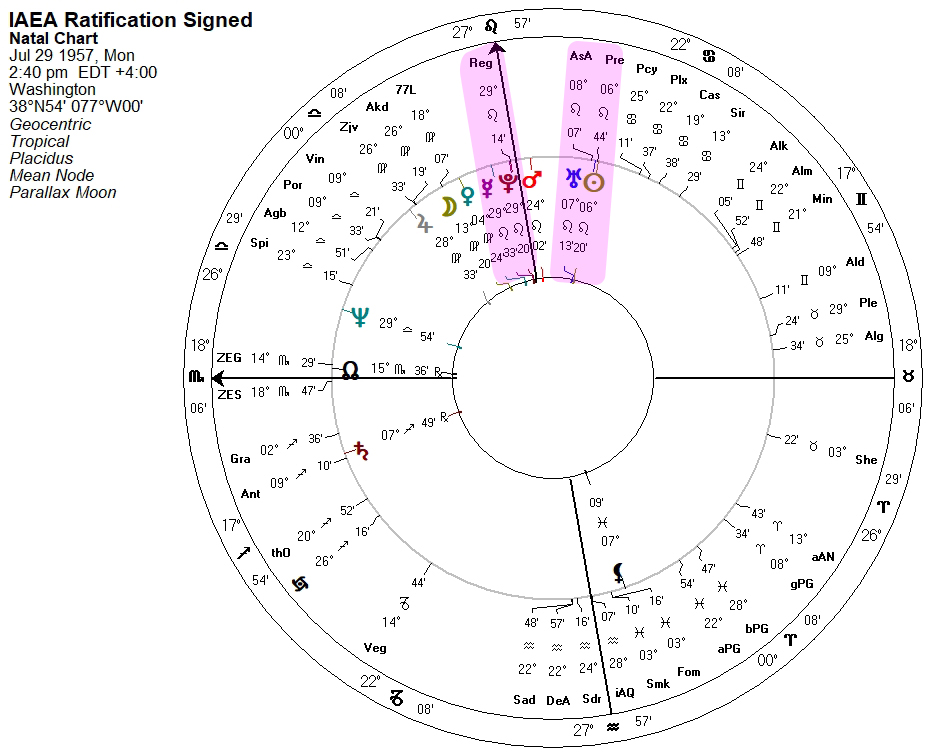
Mercury/Pluto/Regulus
The name “Regulus” in astrology has a meandering origin story, but it’s definitely connected to the ancient moniker: a King Star, though secondary to Jupiter:
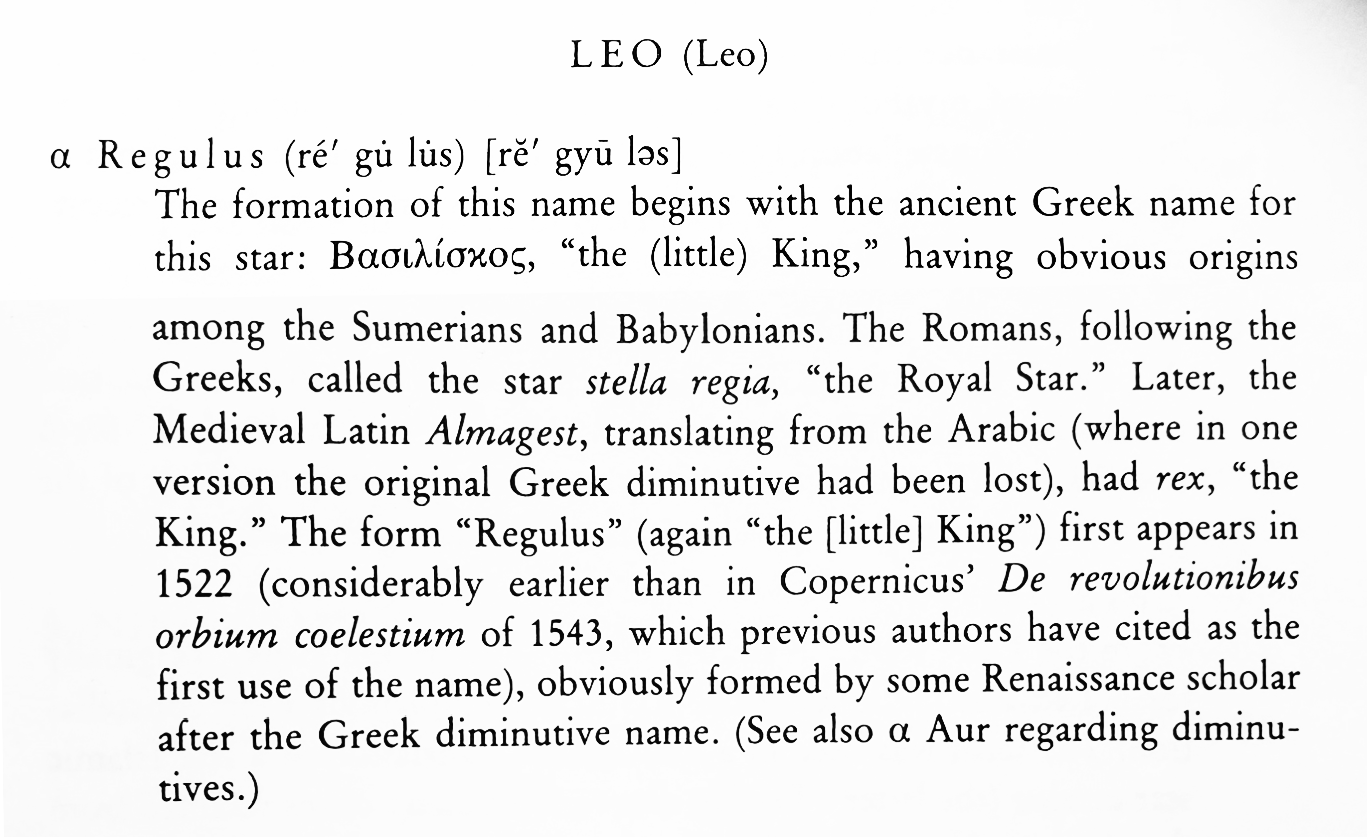
Regulus has another meaning, however, in the world of alchemy and metallurgy. In this sense, one might draw parallels between the elements of Uranium and Plutonium, where the latter is a kind of synthetic element that comes from processing Uranium in a certain manner.
Sun/Uranus/Praesepe
The Saturn/Uranus conjunction aligns with the Praesepe [aka the Beehive Cluster and M44], known to the Greeks as “the Manger,” which makes symbolic sense if we think of the Sun as a giant contained nuclear reaction, and the cradle of new elements coming out of the plasma.
A Sky Map Pro graphic of the alignments with some markups:

Mundane Synastry
The “chart” for Plutonium

One of my favorite astrology books, and one I think every serious astrology researcher should own, is Nick Kollerstrom’s The Metal-Planet Relationship. It has some errata that needs to be addressed, as does basically every astrology book, but Kollerstrom’s research is keen and his ducks are in a row.
Kollerstrom chose the glyphs of Pluto and Mercury for the cover, no doubt to clue us into something Hermetic. Quicksilver is essential in the metallurgy of gold, but some metals are far more valuable than gold in our modern world.
It may be surprising for many to learn that Uranium and Plutonium are metals, as we tend to think of metals as either iron, steel, copper, brass, aluminum, etc. The fact is that most elements in the Periodic Table are metals.
Traditionally, astrology associated the seven planets with the seven known metals: Sun = Gold; Moon = Silver; Mercury = Mercury; Venus = Copper; Mars = Iron; Jupiter = Tin; and Saturn = Lead.
When Uranium was “discovered” to be its own element in 1798, it was named after the newly-discovered (1781) planet Uranus. The name Uranus was affixed to the new planet by German astronomer Johann Elert Bode, who wanted a non-political name for the newly-discovered body; the naming of the “new” element Uranus also had anti-political overtones as well.
In any event, it takes Uranium to synthesize Plutonium. The idea that this could be done was only hypo-theory up until it was proven in a lab at Berkeley, California, during a process that lasted about eight hours, beginning at 8 pm on December 14 of 1940. Ironically, Pluto is on the ascendant at that time:
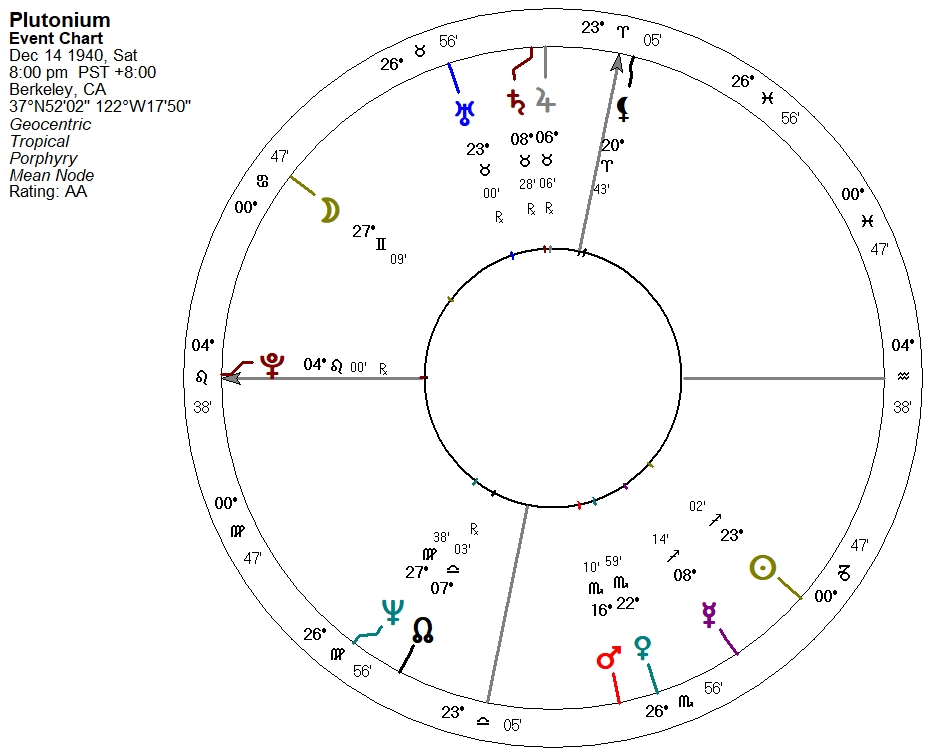
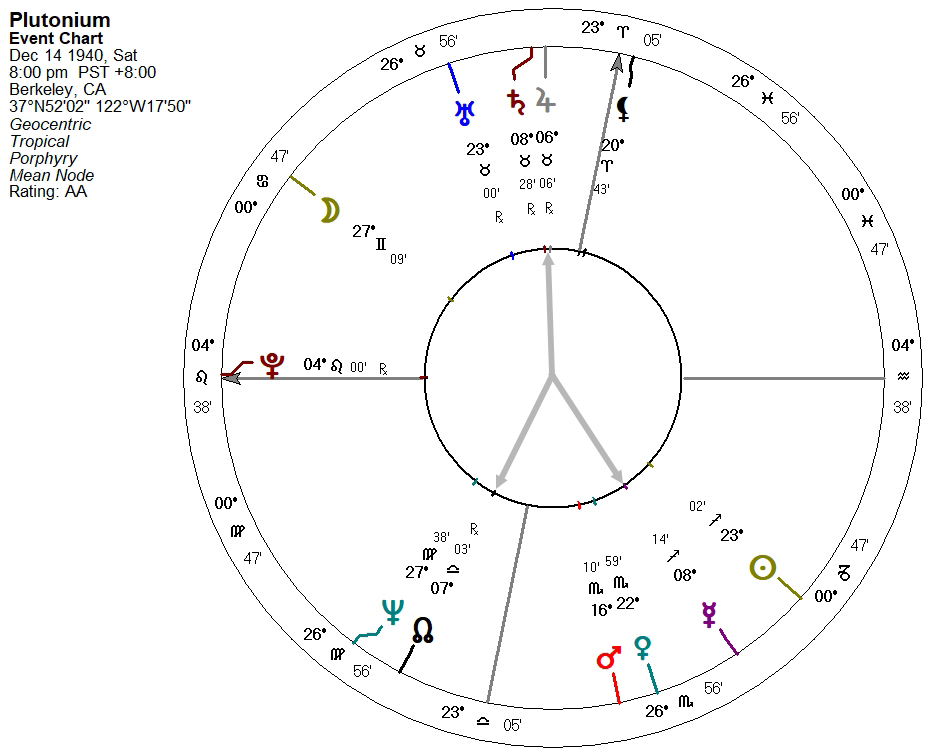
This world-shifting experiment took place within the generation-shifting triple-conjunction period of the big boys: Jupiter and Saturn. Jupiter and Saturn meet up about every 20 years, which was not lost on the ancients, as that was basically the longest cycle between two planets.
That conjunction is the finger in a so-called “Finger of God” or “Yod” triangle:
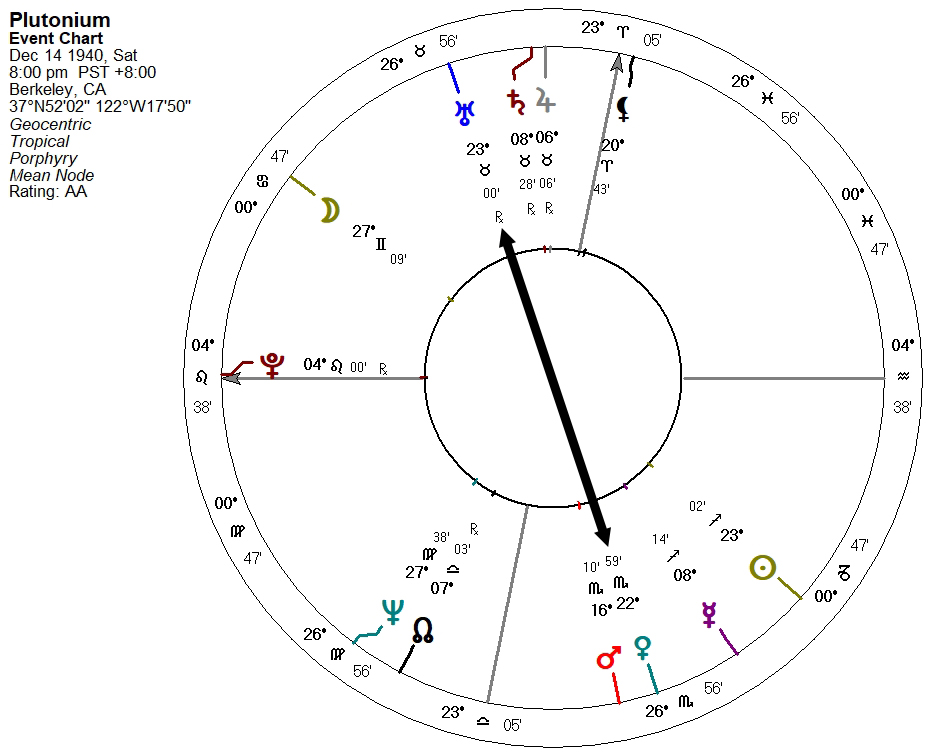
A nearly partile Venus/Uranus opposition is present:
A full moon that aligned with Orion had perfected only hours earlier, tapping into my soon-to-be famous Holy Grand Trine pattern, along with Spica on the IC:
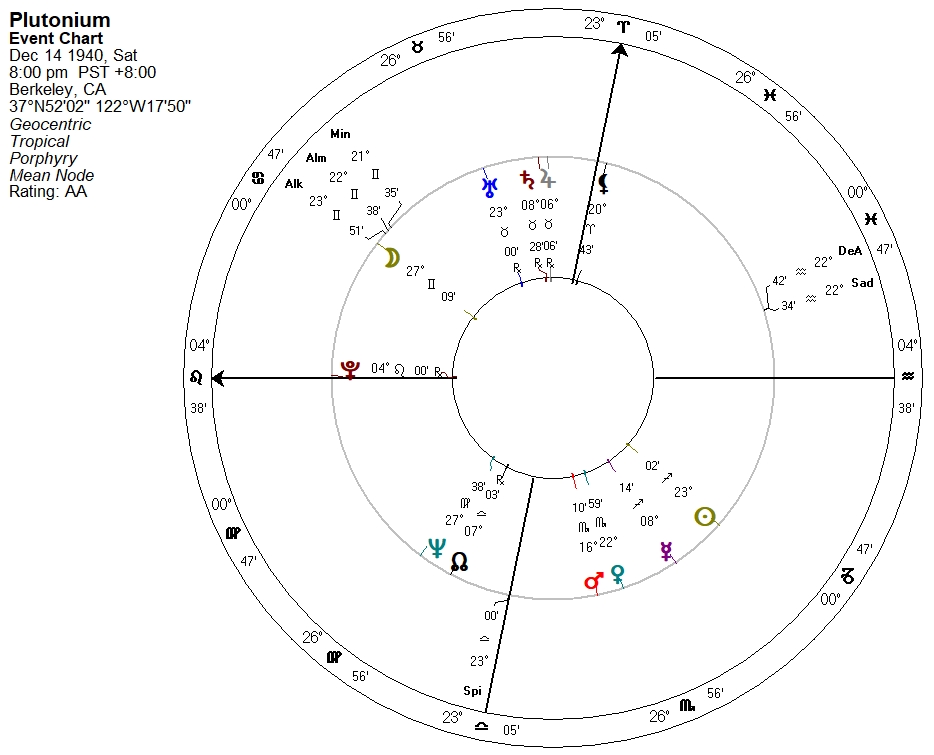
The Moon is square to Neptune, evoking the mysterious, and also the chemistry, or maybe the alchemy:
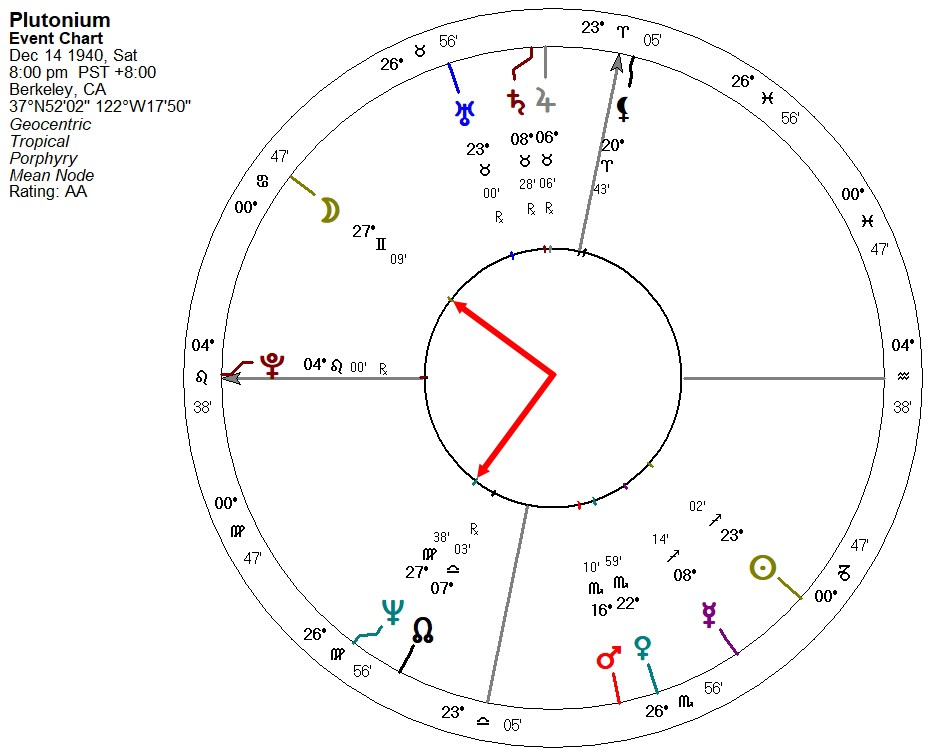
As you can see, there’s quite a lot going on with this chart on the primary level. The entire world truly silently shifted that night in ways few could grasp.
The IAEA signing chart has strong inter-chart alignments with the Plutonium chart:

Note that the signing Sun/Uranus/Praesepe is square to the Jupiter/Saturn conjunction of Plutonium; Note that the signing Saturn is closely conjunct Plutonium Mercury and sextile Plutonium North Node, and thus the two charts are humming along together through multiple aspect patterns.
Atomic Energy
Nearly two years after Plutonium was created, the Manhattan Project’s top-secret lab at the University of Chicago was able to produce power, but with Uranium.
Kollerstrom briefly explains the process on page 122:

The now-legendary experiment, which lasted for 23 minutes, has yet another Moon/Neptune pairing, but this time the conjunction, and it is in a nice trine with Uranus:

Thus, the 1940 Plutonium chart has a closing “sinister” Moon/Neptune square, and the 1942 Atomic Energy chart has a Moon/Neptune conjunction that had been applying. One could argue that (at least in astrological parlance) that the creation of Plutonium, and then power generation, were occult demonstrations – alchemical feats of Neptunian magic. Well, that’s probably what Isaac Newton would have said if he were around for it.
Kollerstrom continues on page 122:

Well, not exactly 5′ of arc, but we can see with better calculations that Saturn was within 2′ of arc to Aldebaran, and exactly opposite Antares, though the offset with Sun is 1°05′:
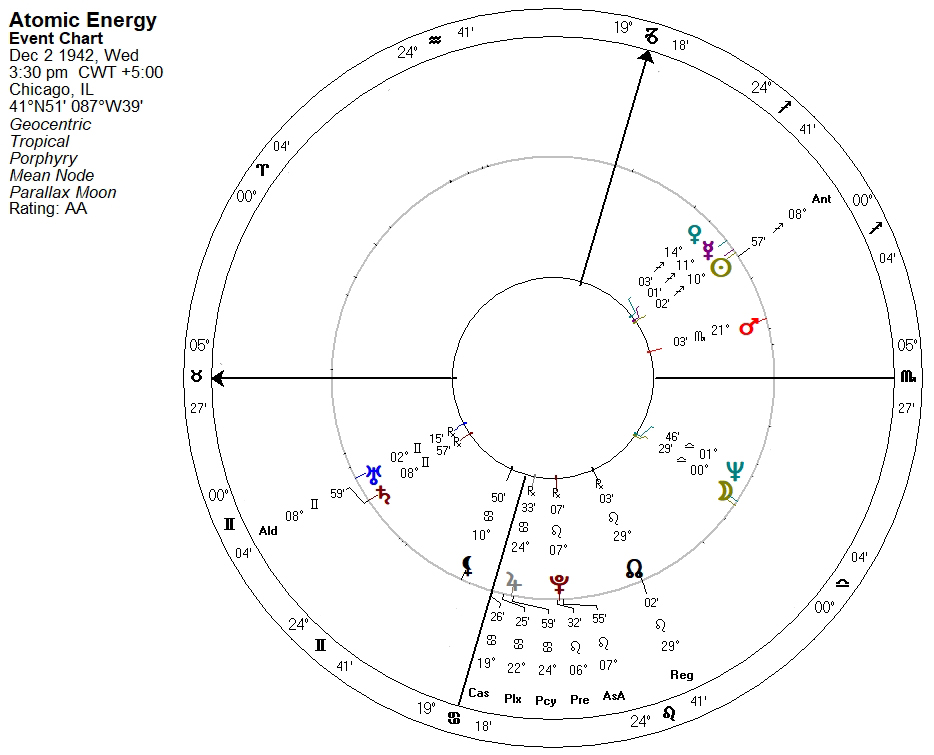
We can also easily see that the North Lunar Node is exactly conjunct Regulus, and Pluto is conjunct the Praesepe. Jupiter is conjunct Procyon, the Little Dog – a star that figures prominently in USA national astrology, as well as many other mundane charts around the world.
Putting it together with the IAEA chart, those positions will be familiar:
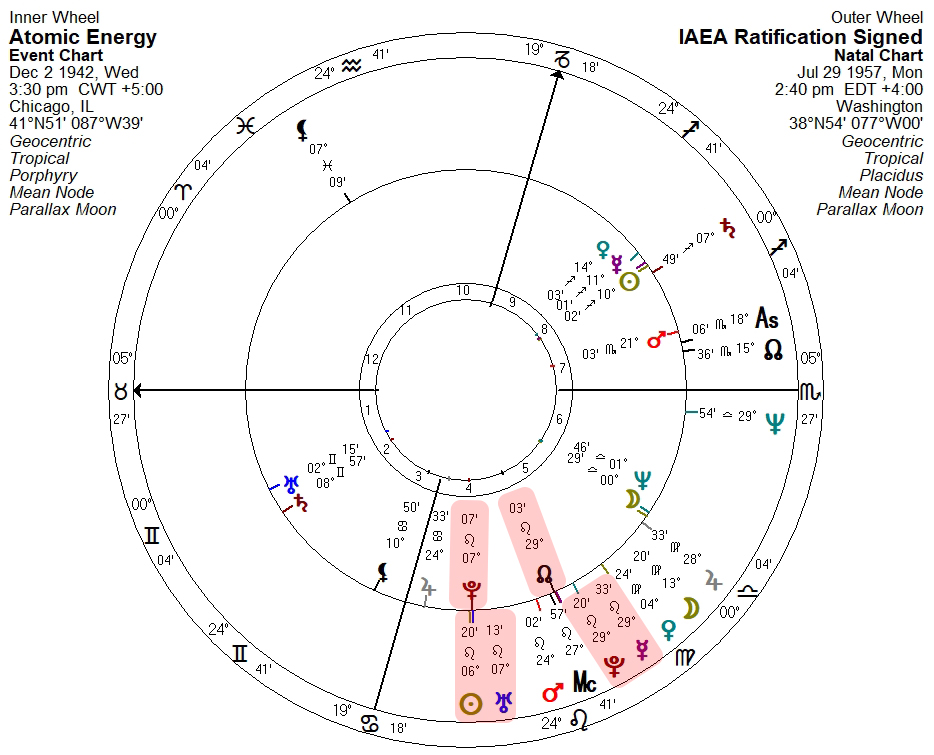
| Atomic Energy | IAEA Signing | Fixed Star |
|---|---|---|
| Pluto | Sun/Uranus | Praesepe |
| North Node | Mercury/Pluto | Regulus |
In summary, we are seeing a pattern emerge that suggests some interesting ritual astrology – but this time the Heavy Metal remake.
In Part Two, we’ll head up to the Great State of Idaho and the magickal place where 22 meets 33 for the demonstration of the technique.

►Ed

 Cosmos of Absurdity
Leave a reply to Rab Wilkie Cancel reply