
Who decides on those abstract generational time periods for the USA?
Who decides whom a “Millennial” is, or whom a “Gen Z-er” is? Why are they all different lengths of time? Do other nations have this wacko system of labeling millions of innocent humans with some temporal pejorative? What is French for, “OK, Boomer!“?
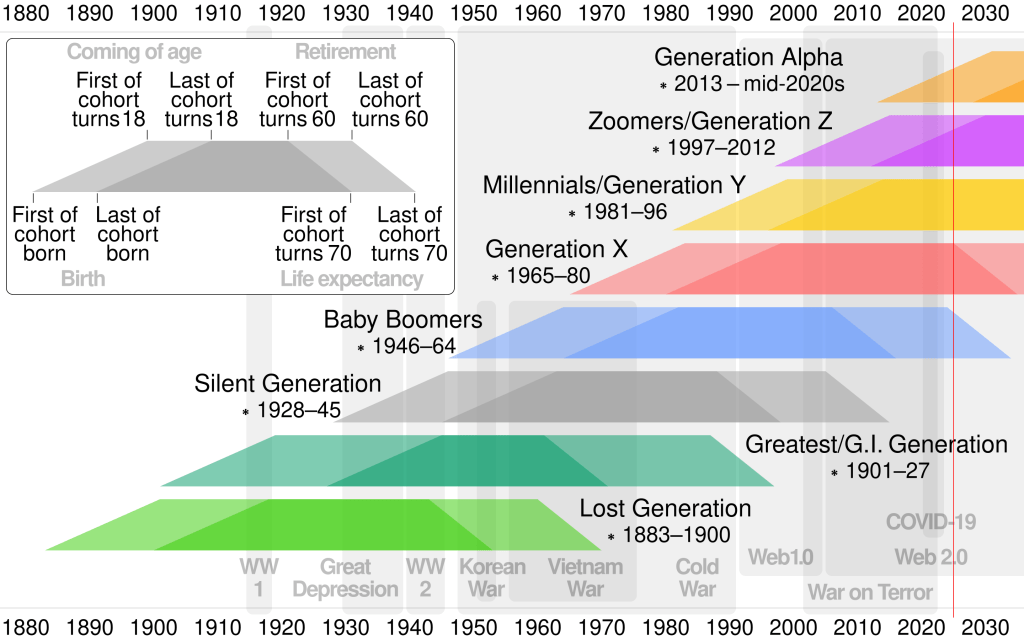
To try and make sense of it, I found this seemingly authoritative graphic, which seems to be explaining something about life stages and expectancy:
I (perhaps foolishly) queried my go-to AI research assistant — perplexity.ai — about these vaunted USA generations, and this is what I got:
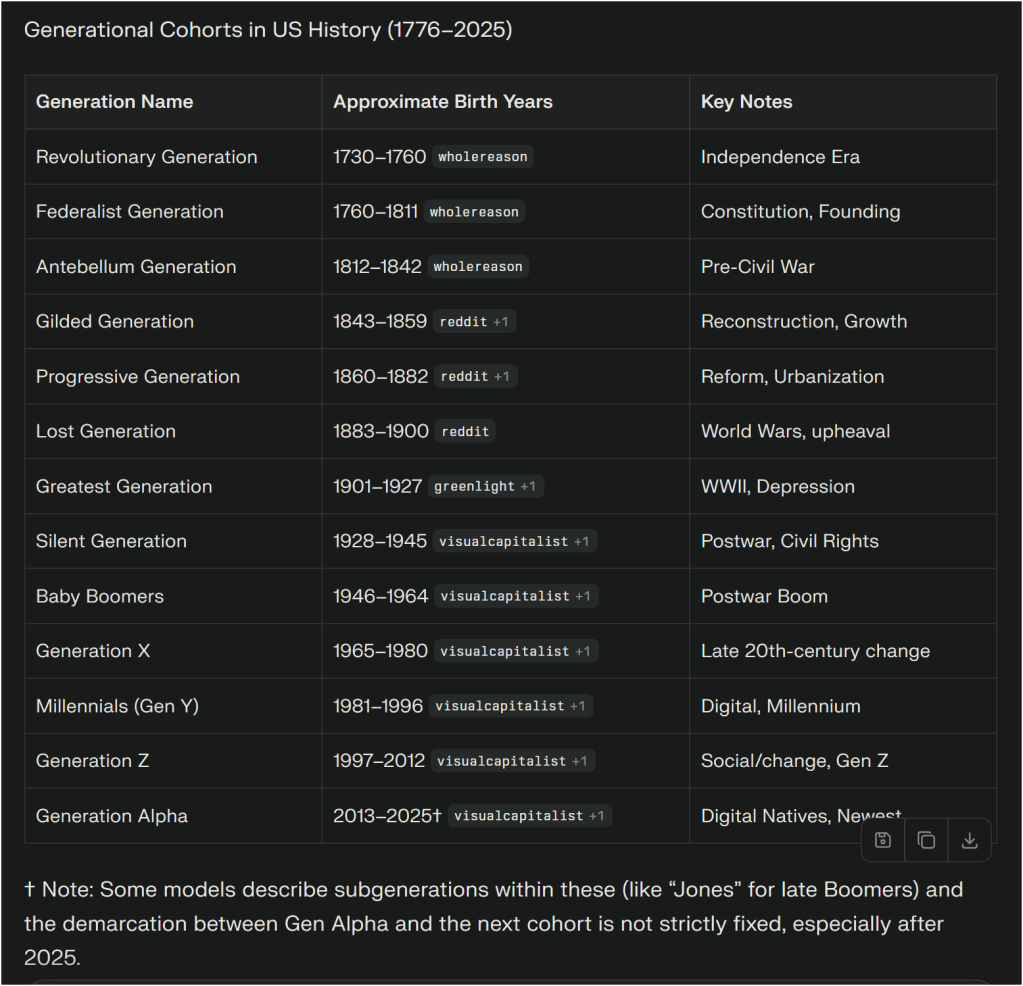
It all seems quite haphazard. Boomers have a 19-year span, but Gen Z has only 16, while the “Greatest Generation” has 27? That “Federalist Generation” is 52 years long? Did people even live that long back then?
As an astrologer (of sorts), I have no use for such abstractions. To me, clusters of temporally-fated humans are born in and around the good old planetary combo cycles. Thus, it is time for:
Ed’s Astro-Generational Table and The Dreaded Math
I got to thinking about all of this recently when looking at some charts of people born in the early 1990s, in very close temporal proximity to the major long-term cycle of the solar system: Uranus/Neptune. (I left out Pluto for a reason, which I will explain later.)
UR/NE is Uranus/Neptune
The previous two geocentric UR-0-NE (conjunctions):
Mar 22 1821 03°Cp01′ D 10°Sg46′ D
May 03 1821 02°Cp51′ R 10°Sg36′ R
Dec 03 1821 01°Cp59′ D 09°Sg43′ D
Feb 02 1993 19°Cp33′ D 24°Sg54′ D
Aug 20 1993 18°Cp48′ R 24°Sg08′ R
Oct 24 1993 18°Cp32′ D 23°Sg53′ D
Uranus and Neptune have orbits that exceed most lifetimes. Uranus takes 84 years for one orbit, and Neptune 164 years. The two planets meet up in a conjunction every 171.4 years, on average, with the minima being about 171 years and the maxima being about 172 years.
The last conjunction was in 1993, and the one before that was in 1821. The math tells us that most humans will not be alive during one of these conjunctions.
Those conjunctions occur at watershed moments for civilization. For instance, aluminum was finally isolated as an element right after the 1821 conjunctions, and the World Wide Web internet browsing protocols went public in 1993.
The Western Hemisphere was “discovered” shortly after the 1479 conjunctions, and Dante’s Divine Comedy began to be penned right after the conjunction of 1307, while at the same time the Knights Templar were dismantled and forced underground.
I’ve listed all of the conjunctions for the last 5,000 years as an appendix.
JU/SA is Jupiter/Saturn
The other two “gas giants” that run the astrological show are Jupiter and Saturn. They meet up in a conjunction about every 19.86 years – a period that will be experienced by most humans.
This period approximates the typical human idea of entering adulthood, between the ages when military service can be had, to being able to legally get served at a watering hole in the now-fascist USA.
I’ve simply assumed over the decades that the vicennial period of Jupiter/Saturn was historically the basis of a generation. Why wouldn’t I? The historical astrological literature says so — it was the longest interplanetary cycle known to the ancients and the Medievalists. But, of course, nothing is that simple after Herschel.
Other Cycles
One Saturn orbit takes 29.5 years, which is too long, as most women gave birth at far younger ages in the past. HOWEVER, in the USA at least, the average age of a first pregnancy is now about 30 years of age. This represents an astronomical (pun intended) departure from the historical average of motherhood beginning in the early 20s. The graph below shows how choice (contraceptives, family planning, etc) has altered the generational landscape in the USA:

First-time births at 18-19 years as a percentage of the birthing population went from 25% to 10% in just 60 years. Also:
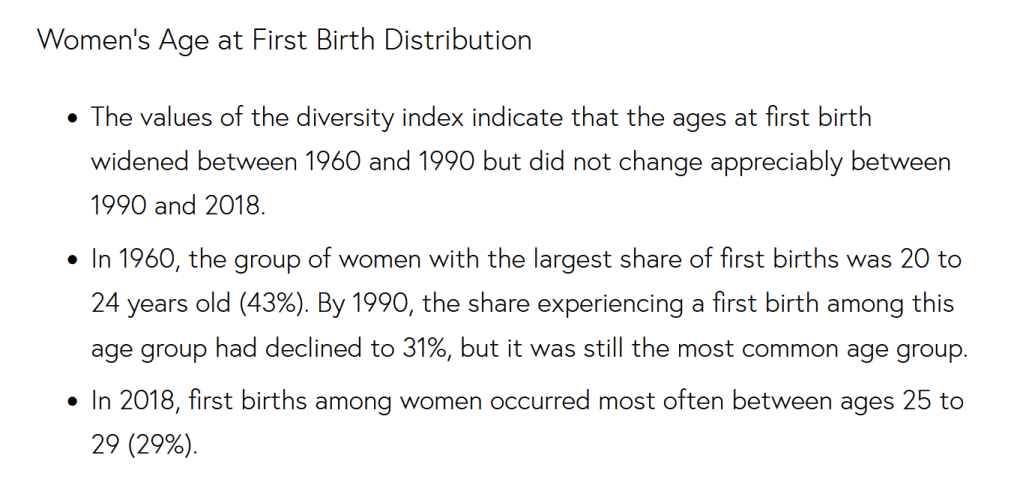
All of which makes me wonder why the Grand Poobahs of generational periods have been shortening the span of USA generations. Women as a demographic are choosing to have babies much later in life, but generation-lengths have been shrinking from 19 years (Boomers) to 16 (Gen Z)?
If anything, generation-spans should be getting longer, not shorter, right? Of course, the idea of a “generation” surely has more to do with a shared learning and awareness curve of a sub-collective within a cultural/technological milieu. What should those parameters be? Heaven knows, right? Maybe someone out there can explain this to me.
Things are definitely speeding up in terms of learning and assimilation, thanks of course to the poisons of social media, but the planets, well, they are still slogging along at their own paces. If a generation represents a cycle, then the cycles of the planets must be driving things. Here are the three major astronomical cycles that approximate a generation:
| Jupiter -0- Saturn | ~19.86 years |
| Metonic Cycle 1 | 19.0 years |
| Lunar Nodes 2 | ~18.6 years |
| Saros Cycle 3 | ~18.03 years |
Of those, the Metonic comes closest to being a factor of the Uranus/Neptune synods of ~171.4 years: 19 × 9 = 171. (171.4 is an average, with a variation of about 5 months — 171.4 ÷ 9 = 19.04.) That is precisely the number of years it was possible to be born a “Boomer”.
Placing the 1821 and 1993 conjunctions near the centers of their respective periods, this somewhat sensible table still keeps the Boomers as the 12th (and 2nd-most ruinous) generation, and the Civil War as the 6th (and 1st-most ruinous) generation:
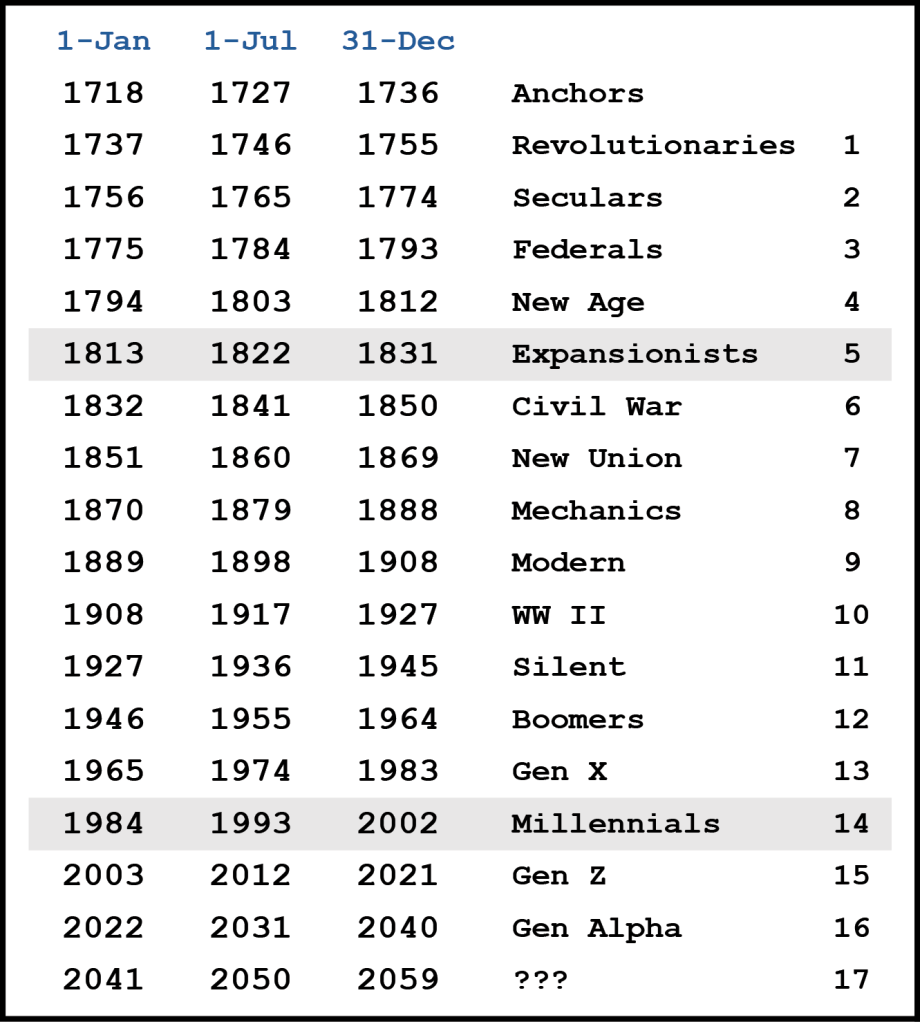
Well, it’s far from perfect, but at least it soothes my OCD, and I guess Orwell.
►Ed


 Cosmos of Absurdity
Leave a comment