
In Part One, we saw how the RAS Royal Charter was astrologically linked to both the discovery of Uranus and the first business meeting of the pre-royally honored club.
Now it is time to look at the royal charter “supplementals”. The supplemental of 1915 specifically allowed women in the club.
…that it would increase the usefulness of the said Society if women could be elected Fellows and Associates thereof, and that it is apprehended by the said Society that women may not now be eligible to be elected Fellows and Associates thereof…
The point of all this is to check whether any kind of ritual astrology was part of the royal sanctioning of the club, but also to educate. Sir William Herschel had a strong partnership with his sister – Caroline Herschel – who had quite many astronomical accomplishments in her own right.
The 1915 Supplemental
There are four important dates to look at in this study of Royal milestones for the Society, with the first two being discussed in Part One:
First Business Meeting: March 10, 1820
Royal Charter: March 7, 1831
Royal Charter Supplemental: June 5, 1915
Royal Charter Supplemental: July 15, 2005
The supplemental of June 5, 1915 will have a new planet, Neptune, to take into consideration. Here is the chart, cast for noon because that’s the Royal way:

Western astrologers might point to the Moon-Jupiter conjunctin in the 7th house as apropos for welcoming (Jupiter) women (Moon) into the club. What else is going on with this chart? Let’s investigate the table of aspects:
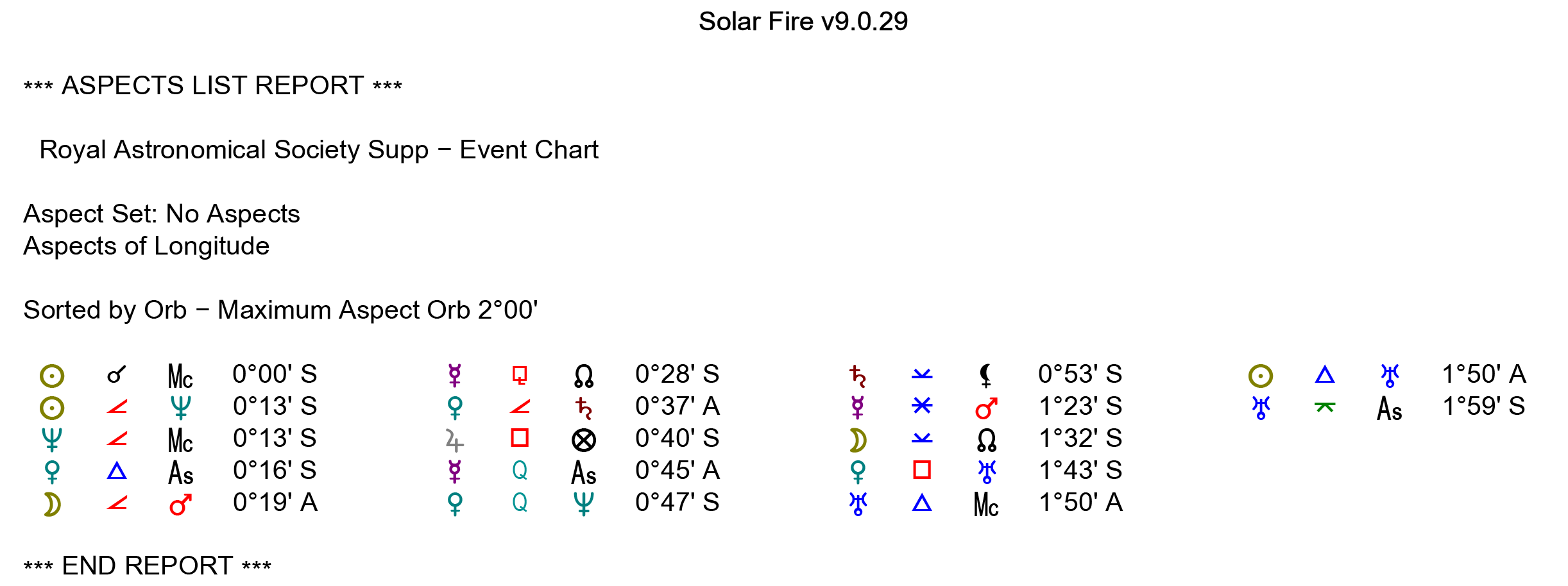
Wouldn’t you know it, the closest aspect is Sun in semi-square to Neptune. Right behind that is Moon in a semi-square to Mars, and Venus in a semi-square to Saturn. Basically, the main masculine planets are connected to the main feminine planets. Clever of those Royals, eh?
Switching over to the Fagan zodiac…
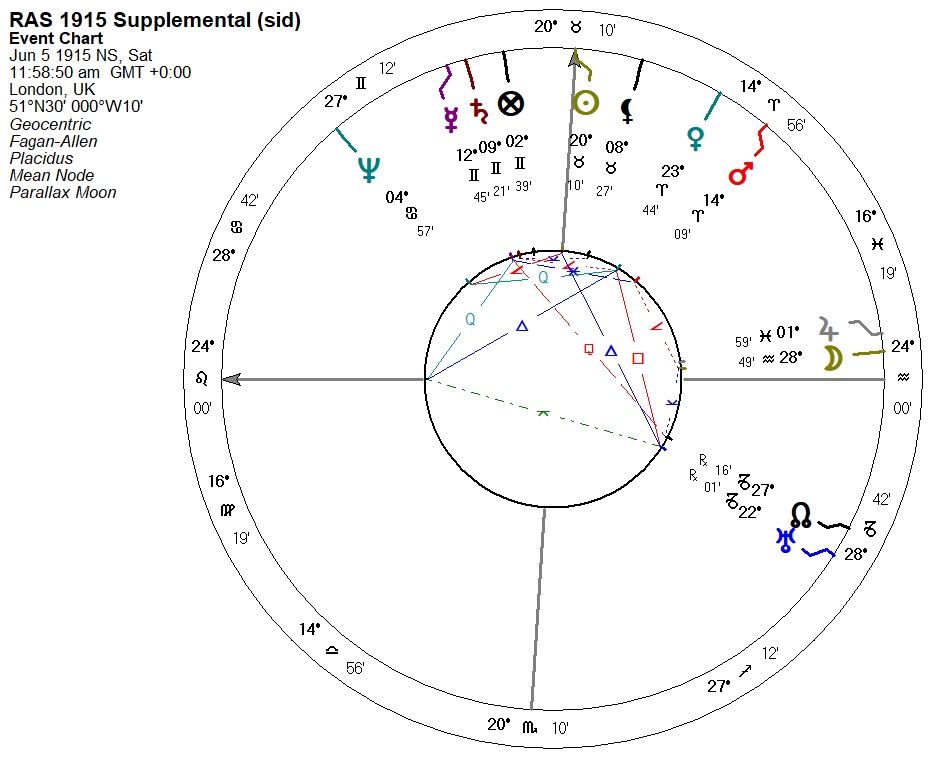
…we can examine fixed star interactions:

On the ascendant, we have our old mysterious friend 77 Leo, who we noticed in Part One was exactly opposite the Sun of the RAS chart. Thus, this bi-wheel where the 1915 horizontal aligns exactly with the 1831 meridian:

Not only that, but we also see 1915 Jupiter in square to the 1915 Part of Fortune, and that completes an inter-chart T-square with 1831 Moon, which we know was conjunct the Galactic Center and opposite the location of Uranus at its discovery in 1781:
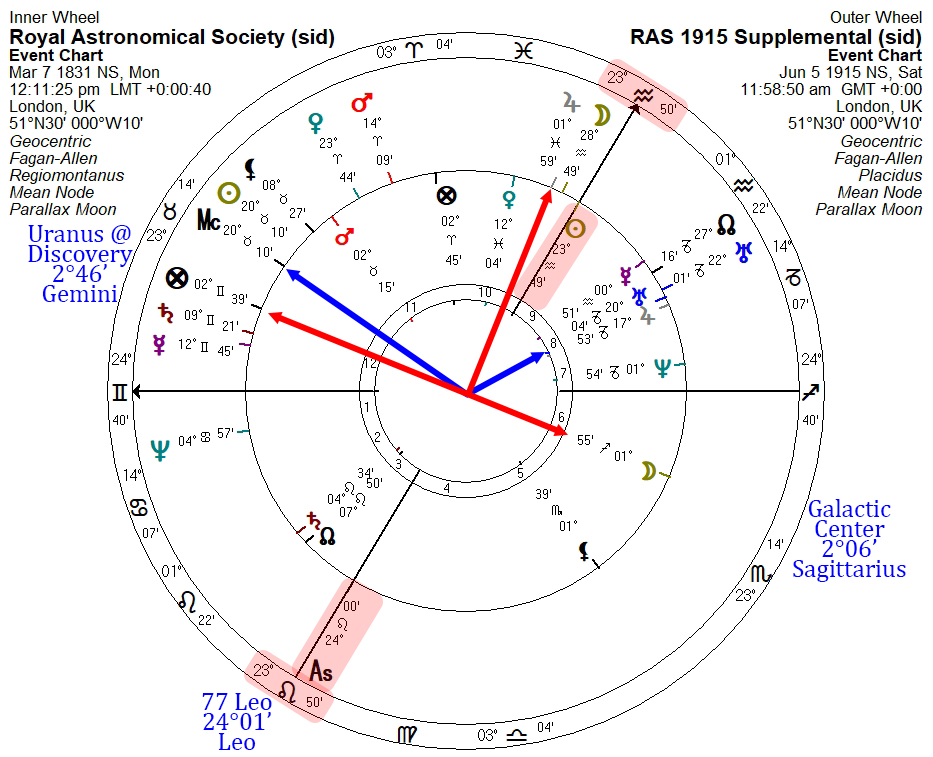
I included the interchart trine from RAS 1831 Uranus to RAS 1915 Sun. Placing the Uranus discovery chart with the RAS 1915 chart, we can see the T-square has been emphasized yet again:

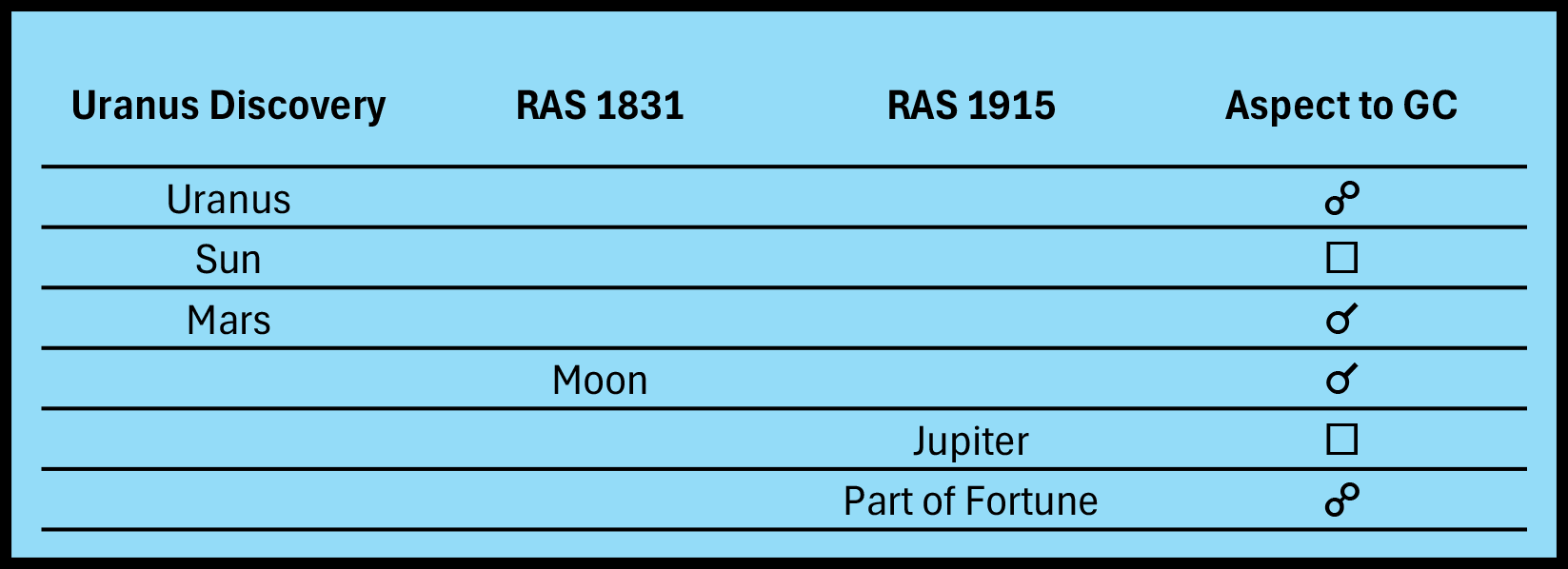
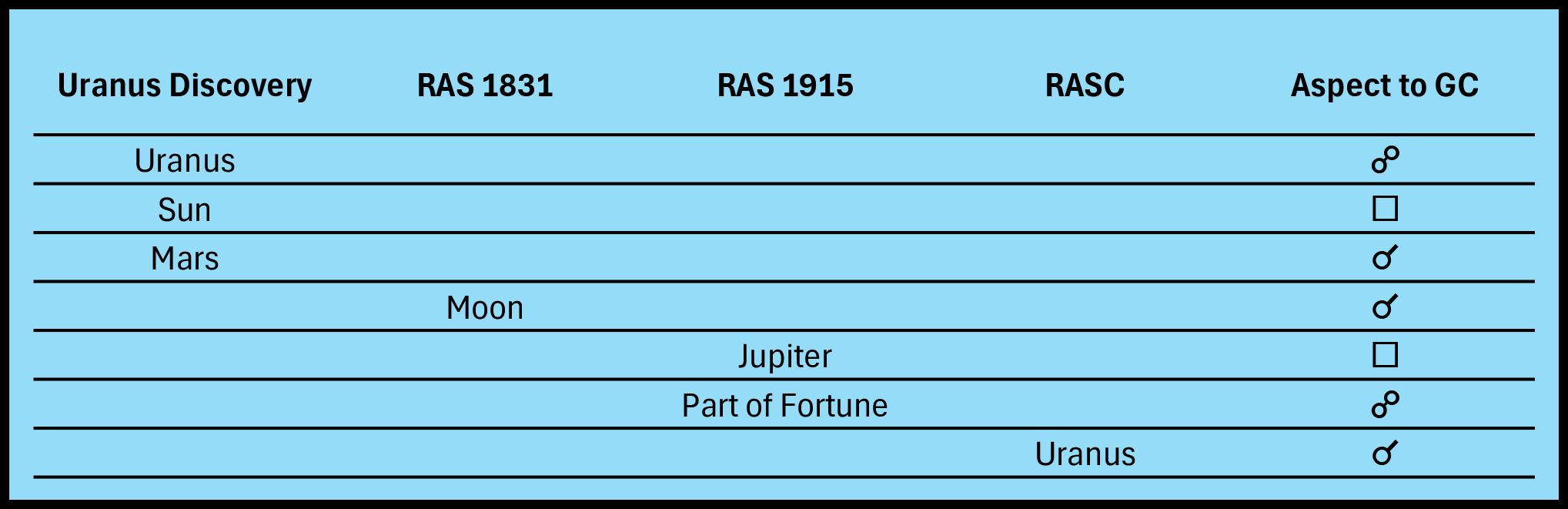
This table summarizes all the connections to the Galactic Center in these three charts:
All of this begs the question: Was Herschel some kind of wizard? Well, he and his sister were musicians first, and there’s something to be said about musical vibrations opening up the mind to portals of the unseen world.
Herschel was so proficient and unique that he was rumored to be Bohemian, which we now know he wasn’t, but he was certainly a German Lutheran, as was Kepler – the same as Yours, Truly’s pedigree.
What About That 2005 Supplemental?
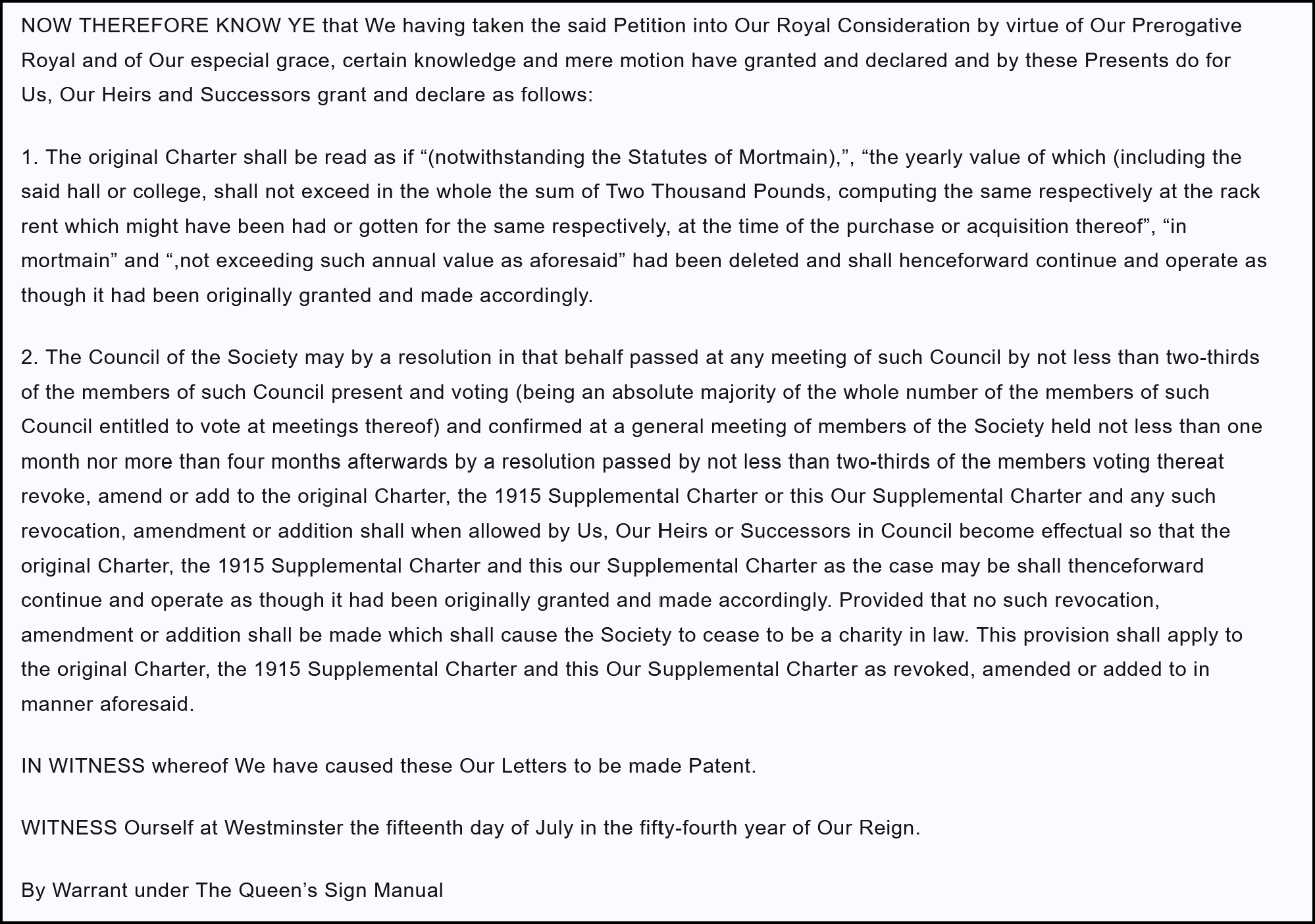
The 2005 Supplemental was not of the 1915 Supplemental, as can be seen in the screen capture at left (click to enlarge).
It had to do with adjusting procedures and financial requisites than with a progressive evolution of the Society. The chart below, with the Lunar Nodes straddling the horizontal while in sextile/trine to Mercury tells us as much. The sinister square from Sun to Mars (@ Venus’ exaltation) does repeat at least part of the T-square motif in the Herschel Uranus discovery chart:

Besides that, it’s rather boring. But, you want excitement, right? For that, we go to the very exciting town of Toronto, Canada, where another group of very exciting astronomers created an astronomy club. Are you ready for this, Rab Wilkie?
Royal Astronomical Society of Canada
That club became the Royal Astronomical Society of Canada – the RASC for short. Are they RASCal scholars? Of course they are, because the British Crown granted them Royal status on March 3, 1903 – 3/3/03.
In May, 1900, chiefly through the efforts of one of the important early members George E. Lumsden, another of Elvins’ friends, and a provincial deputy minister, the name was changed to The Toronto Astronomical Society (tradition holds that Mrs. Lumsden’s Victorian propriety was offended by the word “physical”, as it could refer to the body!). In early 1903, the King of the Dominion, Edward VII of England, was petitioned through official channels to allow the Society to adopt the “Royal” style. On the 27th of February the Society was informed that “His Majesty the King has been graciously pleased to grant permission to the Toronto Astronomical Society to adopt the title of the Royal Astronomical Society of Canada” (the change was enacted in a provincial court on March 3, 1903). We have been known by that name ever since.
That high noon chart for Toronto in the Fagan zodiac:
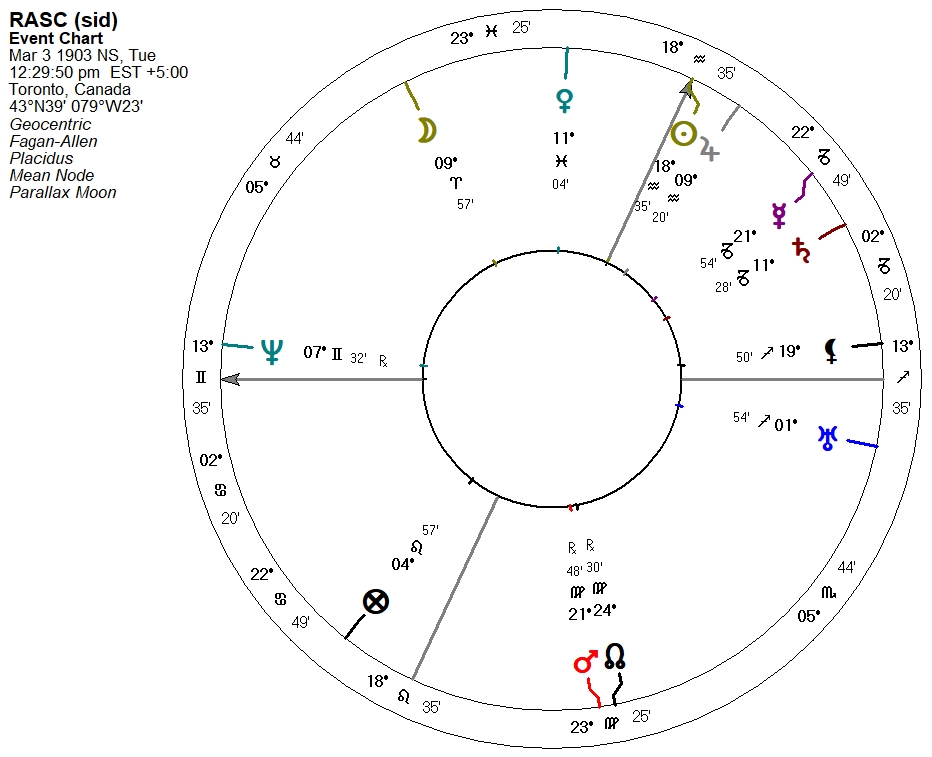
Are any of these posits looking familiar? As we should expect by now, yes, comparing to the “mother chart” of 1831:

Of course this means that the original alignments to Regulus and the Galactic Center can be found again:

- Part of Fortune = Regulus
- Uranus = Galactic Center
We can update our table as well:
The bi-wheel with an extra ring shows the interchart conjunctions at ~5° Leo and ~2° Sagittarius:

The three remaining conjunctions to fixed stars are:
- Moon = Sheratan (beta Arietas)
- Black Moon = Vega (alpha Lyrae)
- Jupiter = Fomalhaut (alpha Piscis Australis) = Sadalmelik (alpha Aquarii)
Jupiter here is interesting, as those two stars mark the actual perihelion of Mars, which again is considered the lower octave of Uranus.
Conclusion
Those wacky Royals love doing ritual astrology, even if it makes the astronomers cringe.
►Ed

 Cosmos of Absurdity
Leave a comment