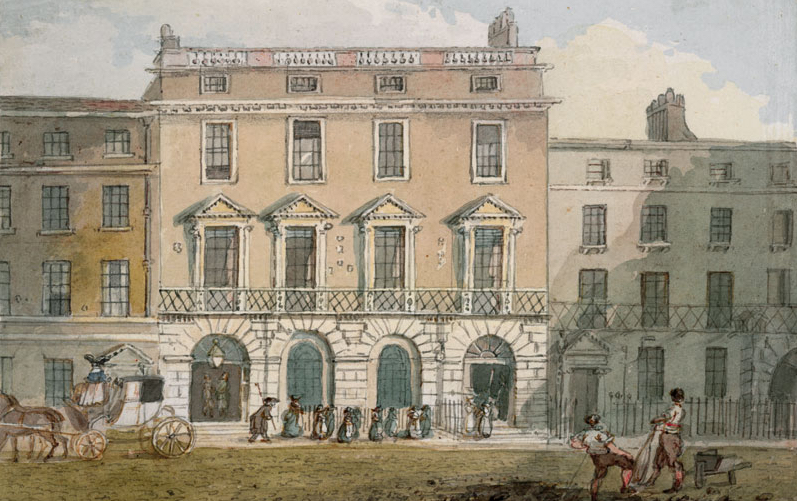
In light of the first-ever member of the fairer sex being appointed Archbishop of Canterbury, it should be noted that the Royal Astronomical Society has been allowing female memberships1 since 1915.
And while I’m sure that members of the RAS would love to bonk me on the noggin with an optical tube for saying this, it’s obvious that the royal charter for the RAS was drawn up with some ritual astrology in mind. If the astronomers had forsaken and poo-poohed the astrology by the 19th Century, the Royals were, and still are, loathe to abandon stella regia – Regulus: the Royal Star.
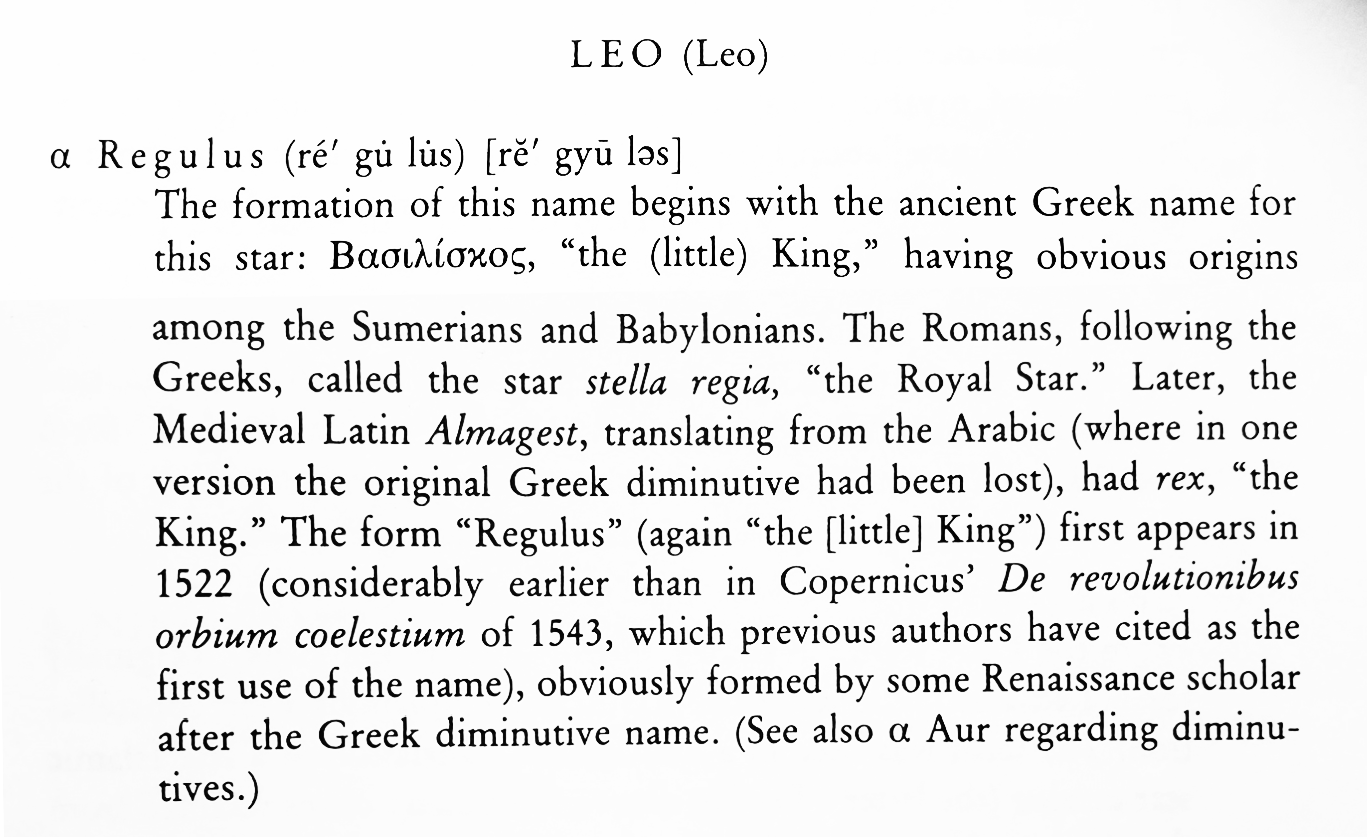
I’ve discussed Regulus in this blog previously, but here is a refresher on the name from Sky & Telescope’s Dictionary of Star Names:
There are four important dates to look at in this study of Royal milestones for the Society:
First Business Meeting: March 10, 1820
Royal Charter: March 7, 1831
Royal Charter Supplemental: June 5, 1915
Royal Charter Supplemental: July 15, 2005
First Meeting of the ASL
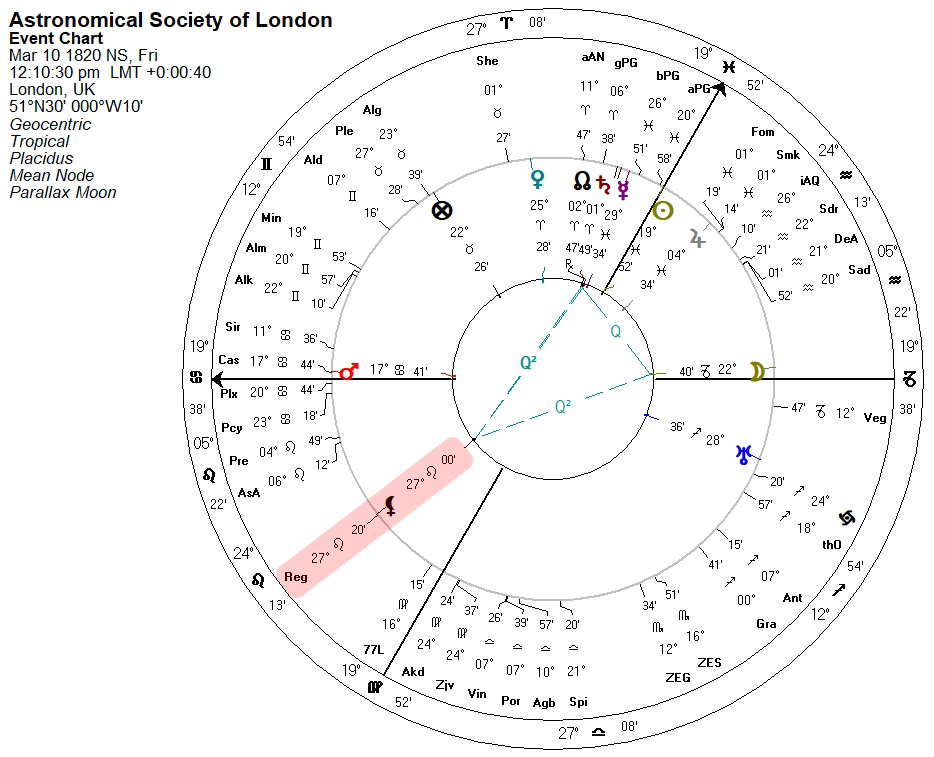
I am unable to locate a time for the first official meeting of the Astronomical Society of London [ASL] at Freemason’s Tavern, so a Sun-on-the-MC chart, or what we call a “high noon chart,” will have to suffice:
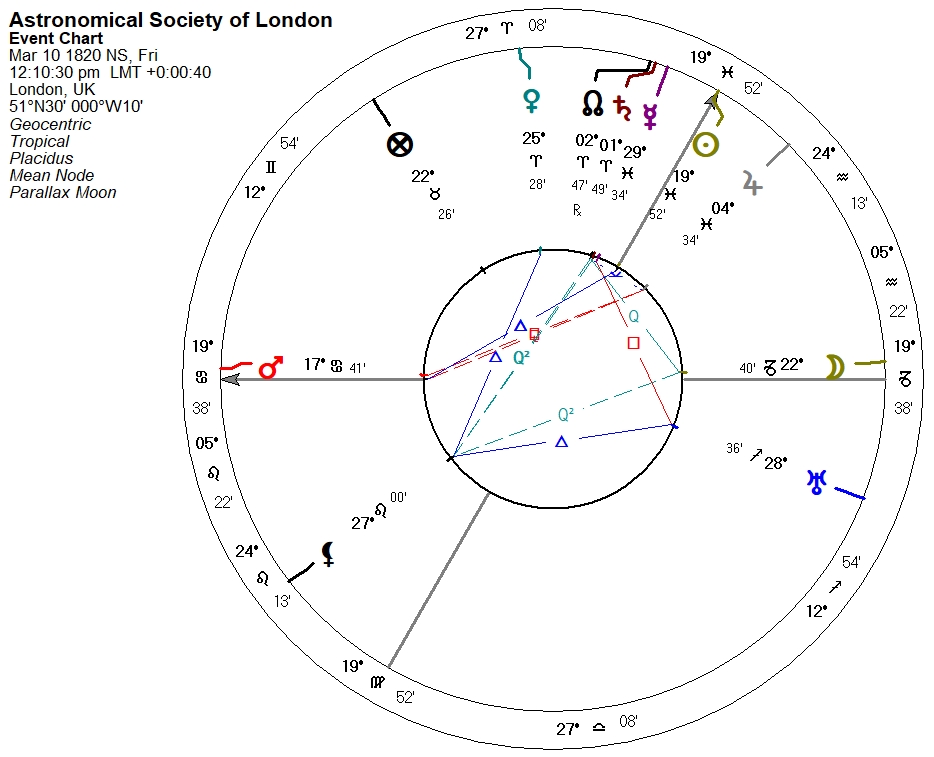
At first glance the chart looks unassuming, but we should remember that Sir William Herschel was the big star of the group (pun intended). He was the discoverer of the planet Uranus, so we should look at what Uranus is doing in the chart:

Uranus makes three aspects: a square to Mercury, a bi-quintile to the POF, and a trine to the Black Moon. Black Moon and the North Node are also in a bi-quintile, and with the Moon make a Schnoz of God formation:
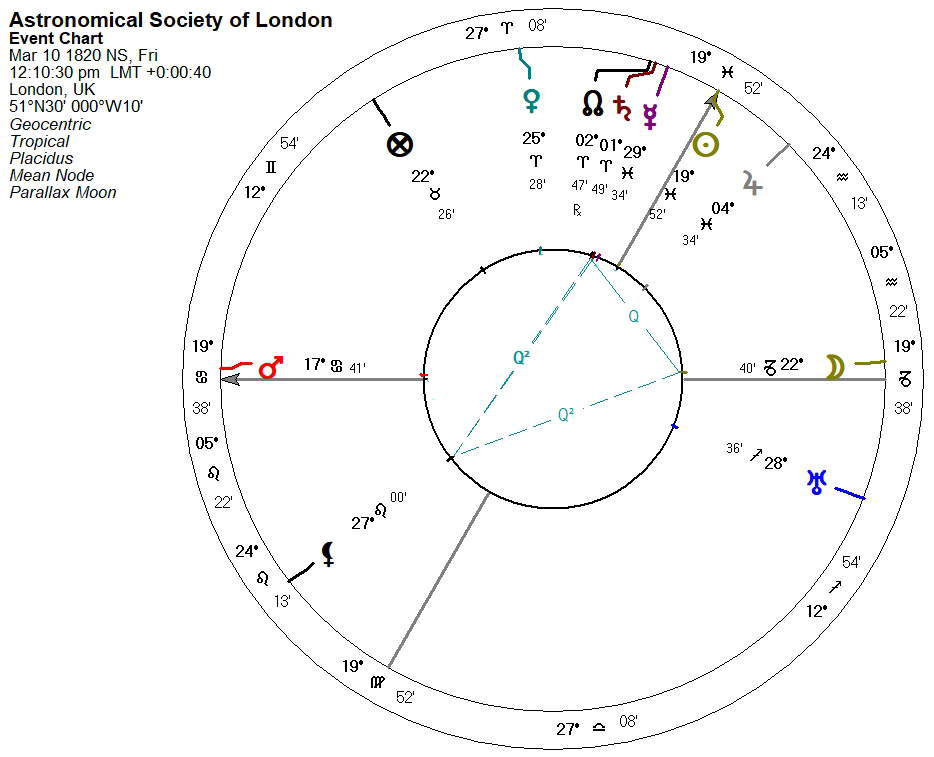
Thus, all three Lunar points are in the Schnoz. That Schnoz of God point at the Black Moon conjoins Regulus, the Royal Star:
The big question remains: was this date astrologically chosen to honor Herschel’s discovery of Uranus?
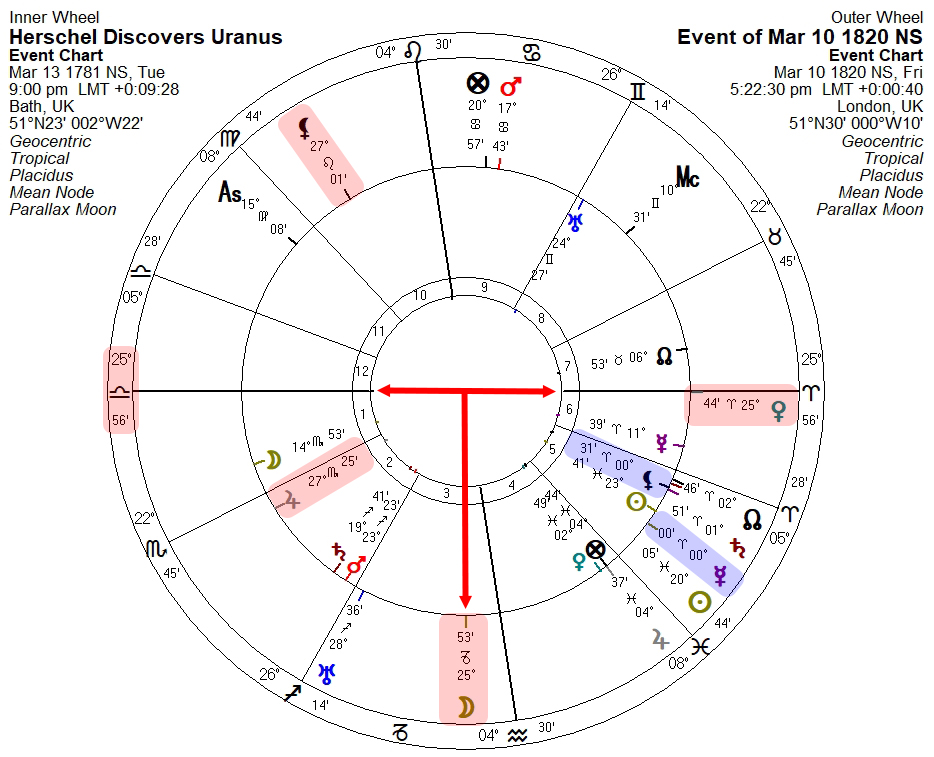
Uranus was first noticed by Herschel on the night of March 13, 1781, during one of his usual night sky observation exercises. The exact time he noticed the new star is unknown, but I think it was probably after 8 pm and before moonrise. Therefore, I settled on an approximate time of 9 pm for a working radix:
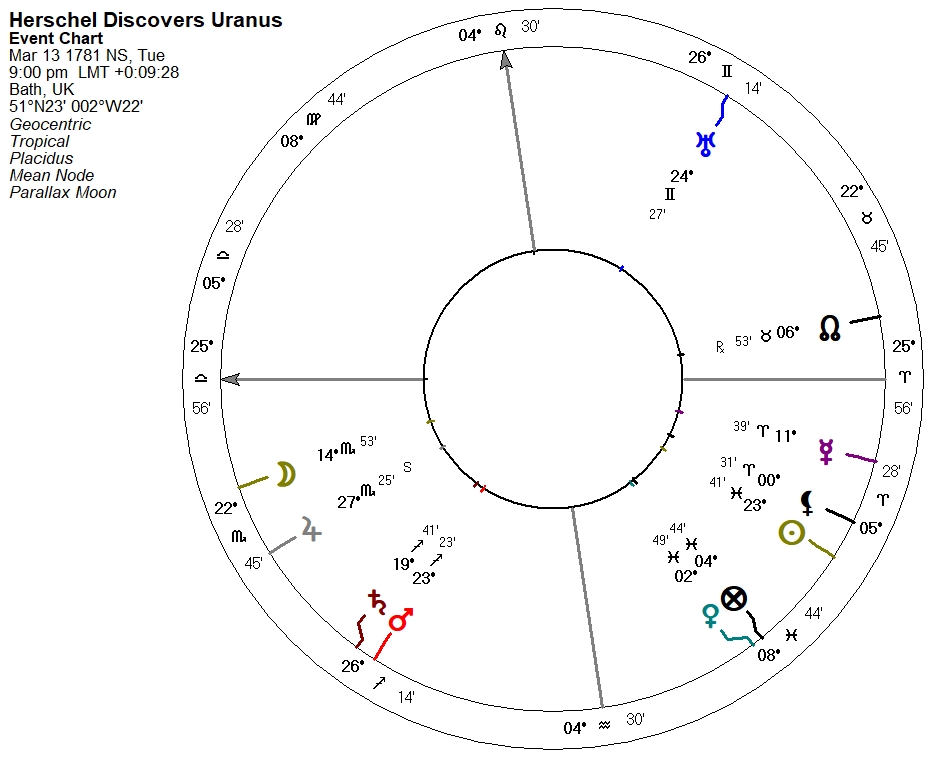
Astrologers have oft noted that the discovery has an interesting T-square that involves Mars and the Sun.
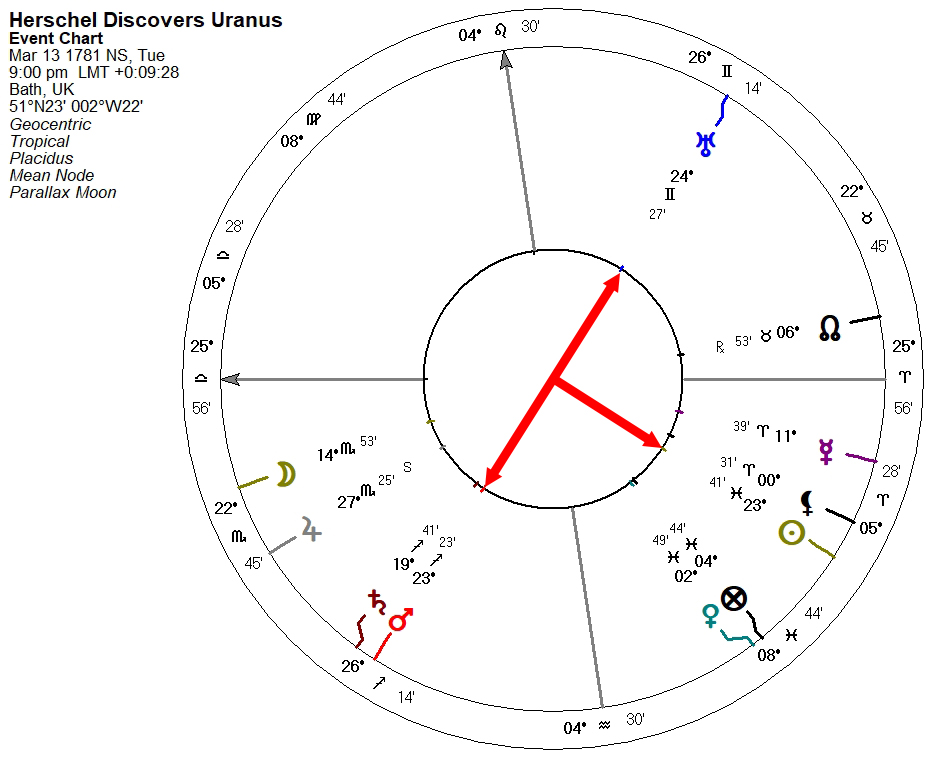
Astrologers find this interesting because Uranus is often referred to as “the higher octave of Mars.” There are two common astronomical glyphs for Uranus:

Astronomers prefer the one on the left, though both are universally recognized. NASA likes the one on the left, and tells us: The symbol for Uranus is represented by combined devices indicating the Sun plus the spear of Mars, as Uranus was the personification of heaven in Greek mythology, dominated by the light of the Sun and the power of Mars.
More than a bit of irony surrounds the astrological circumstances for the discovery of Uranus.
In any event, if we place the discovery chart in a bi-wheel with the ASL first meeting chart, we might think that the latter was indeed chosen to honor Herschel’s big discovery, given that ASL Jupiter is right on discovery Part of Fortune, and ASL Venus is on the ASL descendant:
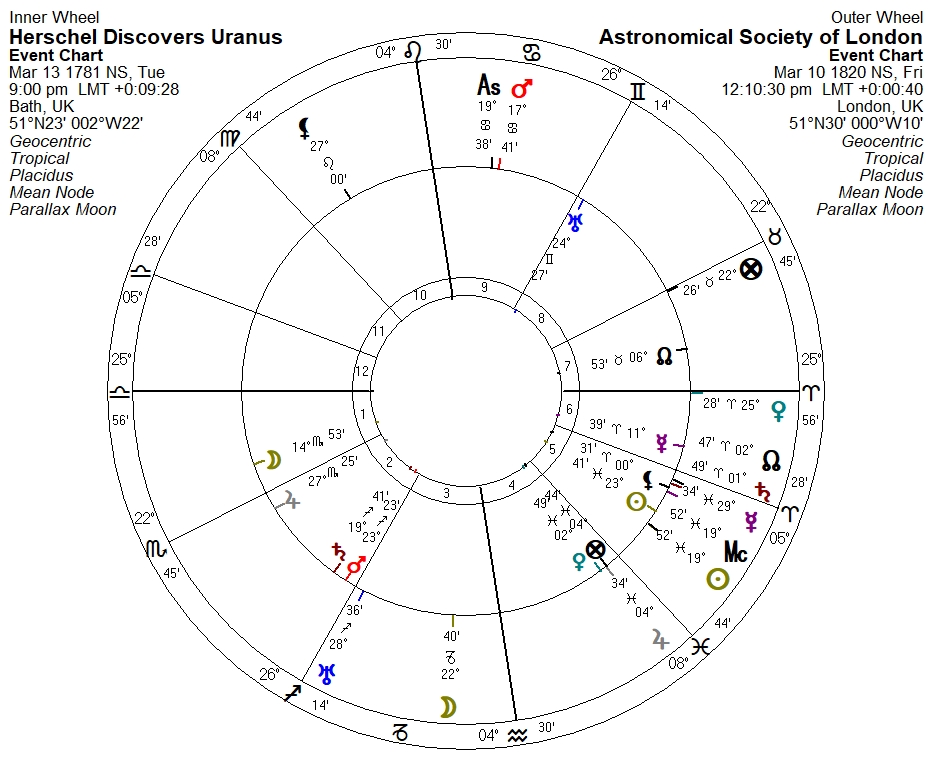
Of course, this assumes my times are correct, and they almost surely aren’t. Regardless of precise times, though, ASL Sun is square to discovery Saturn, which may symbolize the nobility and life achievements2 of Herschel.
Another peculiarity of the ASL chart concerns Mercury in the last degree of Pisces, and indeed the ecliptic altogether. Could it be that the first meeting was timed (5 pm?) for that special moment when Mercury was on the Vernal Point? Venus and Luna line up almost perfectly with my 9 pm discovery radix:
I would also note that either ASL Mercury makes a sesquisquare (135°) aspect to discovery Luna at the cross-quarter point of 15° Scorpio. Kepler would applaud.
The Royal Charter
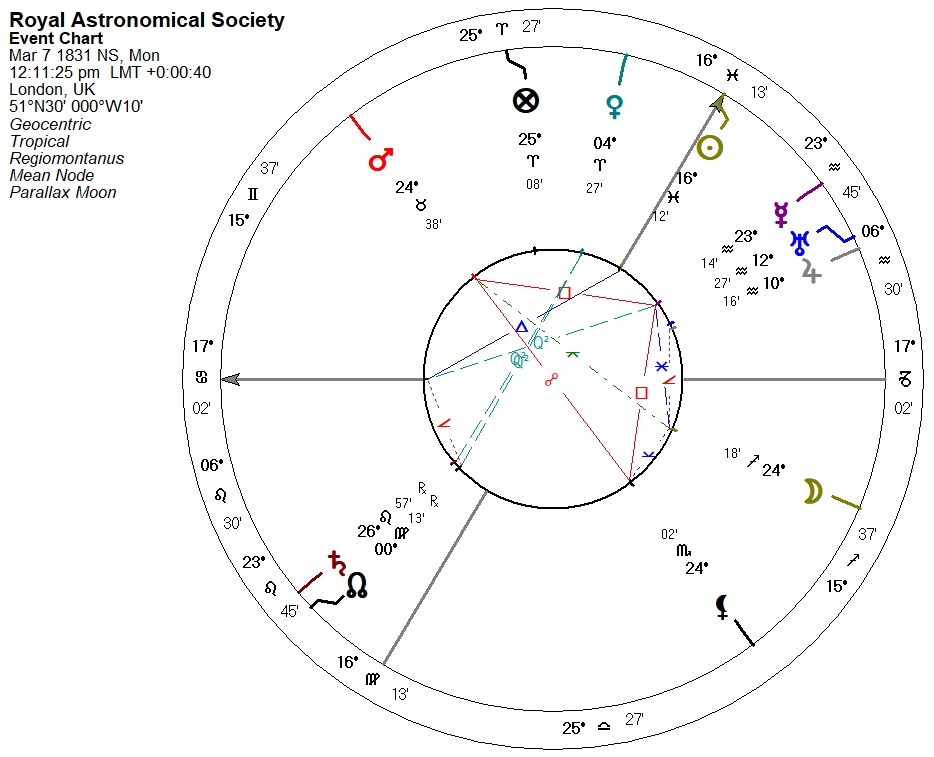
Moving along to the Royal Charter, we know that proclamation reflects the astrological circumstances of high noon, as a royal edict should. It is again dated in March, and so far our three charts are all in March, on the 7th, 10th, and 13th.
This chart is peculiar in that so many planets are stacked up in the 23-26 degree range. Another T-square pops up with Mars, Mercury, and Black Moon. Moon is in sextile to Mercury, and square to Saturn, while inconjunct (30°) Black Moon and quincunx (150°) Mars:
The real interesting stuff has to do with the fixed stars.
- Saturn is conjunct Regulus, which makes it in an interchart conjunction with ASL Black Moon;
- The Sun, and thus the meridian, align with our old friend 77 Leo;
- Mars is conjunct Algol, among the favorite stars of astronomers.
- The ascendant is conjunct Castor, which Mars was conjunct in the ASL chart above (see Figure 2-a);
- Moon is conjunct the Galactic Center.
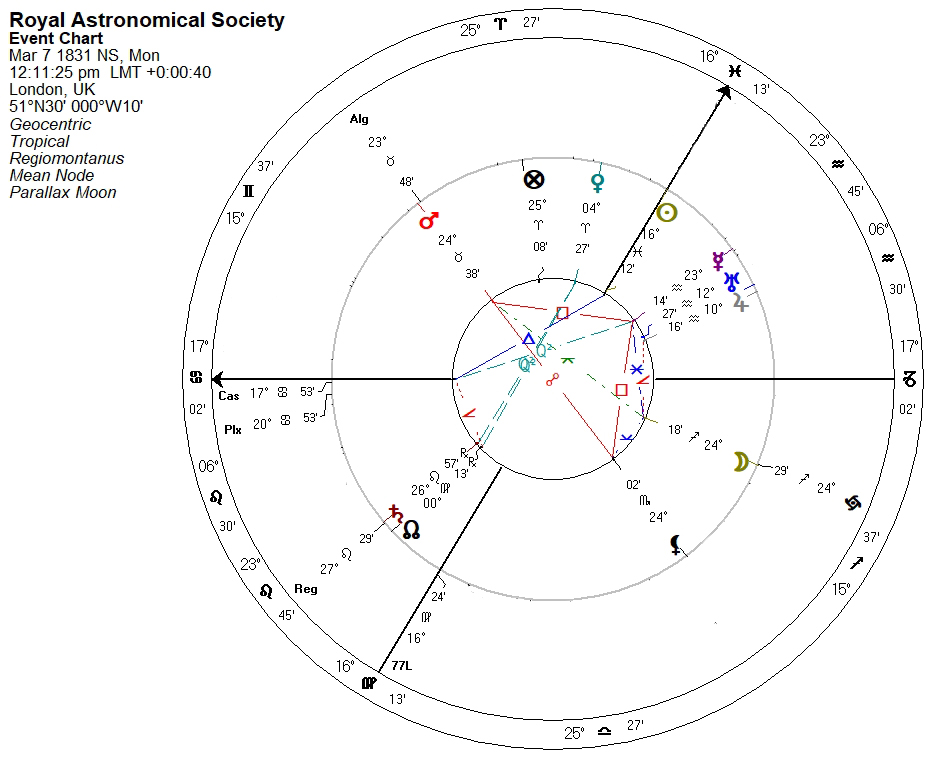
Castor in these charts brings the freemasonic element to the fore. Castor, of the famed Gemini twins, was conjunct the Sun on Saint John’s Day in 1119 AD when the “Sionist” Knights Templar were created and assumed control of Solomon’s Temple.
Back to Regulus. A bi-wheel cast for the ASL and the RAS yields three interchart conjunctions:
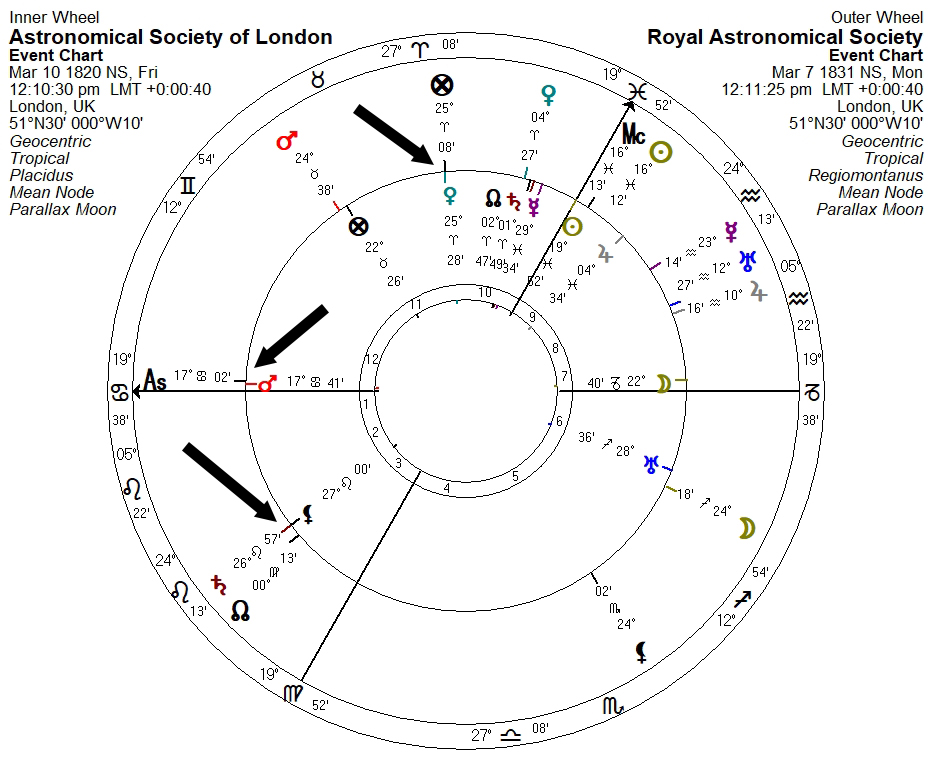
The next bi-wheel is the same as above, but in the Fagan zodiac in order to stabilize fixed star positions.
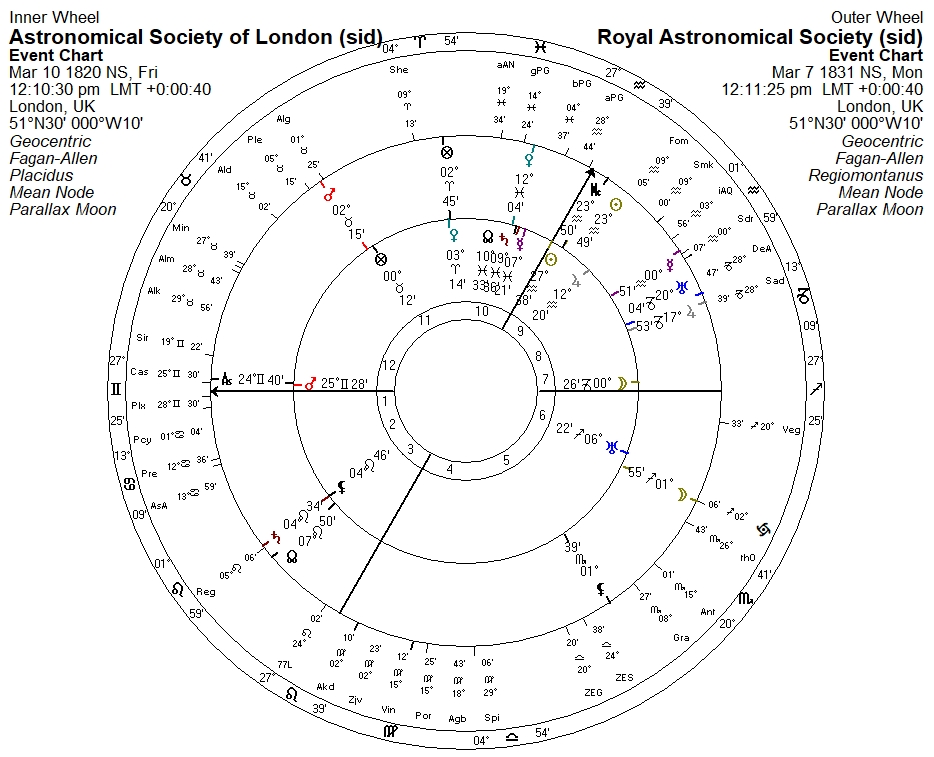
| ASL | RAS | Fixed Star |
|---|---|---|
| Black Moon | Saturn | Regulus |
| Mars | Ascendant | Castor |
| Venus | Fortuna | |
| Mars | Algol | |
| Mercury | Sadr | |
| Moon | Galactic Center |
The really big deal, though, is the Moon conjunct the Galactic Center @ 24°29′ Sagittarius.
Could it be that knowledge of the center of the Galaxy existed among learned Royal-level astronomers of the 1820s? Or, was this some kind of fluke? The idea of our Milky Way as an independent galaxy among many others did not enter the human consciousness until the 1920s. Detecting the center of the Galaxy required radio astronomy, and that was not known in Herschel’s time.
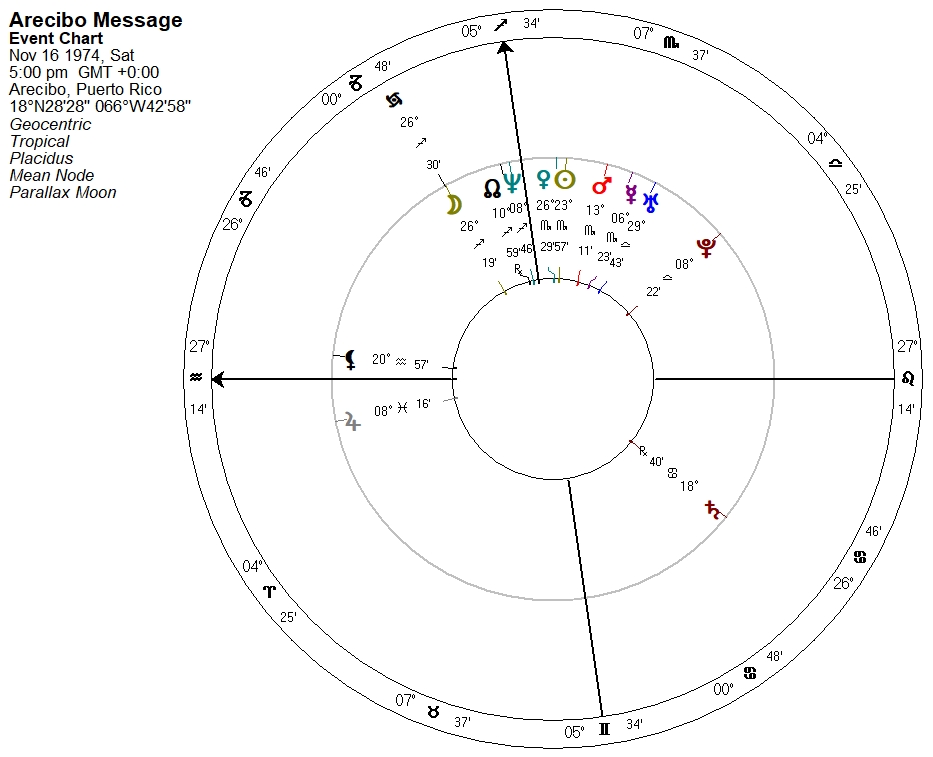
It reminds me of another contrived astronomical event – Cornell University’s Arecibo Message.
In 1974, at 1 pm on November 16, the giant radio telescope at Arecibo, Puerto Rico, transmitted a strong signal to outer space. The idea to do so and design the message came from a team of scientists at Cornell University and the Arecibo Observatory, led by Frank Drake, who was a professor of astronomy at Cornell. Other contributors included Richard Isaacman, Linda May, James C.G. Walker, and Carl Sagan. The astrology chart for the transmission shows that the Moon was precisely ecliptically aligned with the Galactic Center:
Converting to the Fagan zodiac, and then constructing a bi-wheel with the RAS chart, shows an exact Moon-Moon conjunction:
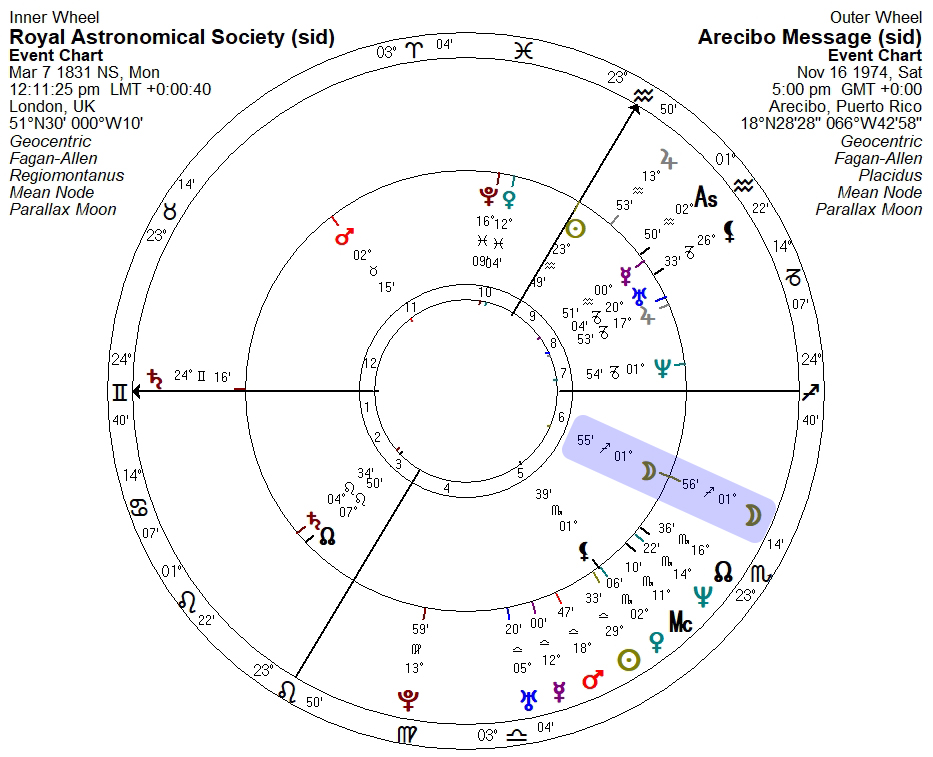
We can also see that Arecibo Saturn is right on the RAS ascendant, which is trine the RAS Sun. (Another interchart connection is RAS Mars and Black Moon aligned to Arecibo Venus and Ascendant.)
When we align it all with Hershel’s discovery-of-Uranus chart, things fit to a T:
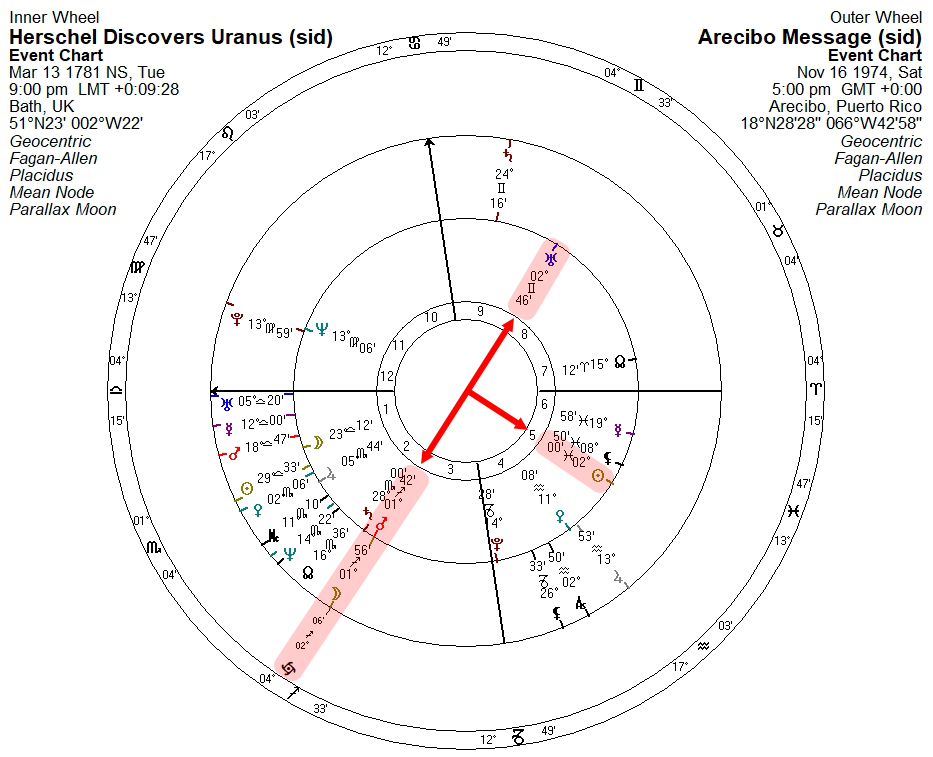
Does Cornell have any significant connections to the RAS? Not that I am aware of, though stealthily honoring Herschel, and showing the aliens that we know where our Galactic Center is, was probably enough to choose this clever messaging moment.
In Part Two, the rest of the story, because I haven’t gotten to the women yet, and the Herschels would be unhappy.
►Ed
- There have been only three female Presidents, the first being Dame Carole Jordan, who was elected in 1994 and is a world authority on stellar and solar physics. Since then, Professor Jocelyn Bell Burnell, co-discoverer of neutron stars, and geophysicist Professor Kathryn Whaler have taken up the post, in 2002 and 2004 respectively. ↩︎
- Honors include but are not limited to: Copley Medal from the Royal Society (1781) — awarded for discovery of the planet Uranus; Elected Fellow of the Royal Society (1781); Appointed King’s Astronomer (1782); Honorary degree from the University of Edinburgh (year not precisely specified, but awarded before 1792); Honorary degree from the University of Glasgow (1792); Honorary degree from Oxford University (date unspecified); Knight of the Royal Guelphic Order (1816). ↩︎

 Cosmos of Absurdity
Leave a comment