
September 23 was the 93rd anniversary of the Kingdom of Saudi Arabia, which is now the 19th most wealthy nation on the planet. September 23 in 1932 was the date of the fall equinox, which makes the radix for the KSA interesting for astrologers.
For a cogent and brief history of the KSA relevant to astrologers, the best place to start is always Nicholas Campion’s Book of World Horoscopes (starting on page 324 of my 1996 second edition1), where articles are arranged alphabetically. I won’t be repeating any of that here, though I should say that Campion does not produce a chart for September 23, but instead tells us that the KSA was proclaimed on September 21.
The correct date is indeed September 23. The exact time of the proclamation is 9 am, at Mecca. I’ll get to that chart shortly. I cannot find a 9 am time in any astrological sources2, as the time was unknown to the outside world until 2021:
… at 9 a.m. on Thursday, September 23, 1932, and from the government house in the Hamidiyeh Palace in the Ajyad district of Mecca, Prince Faisal bin Abdul Aziz, the Viceroy in the Hejaz, officially announced the birth of the Kingdom of Saudi Arabia, by reciting Royal Order No. 2716 issued on 17 Jumada I 1351 AH corresponding to September 18, 1932 AD, which included King Abdul Aziz’s approval to convert the name “Kingdom of Hejaz and Najd and its accessories” to “Saudi Arabia”, and the artillery launched 101 shots to greet that glorious day.
Sunrise @ Mecca
An astrological chart for sunrise on that day at Mecca, with the cardinal points all aligned, shows both luminaries on angles, and therefore also the Part of Fortune conjunct the Moon:
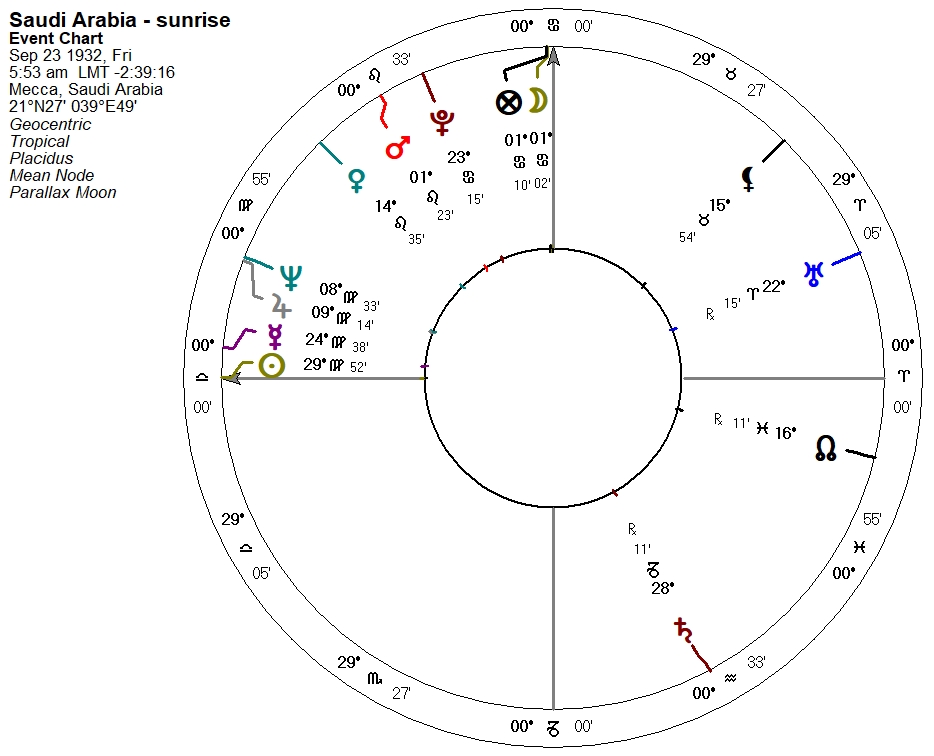
The Part of Fortune is beneficial, as the name implies. To me, the Parts are silly, but they have a long and steady tradition in the craft.
A Sun/Moon sinister square on the angles like this seems troubling. One might get the impression that the feminine will dominate the chart, and indeed Islam holds the Moon and Venus in highest reverence. This seems a bit off for a country that is notorious for poor treatment of women, and the lack of freedoms for everyone that isn’t part of the monarchy.
Having said all of that, this is only a sunrise chart, which astrologers like to cast to get the ‘feel’ of what that day was like in general.
On to the 9 am Chart
The moment of the Sun exactly on the equinox point is almost precisely 9 am – 8:56 am LMT. This suggests that the time for the announcement was deliberately chosen to coincide with the moment of equinox. Hey, astrology was and is serious business everywhere!
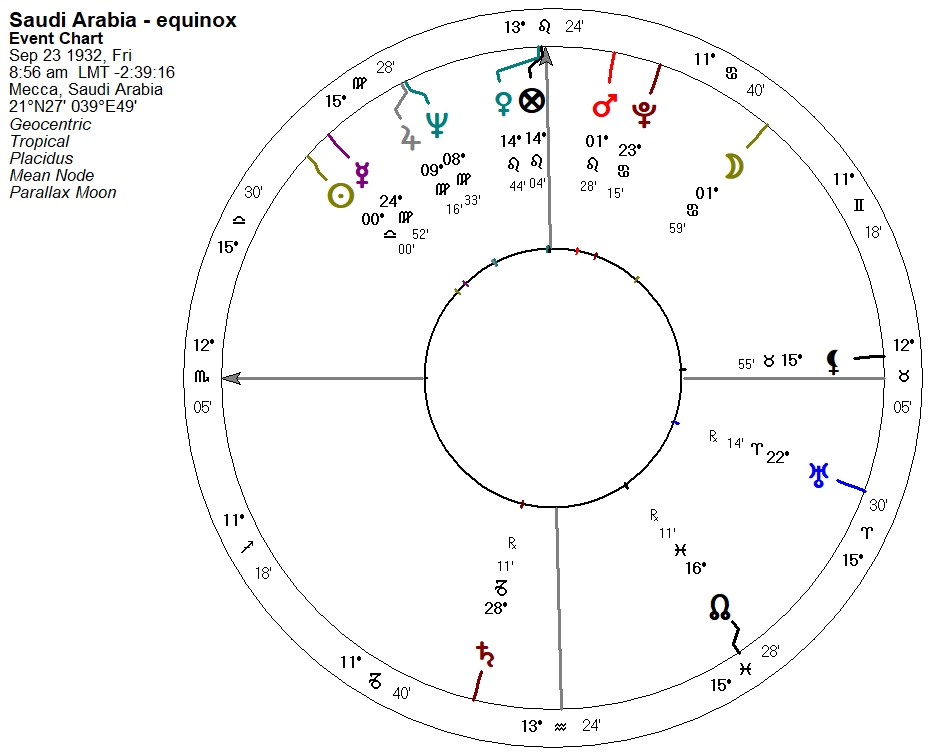
This time places Venus on the Midheaven with Fortuna, which again seems off for a nation where freedoms are highly curtailed, but again, this is only a proclamation chart. The true moment of monarchical power being realized is unknown, and at least a week earlier. The point of the proclamation being given at this day and time was to send a message to the world, and to show that the Arabs were still a learned people of the mathematical and astronomical tradition. To show competency in temporal power, one must show how to tell tempus.
A Jupiter/Neptune conjunction dominates the chart, and many astrologers will tell you that means oil (Neptune) riches (Jupiter). I don’t necessarily share that idea, but we can at least say that the pairing is all about big (Jupiter) dreams and delusions (Neptune).
The square from Uranus to Pluto is also troubling, but that outer planet square was directly connected to the rise and assumption of power by the Nazis in 1933. Could we say that the KSA resembles a national socialist type of regime? Or, are all monarchies basically like that throughout history – conservative dictatorships?
Why even bother asking that rhetorical moot-point question. The point is that the Saudis saw an astrologically potent time and ran with it.
Do I spot Saturn at the exaltation degree of Mars? Yes, I do, but we’re in the wrong zodiac, right? Or do the exaltations have a double-indemnity clause?
The Persian Calendar
The equinox plays a part in another chart from the Islamic realm, but this time from Persia. The Jalāli Calendar was created to begin at the year of the Hijri of Muhammad from Mecca to Medina, but kept its solar scheme of years being 365 or 366 days long, with 12 months, somewhat similar to what Gregorian calendar does.
An effort to fine-tune the calendar took place in the 11th Century, and the mathematicians decided to calibrate the new year, or Norwuz, to a more precise moment, which I show next:
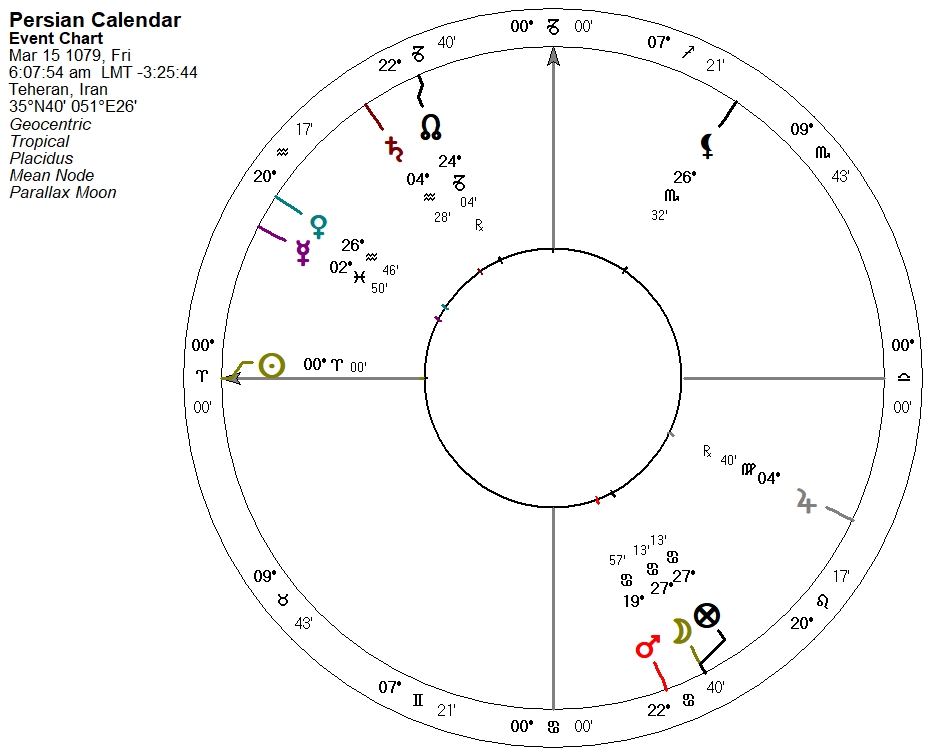
Here we find a happy little chart, with a gibbous Moon in its own sign, in a quincunx to Venus, while the Great Chronocrators are also in a quincunx. Note also that the difference between Sun and Venus is 33°, and 22° separates Saturn from Venus. Saturn is in its own sign as well, and the good one too! Well done! Bravo!
The Persians, however, were not willing to give up on the old zodiac. When we convert to the Fagan zodiac, we find that the Moon conjoins Jupiter’s exaltation in the center of its own sign:

Venus @ 14°51′ of Aquarius squares the fiducial stars of Aldebaran and Antares, of the so-called “Royal Stars of Persia”:

Well, these royal stars weren’t actually Persian, and the Arabic Parts weren’t actually Arab. Those misnomers originated during the Renaissance and persist today, unfortunately (pun intended). BUT, that doesn’t mean they were not of use to the astrologers.
For kicks, I made a bi-wheel of both equinox charts of the two rival Muslim realms. It’s not very exciting:
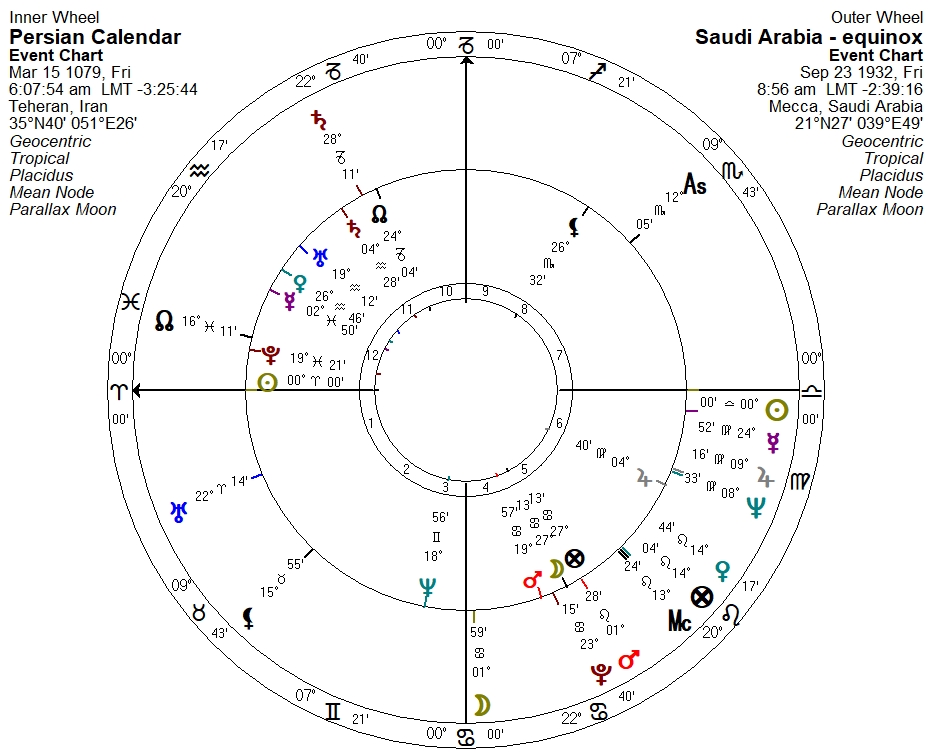
Switching to the Fagan, wouldn’t you know it, Mars lines up with Mars:
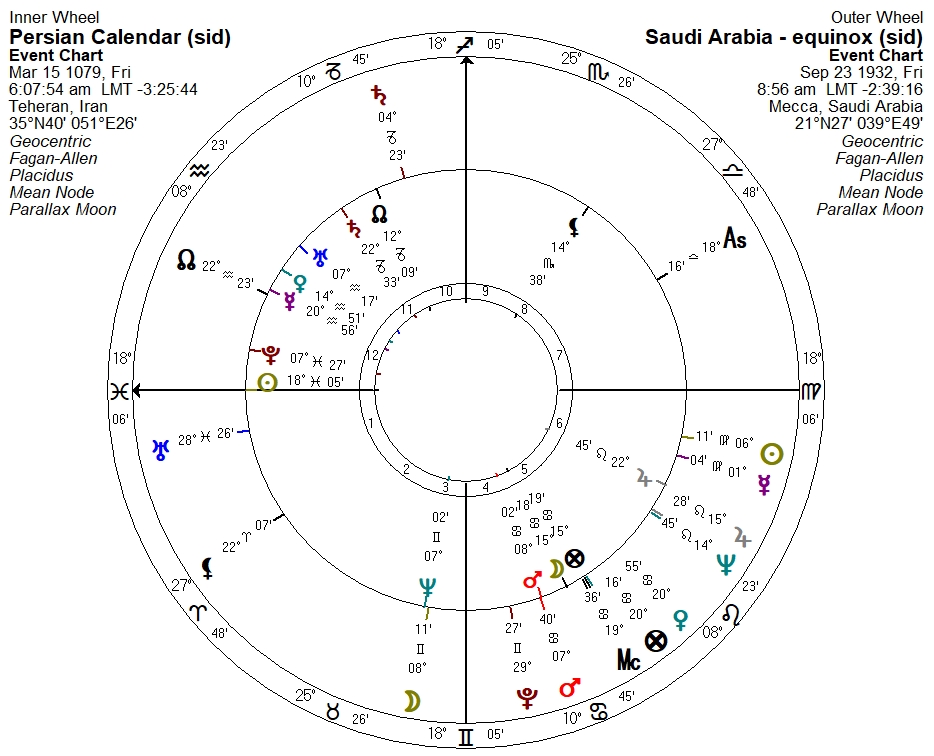
The KSA chart does strike bells with the Hijri chart, as one would hope given the locale. Note that the 1,310 years that separate the chart are just about eight(!) Neptune orbits, and how the KSA’s Uranus/Pluto square aligns with the Hijri Pluto:

Interchart connections abound:
| Hijri | aspect | KSA |
|---|---|---|
| Sun | -0- | Pluto |
| Saturn | -0- | Mars |
| Moon | -0- | MC |
| Venus | -0- | Venus + POF |
| Pluto | -0- | Uranus |
| Pluto | 90 | Pluto |
| Uranus | 60 | Moon |
| Sun | 60 | Mercury |
| Jupiter | 180 | Jupiter/Neptune |
The Foundation of Baghdad
The final Islamic chart I want to look at is the famed Foundation of Baghdad chart, discussed here by P. James Clark, and here by Anthony Louis. The chart comes down to us through Al-Biruni, admittedly not a contemporaneous source, and his data has been translated to this approximate time:
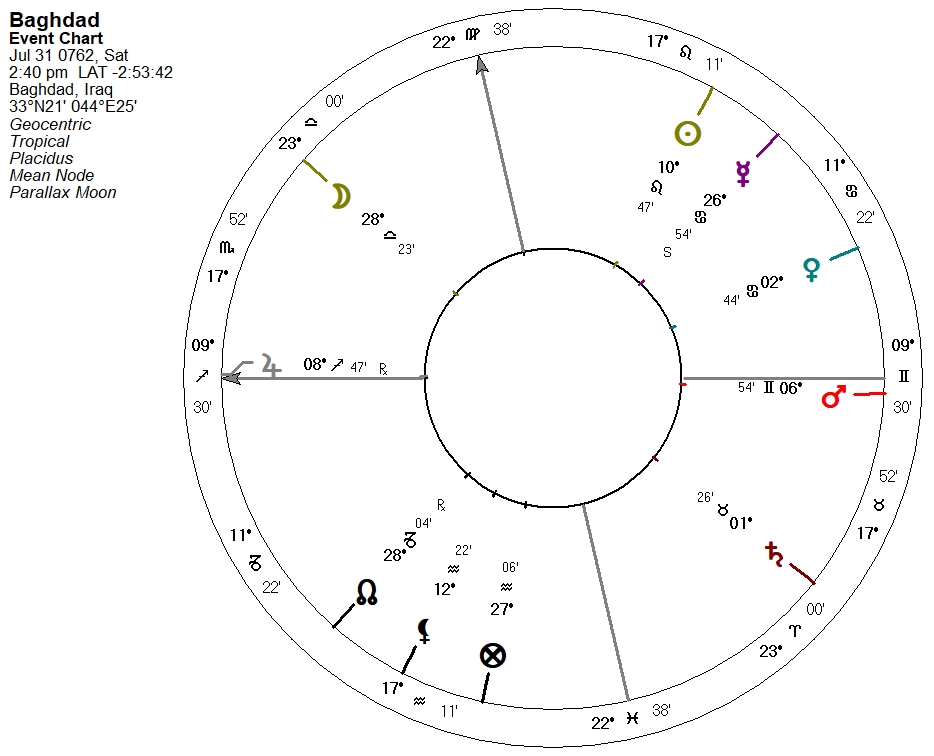
The debate goes on over which old rules would have caused a chart like this to be elected, as Mars is on the descendant and invariably inviting enemies, while the Moon is square both Mercury (in the Moon’s sign of Cancer) and the nodes and opposite Saturn.
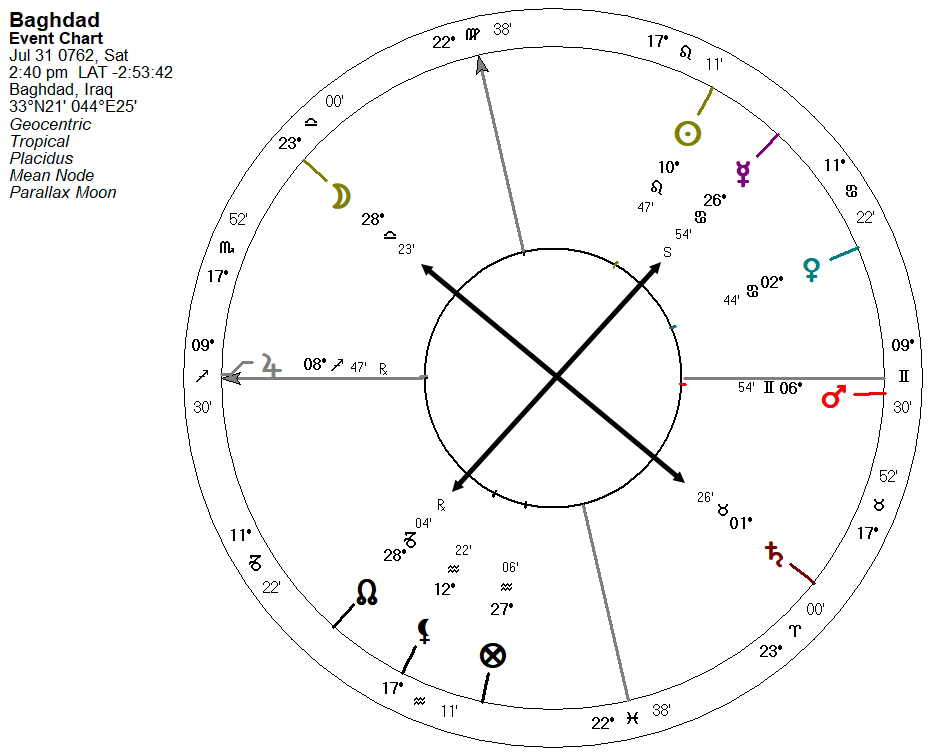
Jupiter on the ascendant can’t save the chart from the rest of itself, according to the simple rulership-and-aspect rules
But, again, we have to look at what was going on with the fixed stars and the exaltations, because earthly form has to be in harmony with the celestial geometry. Placing my array of stars on the outer ring, we find some alignments of note:
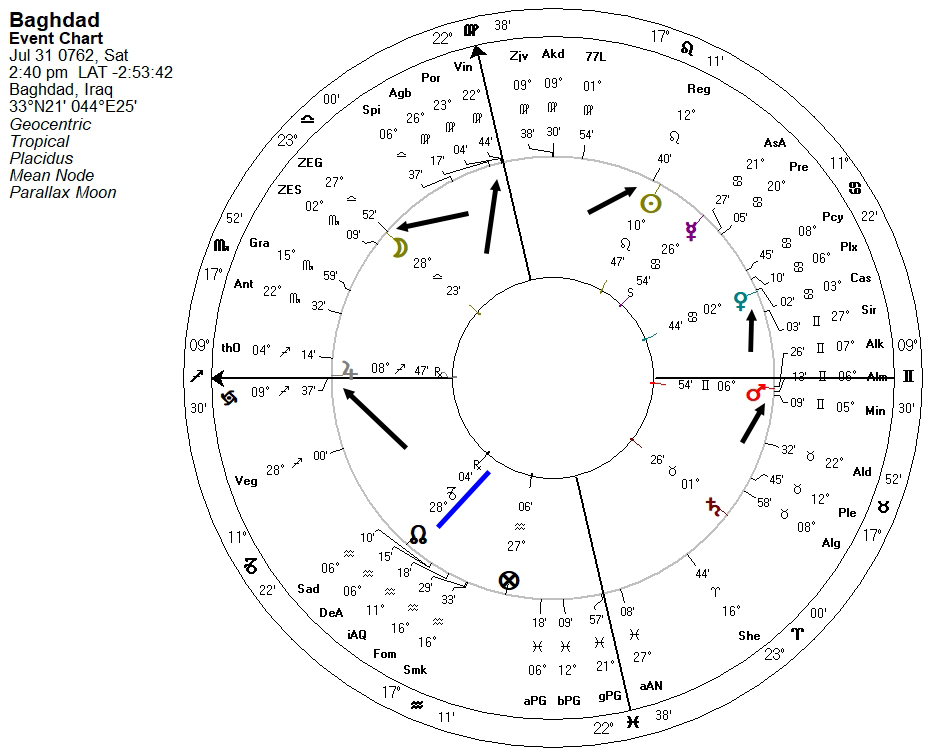
- Sun = Regulus
- Moon = Zubenelgenubi
- Mars = Alnilam & Alnitak (Orion’s Belt)
- Venus = Castor
- Midheaven = Porrima and Vindemiatrix
The glyph by Jupiter is the Galactic Center, and that was unknown to anyone prior to 1940, so ignore that, yet it is interesting that they stumbled upon this. Also, the North Node is at Mars’ exaltation degree, but this is in the tropical zodiac and perhaps unimportant, as the chart makes more sense when we look at it in the Fagan zodiac:
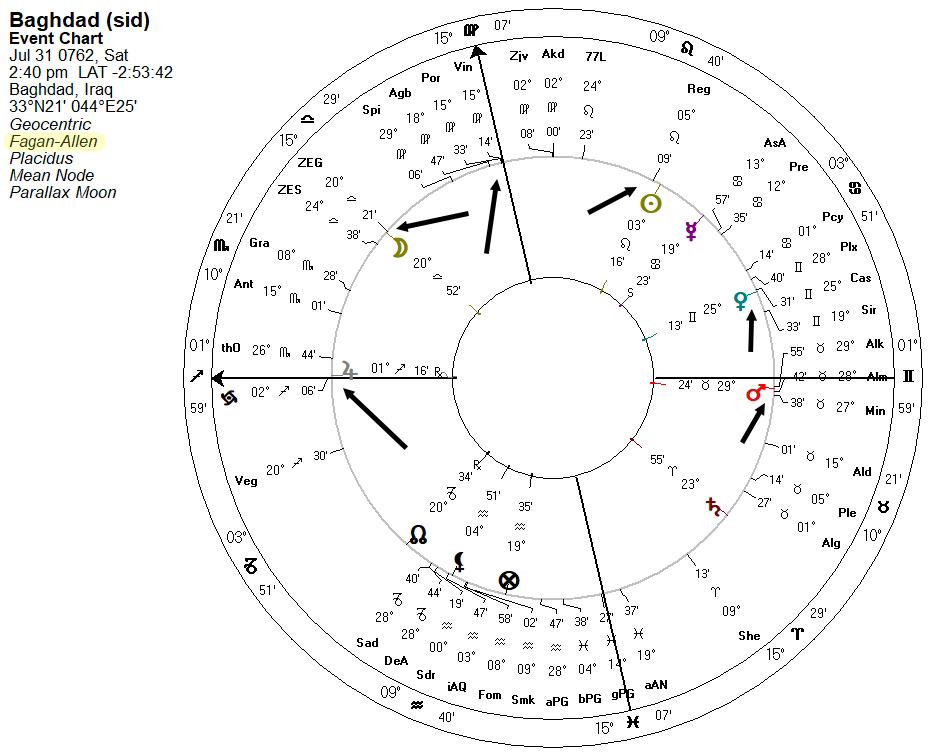
Now we can see that Moon is at Saturn’s exaltation, which dampens the negative effect of being opposite Saturn and square its own nodes. We want a strong Saturn for a city with borders and rules and all that, while also being a place of wealth and riches (Jupiter).
The Midheaven is at the exaltation of Mercury, which one would want for a place of learning and commerce. Mercury on the South Node is precarious, but not a deal-breaker; the square to the Moon and Saturn, on the other hand, would seem perilous, but again, the exaltation of Saturn would alleviate the negative through reception. Venus, in the other Mercury sign, has favorable reception with the Midheaven on Mercury’s exaltation.
Jupiter on the ascendant is also in a trine with the Sun, and both are in their own signs, which would be highly regarded in any chart. Even though the chart shows Jupiter as retrograde, it is actually stationary and about to go direct. This type of Sun-trine-Jupiter where Jupiter is stationary-direct shows up in the chart I was dissecting on my other blog – the Foundation Stone of the new St. Peter’s Basilica ordered by Pope Julius II.
As for Mars with Orion, well, I can’t speak to Arab sky lore very well, but we know that Orion was the central constellation of their heavens, a feminine deity, a “giant,” and central to the circle of constellations.
Orion shows up in so many political charts that it’s hard to keep count.
►Ed
- In my edition, for some unexplained reason, a chart for the inauguration of George Washington in 1789 is placed in between the entries for the KSA and Senegal. These things happen sometimes in publishing. ↩︎
- I found a mystery chart in Glenn C. Malec’s otherwise very useful International Horoscopes (AFA, 1982), which claims, “The New York Times reported that on October 6, 1932, King Saud was crowned and the Kingdom of Saudi Arabia began its first day of existance.” p 126. I can’t find any such reference in the Times, or anywhere else, for this claim. ↩︎

 Cosmos of Absurdity
Leave a comment