

Sometimes I get these corny ideas that I think are really hilarious. But they aren’t to everyone, because what’s funny in my own personal Mercury/Neptune head is usually just a mystery to others.
Take the highly clever Coldplay Kiss Cam meme upgrade shown at right that took me 15 minutes to assemble on Photoshoppe so I could post it on Flakebook. Why would this be funny?
To the non-astrologer or non-astronomer, it’s not, even though this naughty couple who got totally outed in public at a big music concert work at a company literally called “Astronomer.” Not clever enough yet? Well, just read on.
When I thought of this meme, I astro-giggled for hours. It has do with Neptune being spotted for the first time when it was conjunct Saturn – in 1846! Yes, yes, I can hear the great howls of laughter echoing through the blogosphere now that you’re in on the joke, right? No? 😦
But, seriously, one thing I was planning on writing about in my epic series, On The Exaltation of Mars, concerns the very enigmatic story of the discovery of Neptune – a notoriously sneaky planet.
Neptunespotting
The discovery of Neptune was quite literally an obsession for the people involved, which is interesting because astrologers are certain that Neptune rules over obsessions. It was the first time a planet was discovered not by accident, as was the chance discovery of Uranus in 1781, but by mathematical calculations, with multiple academics vying for the prize.
The most accessible book I have on the topic, The Neptune File by Tom Standage, is a fun read, if that kind of popular-press non-fiction is your bag.
The discovery of Neptune was a triumph of science. The story can be simplified to this: astronomers were puzzled as to why predictions of Uranus’ orbit were slightly off, and it dawned on a few people that another large planet was perturbing Uranus’ orbit.
The only way to decode the situation was with mathematics. After spending years on the problem, a handful of astronomers from various, unconnected places, began to narrow down the possibilities.
Things came to a nexus in 1846. A Cambridge scholar, George Airy, who was by then Astronomer Royal at the Royal Observatory, suggested an area of the heavens that should yield the mystery planet.
Many eager astronomers, amateur and otherwise, were busy hunting for new planets in the 19th Century. Four of what we now call “asteroids” were discovered within the first 6 years of the 1800s, and finally a fifth was discovered in 1845. One could make a name for oneself if a new planet was discovered, as can be seen by the famous household names of asteroid discoverers in this handy AI-generated list:
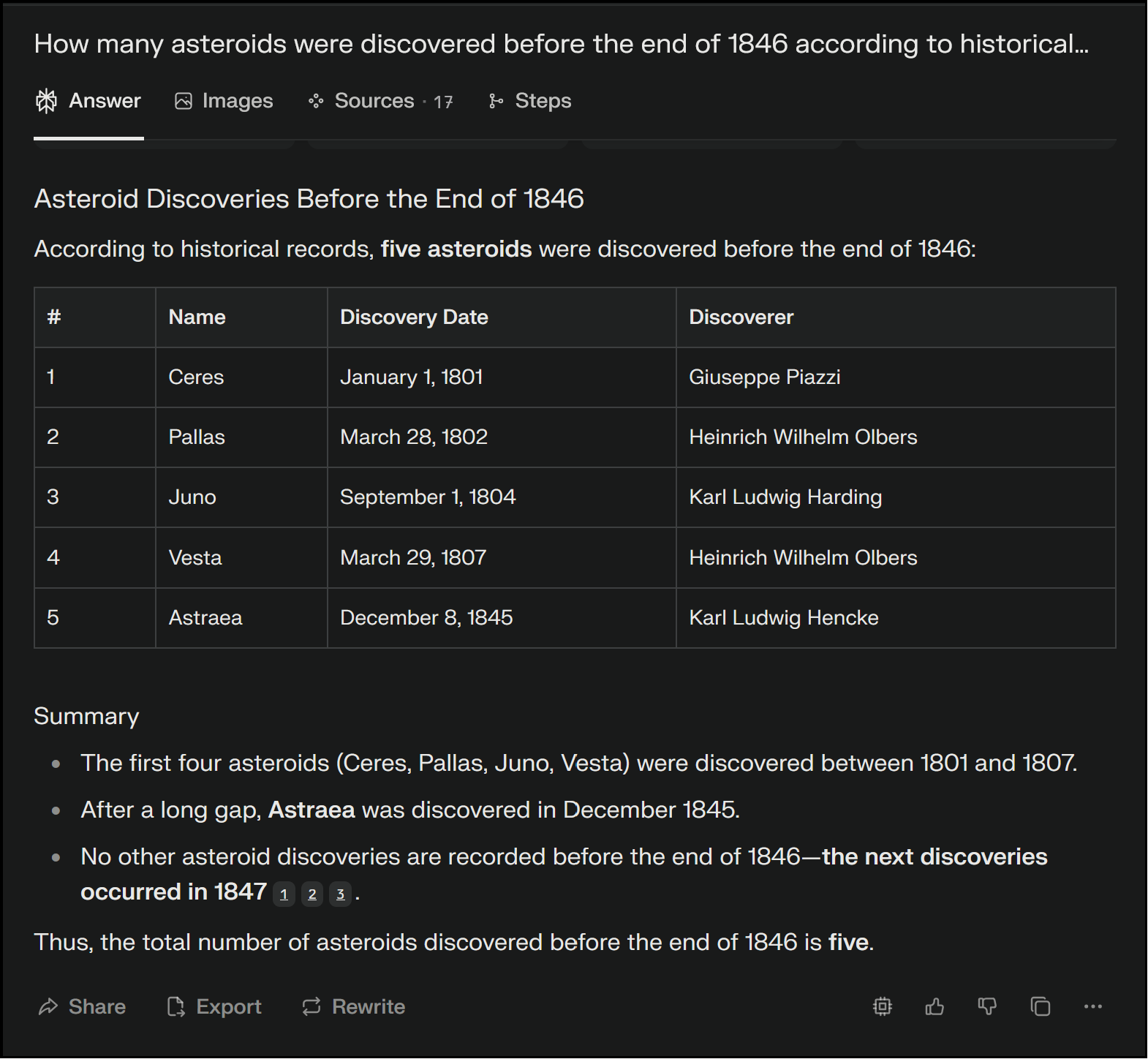
Well, easy come easy go, of course, because basically no one remembers the names of anyone who ever discovered a planet. Unlike viral kiss cam blunders, planet-discovery is just not very sexy.
Back to Neptune. Standage was kind enough to include this graphic in his book, approximating that zone of the heavens where Airy was certain the “unseen planet” could be located:
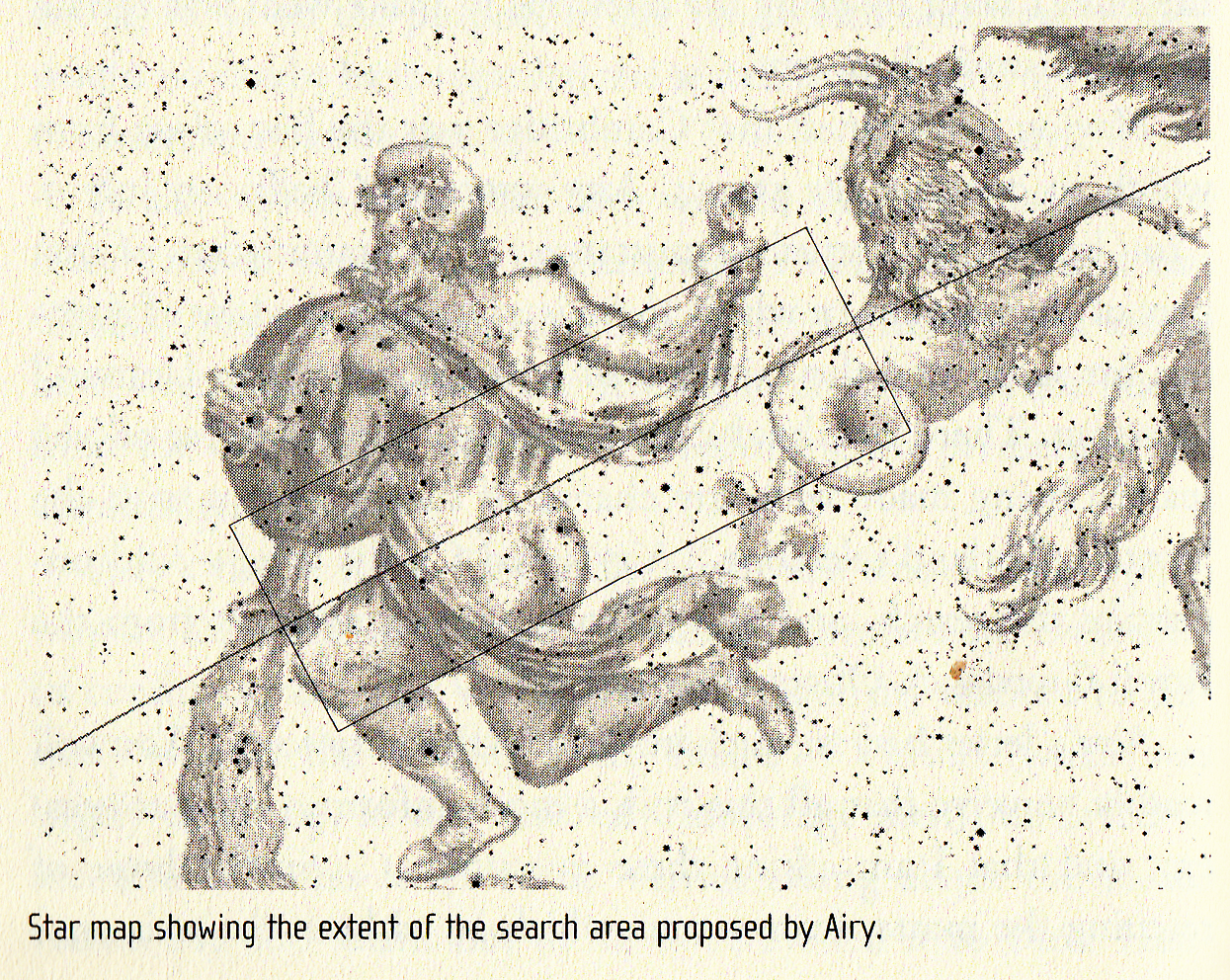
As readers of my other blog know, this is also the zone where Mars attains its brightest magnitudes, due to its orbit that brings it closest to the Sun in this area. The ancients knew of this zone, and eventually a specific degree of the zodiac was deemed to be the place where Mars was “exalted.”
The precise exaltation of Mars in the astrological tradition – 28° Capricorn – happens to align with two fixed stars, which I have highlighted over Standage’s graphic:
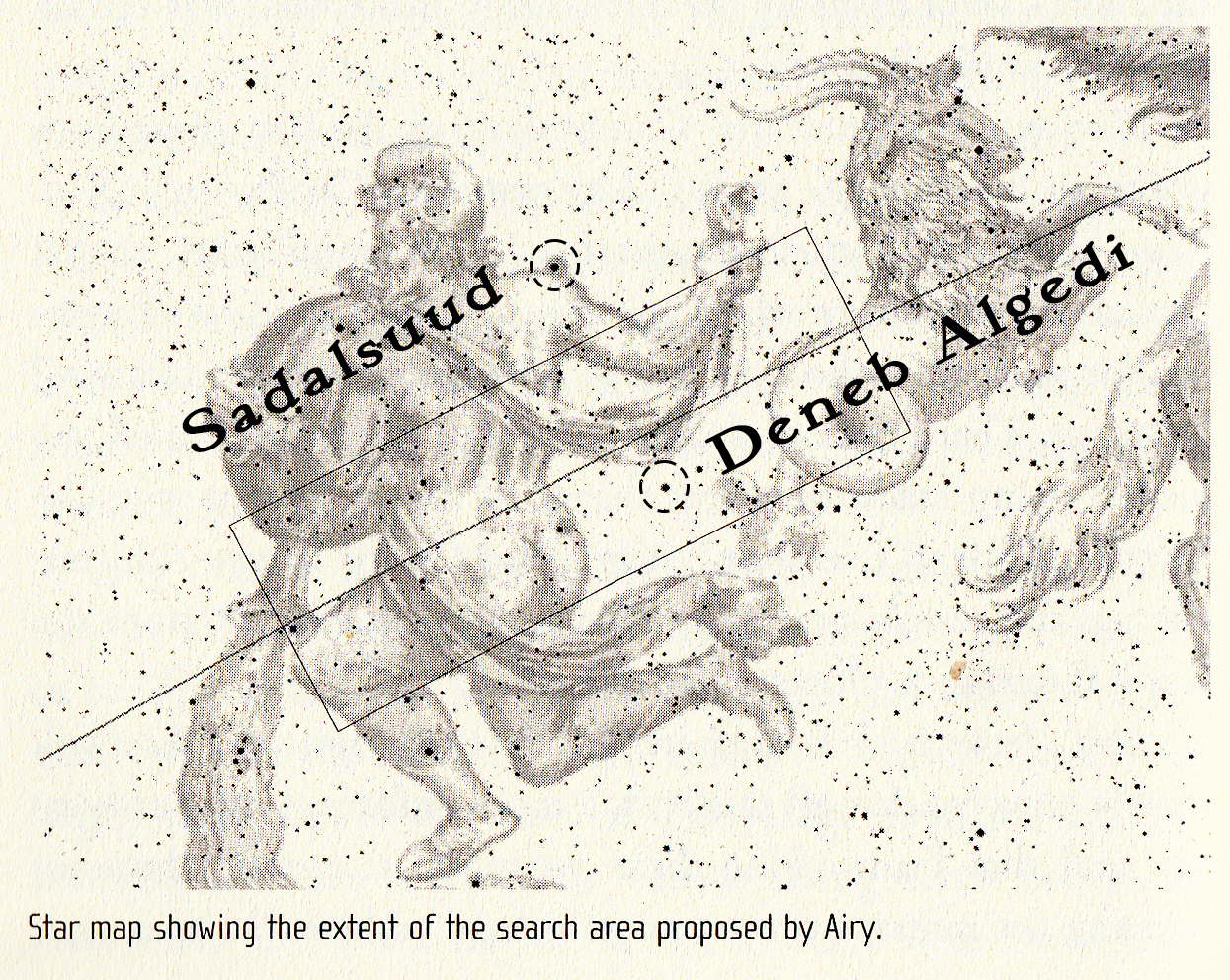
This place is unique in the zodiac constellations. Capricorn and Aquarius “overlap” quite a bit here in terms of ecliptic longitude, moreso than any other adjacent zodiac figures.
The one flaw in Standage’s graphic is with the caricature of Capricorn. The Sea-Goat’s tail should extend further to the left, well underneath the arm of Aquarius, at Deneb Algedi:

But that’s not a big deal. The important thing about this zone of discovery is that it includes this very peculiar part of the zodiac, where those two stars “point to” the Northern Cross – the very Christian symbol of man’s persecution and salvation:
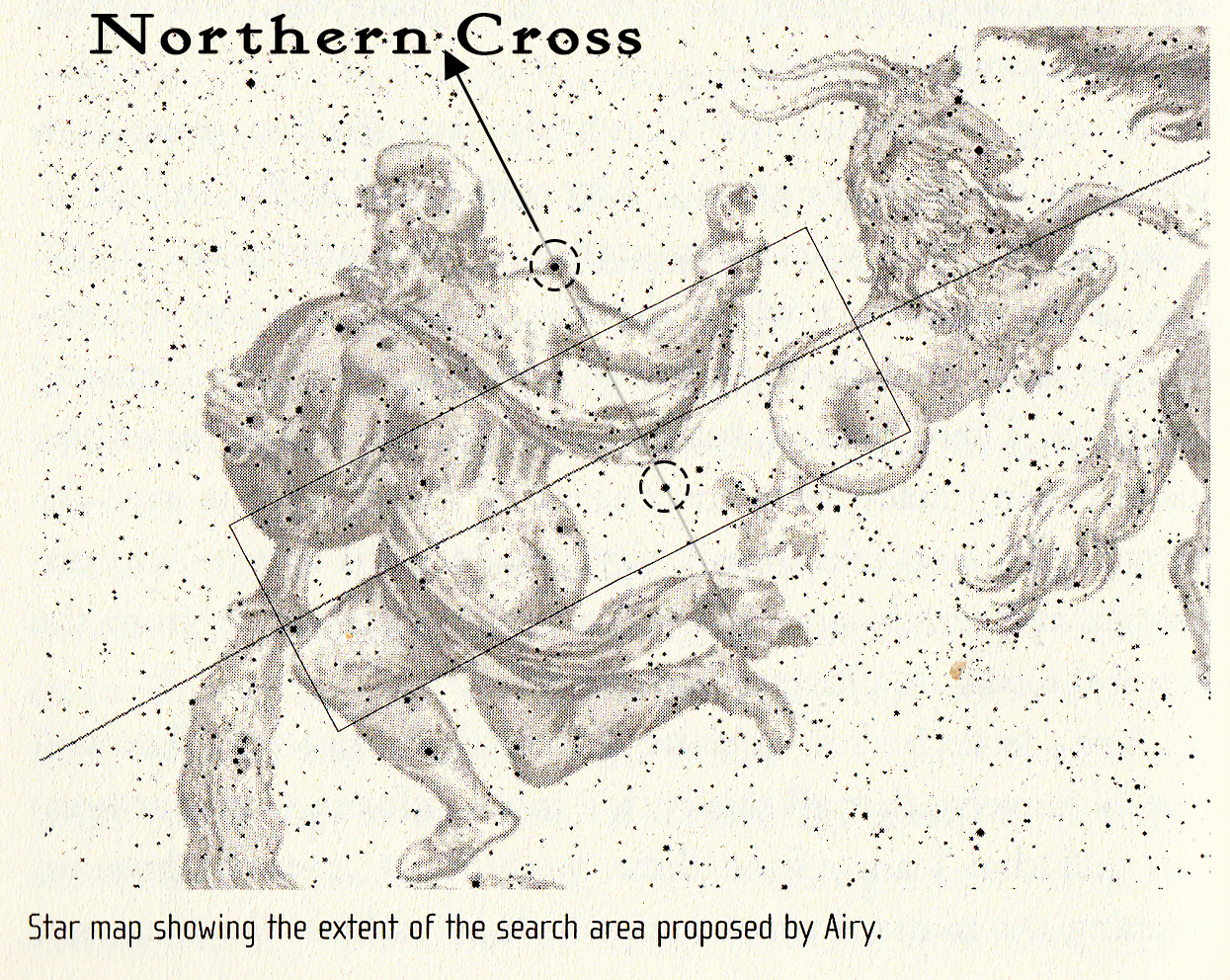
When Neptune was finally located, on the night of an autumnal equinox, it was located at about this location:

So, basically, Neptune was discovered in the ass of Aquarius – the sign “ruled” by Uranus. Tee-hee-hee-hee, right? Sky Map Pro gives us a more adult picture of the posits, within Airy’s zone:
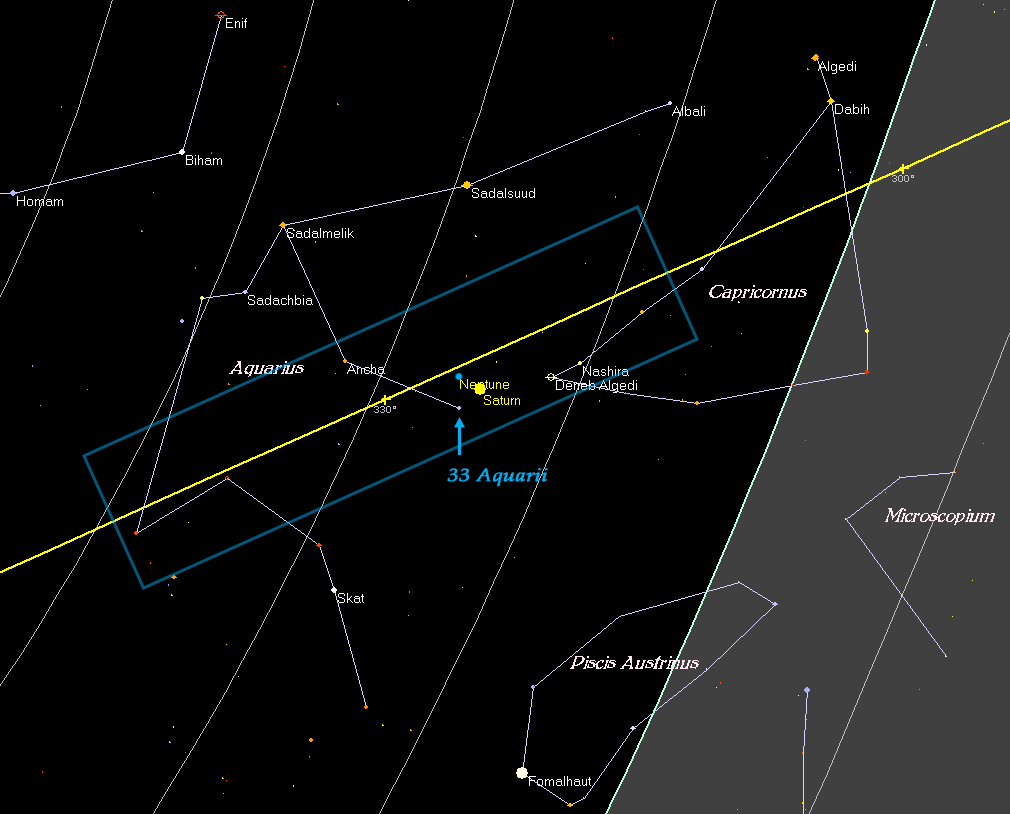
So, there we have it – Neptune was discovered when it was very close to Saturn – the original “ruler” of Aquarius and Capricorn, while it was straddling both constellations; Saturn is the planet that rules over hard work, rules, groundedness, finite mathematics, and what I like to call “reality-based shit.” You just can’t get away with shit when Saturn is around. See how all of this works?
The Astrology of the Detection
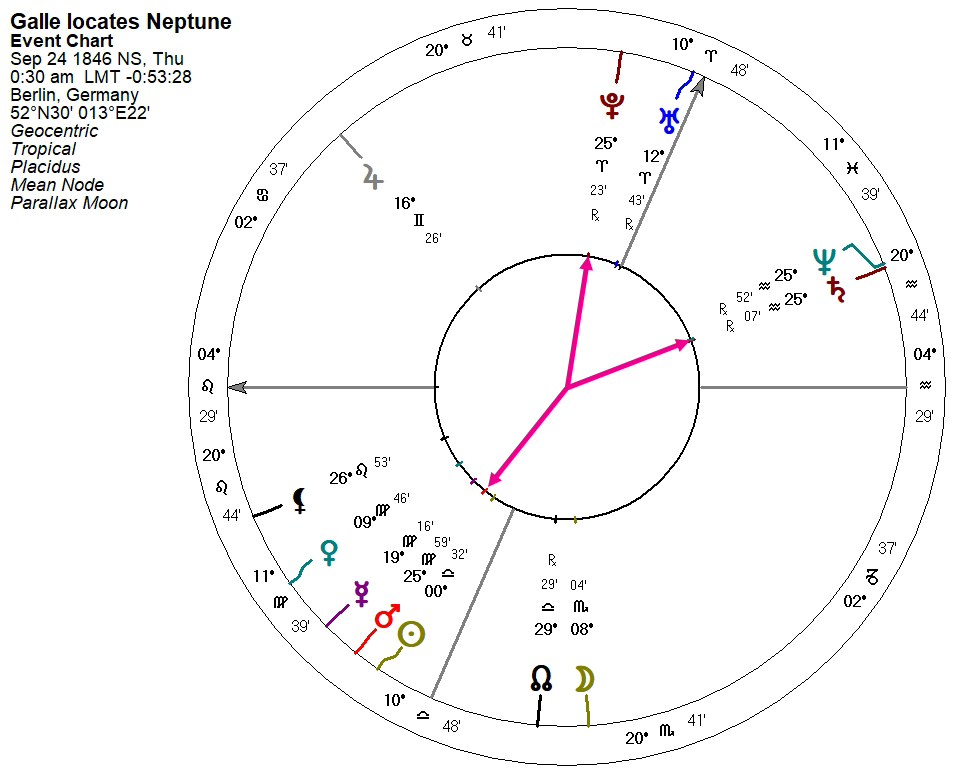
As you can see, Mars, Saturn, and Pluto had to have an intervention with Neptune, who had always been shy and a total drug fiend, to get it into see an astro-therapist.
Seriously, this chart is worthy of much study. I marked how a “yod” formation was present; yods are magical things to astrologers, for some reason, but in my view, they represent a harmonic of the trine family. They always have a sextile aspect (60°) and two quincunx aspects (150°). They therefore constitute a combination that can be expressed as such:
MA = (SA-0-NE)-60-PL
When we take out the Neptune (NE), we’re left with the three big baddies of the solar system: Mars, Saturn, and Pluto – the enemy of all best-laid plans (pun intended). In some sense, Neptune was finally coaxed out of hiding by the neighborhood bullies.
And, thus, the “Astronomer, Inc” meme above, where the hapless chick-on-the-side was “discovered” to be with the CEO during the current conjunction of Saturn and Neptune.
Saturn and Neptune only go to Coldplay concerts every 36 years or so:
1846, 1882, 1917, 1952-3, 1989, and 2026.
Did I mention that, back in the Hellenistic days, Saturn ruled over the cold? Not the virus, but the temperature? Coldplay?? Oh, the irony, though Saturn does rule over the metal we call lead. Mars rules over iron, but irony itself is surely the domain of Neptune, no? WHAT SAYETH THOU, GOOGLEY AI?

What about the factoid that a man named “Airy” was certain that Neptune would be found in Aquarius – an “air sign”? How did a water-bearing icon end up being an air sign and not a water sign? If you want to have some fun, make an astrologer explain that one.
The moral of the story is: don’t take your paramour to see Coldplay during a conjunction of Saturn and Neptune. In fact, just don’t go to any Coldplay concert – they suck! If he had taken her to see AC/DC, well, things would have been different, and the after-show sex would have been hot!
(Hey, I’m old enough to know these things, ok?)
The important thing for us, though, is this: Mars’ exaltation is a corner of astro-history that needs to be come out of the cold.
►Ed

 Cosmos of Absurdity
Leave a comment