When I first took an interest in astrology 30 years ago, I never thought I would have to weed through so much nonsense and “unlearn” things just to find some sensibility. But when you’re in love, you tend to stick with your partner even with all their flaws.
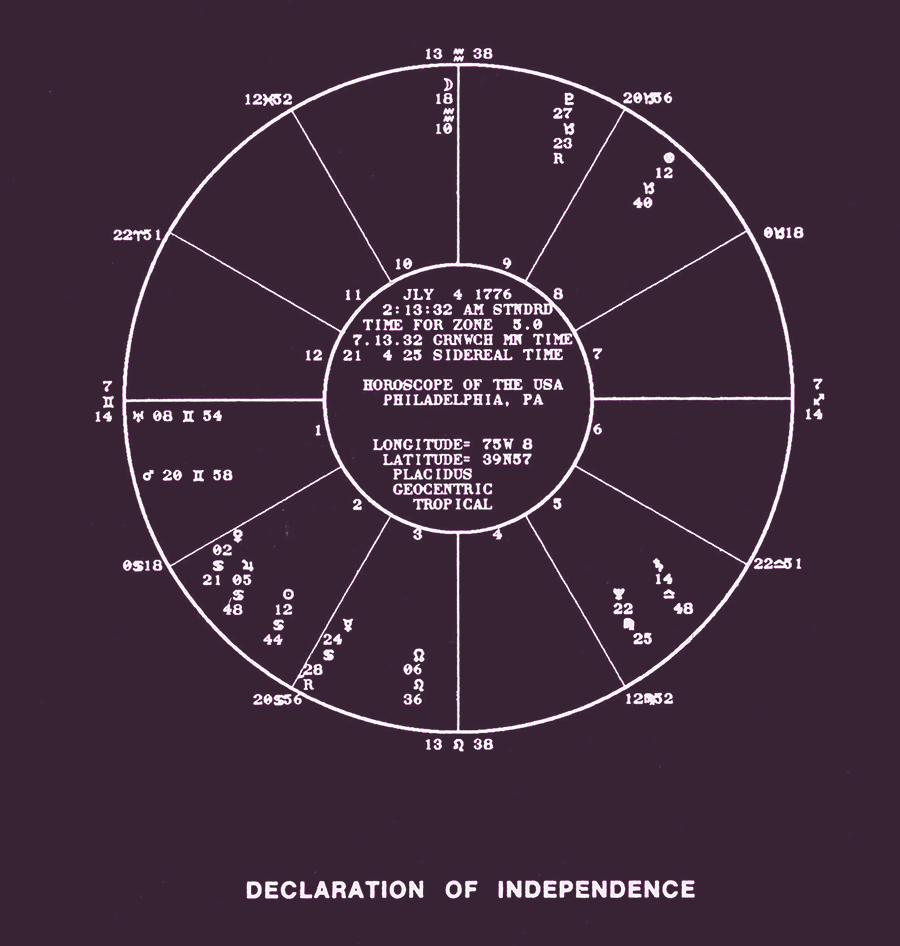
One of those bits of BS was the so-called “Gemini Rising” chart for the USA, which claimed that the USA began at … get this … 2:14 AM on July 4, 1776.
Yes, you read that right. Apparently, in the wee hours of the morning, right after the bars in Philadelphia closed, the core group of Founding Fiefdomers were so committed to the new nation that they went back to the Pennsylvania State House, and secretly held a magic ceremony between 2 and 3 am that commenced United Stateshood while everyone else was sleeping. That was it, there was no more work to do – America had begun! Silly, right?
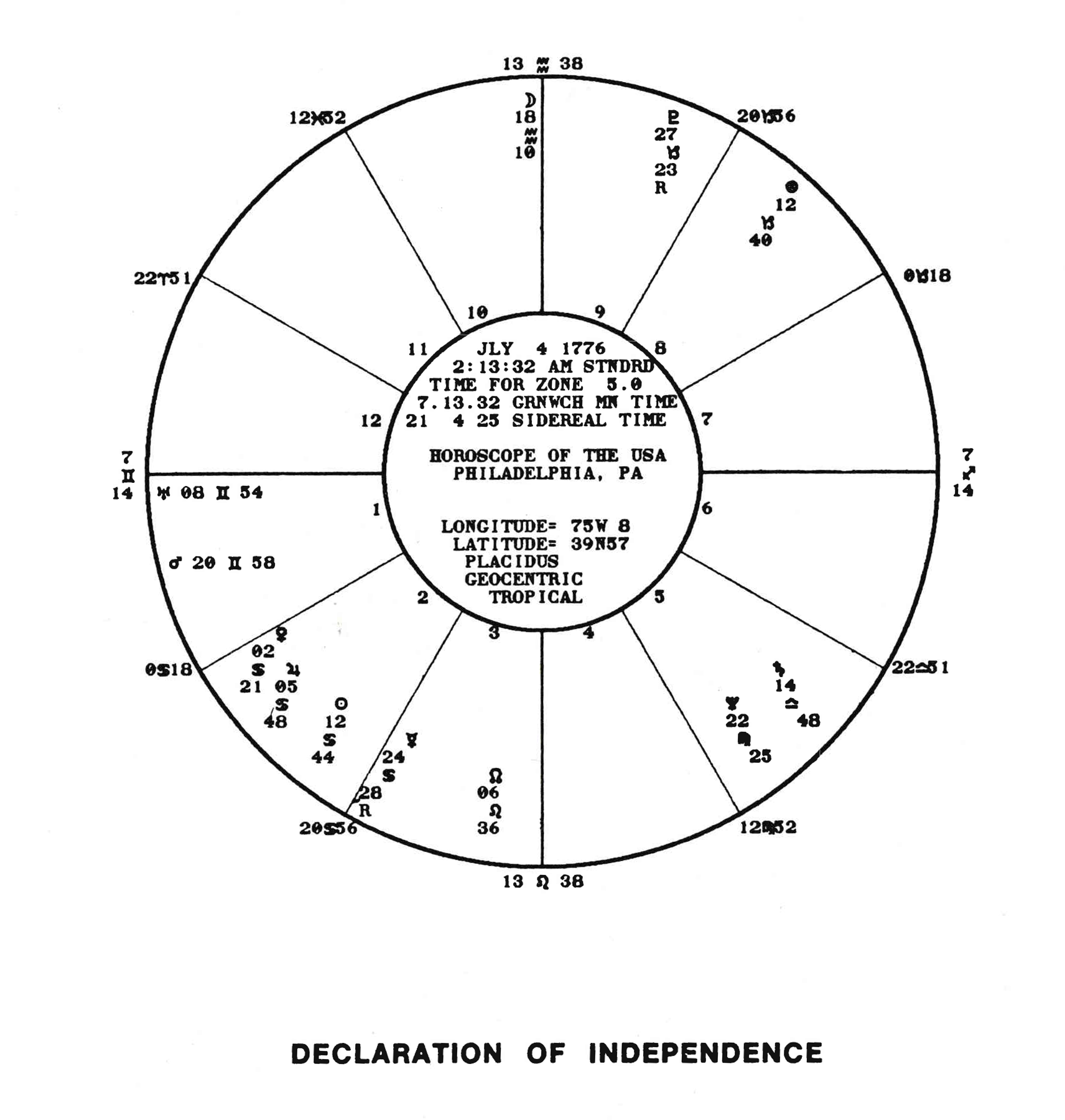
Here is my reproduction of the original with a 7°35′ ascendant:

Of course, this is a bunch of hooey, but at the time, I took it seriously, because I trusted other astrologers. Who was I to say any better? It’s not like I was a scholar of the Revolutionary War, or could even name more than five of the people who ended up signing he Declaration. Yet, something about it just didn’t feel right.
Luckily, I had a ravenous appetite for accruing information, and set out, on my own, to self-teach my brain the craft. Instead of taking classes, I got online and started bothering any other astrologer in any chat group I could find. Instead of taking classes, I scoured Southern California book stores with my trusty special friend Barbara Barrett, in search of the truth. I had to get to the bottom of this.
In short order, I learned that there was a hot debate in the world of astrology as to which “birth” chart was most accurate. The fact is, even after 200+ years of USA history, the astrologers still were just guesstimating, without consensus. Every astrologer, I came to realize, had their own favorite chart for the USA, and, behold, for all them, they would declare without hesitation that their own chart “works for me!”
Still, of the plethora of possible charts for the USA that have been proffered over the years, the one for 2:14 am has to be the worst. So, how did this come about? Thankfully, a very fine history of this chart was posted by astrologer DW Sutton, and can be found online here. (For the record, I have not met DW Sutton.) In it, Sutton explains that the origins of this chart are a bit murky, and no one really knows to whom it can be properly attributed, but the likely suspect is a Dr. James D Keifer, sometime around 1900.
The conclusion of Sutton’s research that I find of prime importance has to do with the early pruveyors of the chart in the first decade of 20th Century, who were adamant that the ascendant was exactly 7°35′ of Gemini, even though the precise time-of-day for the chart differed depending on where it popped up. Sutton explains (my emphases in bold):
It is definitely known that Elbert Benjamine in 1908 was convinced that 7 degrees of Gemini was the approximate degree on the ascendant of the United States chart: and that in the 1928 edition of Mundane Astrology he presented a chart published by HV Herndon in 1924. The pictured chart had 7 Gemini 35 on the ascendant, but it’s important to note that he doesn’t claim to have used the chart. The chart is timed for 2.17am, but this time doesn’t give 7 Gemini 35 rising (or 8 Gemini 47). It gives 8 Gemini 21. So what we have is a right chart with a wrong time. The same unsourced, but more precisely calculated chart with 7 Taurus 35 – should be 7 Gemini 35 – on the ascendant was published in the 1935 edition of Mundane Astrology. It was timed for 2.14.43am – and 2.13am – and while the time kept changing the ascendant stayed the same.
How could that be, you may ask?
The Trying Times of Telling Times
It probably came down to which time convention was being employed to do the chart, as there were a few to choose from. In 1776, in the British realm, timekeeping was going through some radical changes. There were no time zones, as that convention didn’t bein until 1883. Before time zones, but during the Revolutionary period, there was a new kind of timekeeping called “Local Mean Time” [LMT], which was only made possible through precise timekeeping devices that came about in the era of chronometers.
Before LMT, and most surely in the hinterlands well after, there was Local Apparent Time [LAT], which is a fancy word for the time of day being based on a sundial. LAT requires that one’s clock be set to 12:00 at the time the sundial registers 12 noon. So, if you could afford a good sundial and a good chronometer in the mid-18th Century, you were probably a really wealthy fucker like Thomas Jefferson, and could keep accurate time for your hefty schedule of Revolutioning.
In any event, to get a chart with 7°35′ of Gemini on the ascendant, at the location of 39°57′ North and 75°10′ West, one needs these times:
- 2:10:18 LAT
- 2:14:16 LMT
- 2:14:53 EST
Accuracy also depends on how precise one’s chart-calculating math was in the early 20th Century, before computers. I think it is obvious that the original “Gemini Rising” chart was calculated in LMT first, and then EST later on, as the 1935 rendition for Mundane Astrology that has a 2:14:43 am time, but others before seem not to.
So, why 7°35′ Gemini?
The mainstay of the chart is that it has an ascendant of 7°35′ Gemini. Back to Sutton:
Then in 1940 Elbert Benjamine categorically states in American Astrology magazine that the chart he had used since 1908 – referring to a chart that had 7 Gemini 35 on the ascendant – had been given to him by Dr. James D Keifer. We don’t have an original copy of this chart – or the Herndon chart – so we don’t really know if either chart actually had 7 Gemini 35 ascending. The chart provided by Elbert Benjamine does and it’s possible that he and the Brotherhood of Light’s mundane astrology class, who were actively engaged in ongoing research into the chart, fine-tuned the approximate degree to a more precise 7 Gemini 35. But the documented evidence from Elbert Benjamine states that he was given the 7 Gemini 35 chart by Dr. James D Keifer in 1908 – so he did it. His Gemini rising chart precedes the Herndon chart by 16 years and astrologers using the US chart with 7 Gemini 35 ascending should identify Dr. James D Keifer as its source – data supplied by an acquaintance who was a descendant of a signer of the Declaration of Independence. And it seems that Dr. Keifer did a lot of research into the chart before he gave it to Elbert Benjamine.
The part about the ‘descendant of a signer of the Declaration’ is probably apocryphal, but even if it was true, how in the heck would such a precise time of the middle of the night be known by someone in the year 1900, but not by anyone else in the world? Was this someone breaking the veil? In my view, this is just another tall tale by a fabulist astrologer, of which we seem to have an infinite supply of (don’t even get me started on the Jacobs family, ugh), and then promulgated down the line without too much critical thinking.
So, without getting led out into the desert, we need to go back to practical detective work about the contemperaneous setting of USAnian astrologers 100+ years ago, and it’s not even that complicated, once we see the numbers, to realize what happened. Let me astro’splain this:
Any astrologer in business at the turn of the 20th Century in the USA, such as Dr. Keifer, would have had access to ephemerides that were based on the year 1850. Ephemerides all have a base date – an epoch – and that is usually January 1 of a year of a half-century, such as 1850, 1900, 1950, and 2000. In the ephemeris industry, “zeroing out” all the data for those dates makes calculations much easier, and that’s why the standard was chosen. In this example The Nautical Almanac and Astronomical Ephemeris of the year 1850, we see that the position of α Tauri (Aldebaran) was 4h 27m of Right Ascension, and 16°12′ north Declination on January 1, 1850:
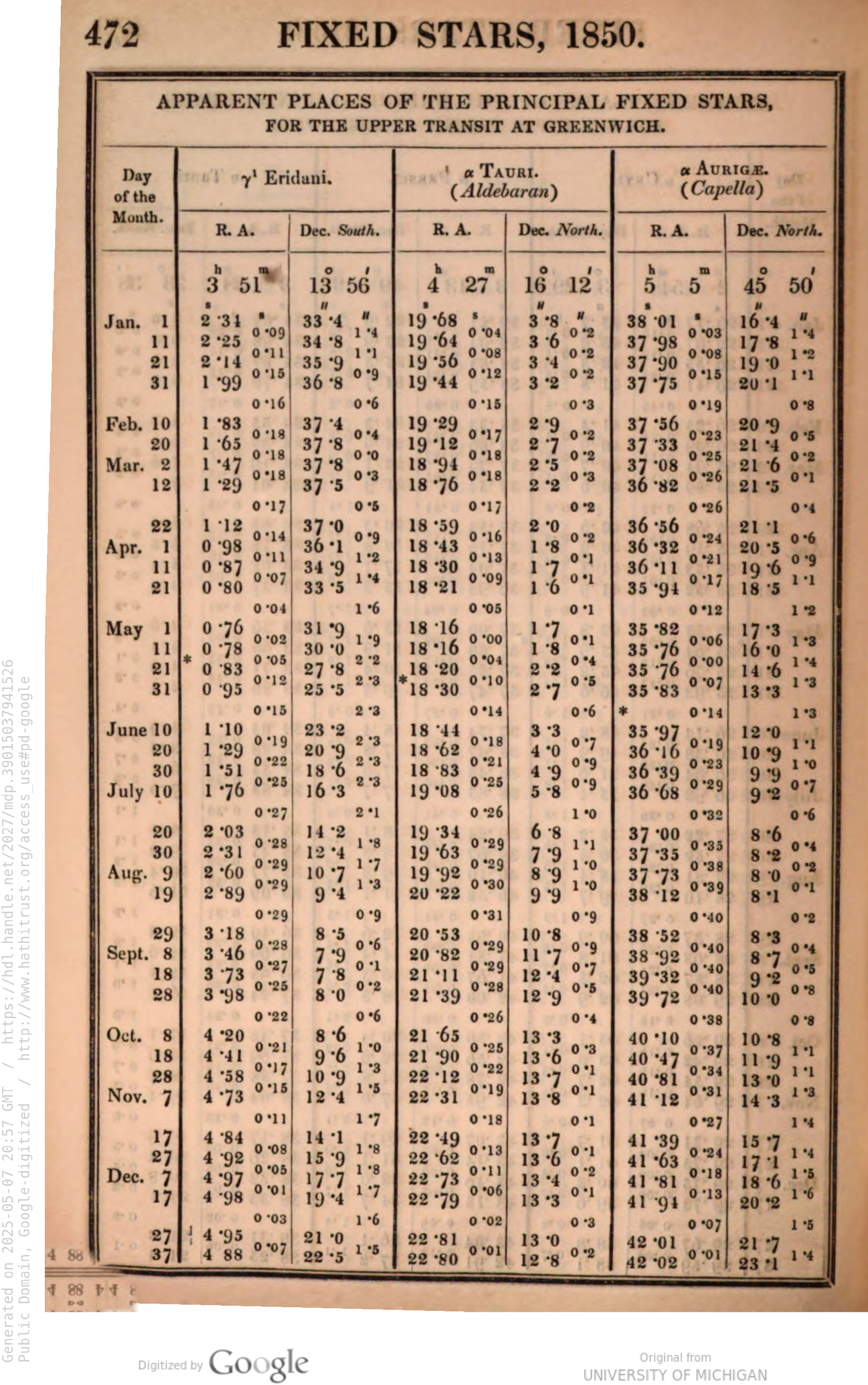
Converting the equatorial coordinates to ecliptic longitude, we get 67.617014°, which is 67°37’01”. Gemini starts at 60°, which means Aldebaran in this guide is at 7°37′ of Gemini in 1850. That is awfully close to the 7°35′ Gemini value for the original “Gemini Rising” chart, and well within the fudge factor for someone who doesn’t want to use too many significant digits. Here are Aldebaran’s values through the period according to Solar Fire:
- 1750: 6°15′ Gemini
- 1800: 6°59′ Gemini
- 1850: 7°41′ Gemini
- 1900: 8°24′ Gemini
I would also add to the evidence for Aldebaran that this all came about right after the 1899 publication of Richard Hinckley Adams’ Star Names and Their Meanings, which devotes a good amount to Aldebaran in astrology, as it should. I wouldn’t take everything in that book as the gospel truth, but Allen does give Aldebaran the stature it deserves.
Thus, my guess is that the original thinking for this chart idea went as follows:
The USA had to be “born” on July 4, 1776 because that’s what it says on the document. We have no idea what time of day to use, but in astrology we must have a time of day for a chart. The new nation was unique, and was founded only a handful of years before the discovery of the planet Uranus in 1781. Uranus represents unique and groundbreaking things, so surely Uranus had to be prominent in the chart. Uranus was also conjunct Aldebaran in 1776, and Aldebaran, being a Royal Star, had much to do with new political entities and good luck. So, why not put Aldebaran smack dab on the ascendant, but keep that part silent while we take our mystical chart public that has Uranus very close to the ascendant but not right on it! Where was Aldebaran in 1776? Who the fuck knows, so let’s just run with the value from our 1850 ephemeris and no one will be the wiser! Fixed stars don’t even move that much. Then we’ll just tell everyone the source was some descendant of some obscure unnamed signer of the Declaration, and no one will question it!
I’m such a cynic.
Also, I know there has to be some old astrology books out there from the previous turn of the century that list the 1850 values of the major fixed stars. I actually saw one once, at the Philosophical Library in Escondido, but that place is gone, and I can’t find the reference. (Shoulda stole that book, eh?) Any help would be appreciated.
►Ed

 Cosmos of Absurdity
Leave a comment