
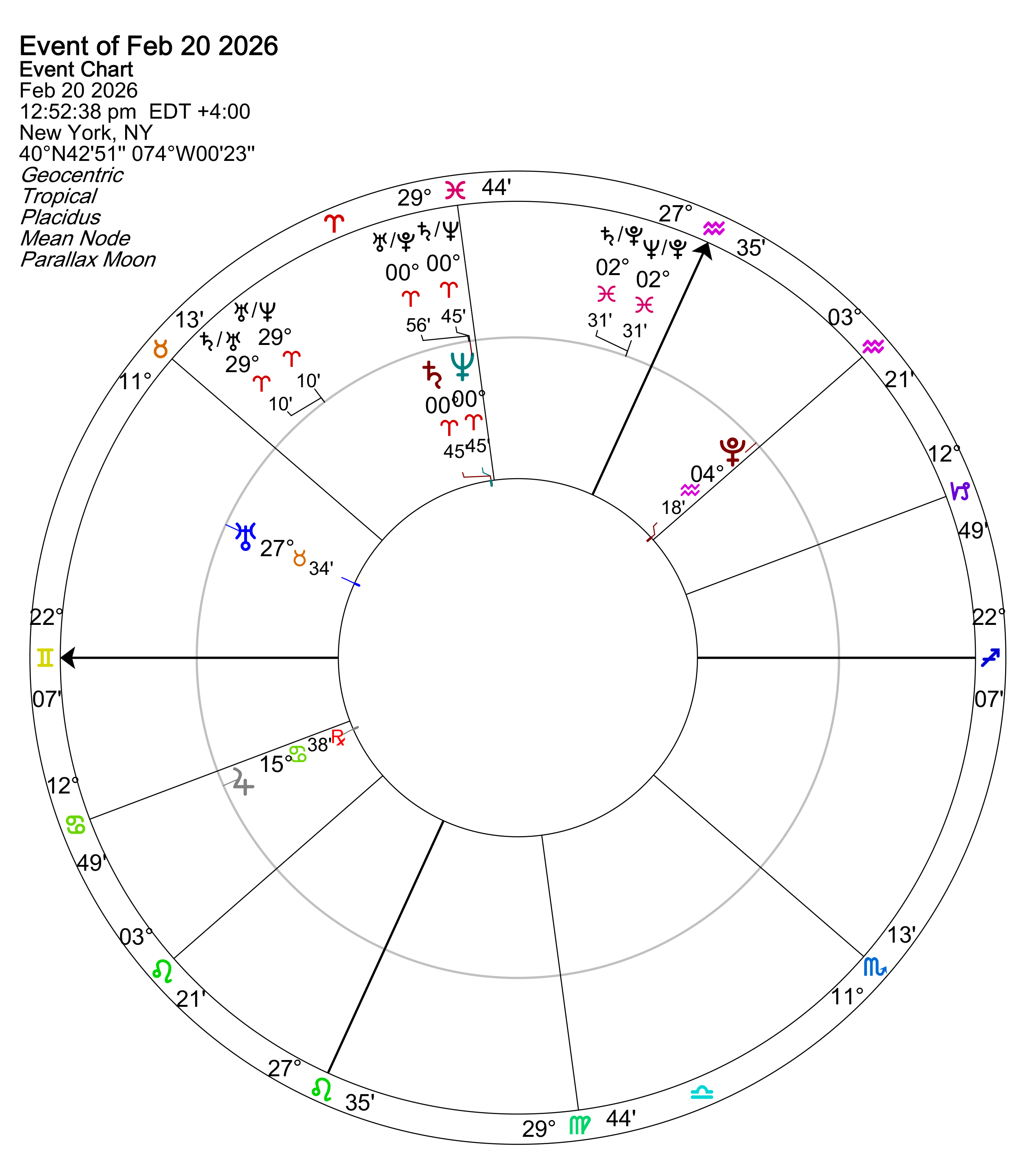
originally published Nov 9, 2024, on Facebook, with some editing:
I want to thank my astrolofriend Laura Smith for making me look again at the upcoming critical outer planet conjunction of Saturn and Neptune on the midpoint of Uranus/Pluto at the Vernal Point, in February of 2026. It’s a doozy, as any astrologer would say, as Saturn and Neptune represent opposite ideals, as in cold hard facts versus delusions and obsessions. The volatility of Uranus/Pluto is what makes this so scary.
In Cosmobiological notation, the scenario is coded like this:
SA-0-NE = UR/PL = VP
The neat thing about formulae is that we can do some math with them, kinda like how chemical formulas can be added and subtracted to get other formulas.
In this case, we can see components such as these, and from there study the cyclic clusterf***:
A) SA-0-NE
B) SA = UR/PL
C) NE = UR/PL
D) SA = VP
E) NE = VP
F) UR/PL = VP
I also consider this to be related and is considered:
G) SA/NE = UR/PL
In this post, to start, I want to look at the NE = UR/PL cycle, which boasts the longest wave of all the cycles. How, you ask? I start by going into Solar Fire (it’s the only software I use because I’m too afraid to change) and run a transit-to-transit routine that lists all conjunctions, oppositions, semi-squares and sesqui-squares, which are the most kinetic aspects, and show us the powerful 8th Harmonic, and thus hopefully how the whole cycle plays out from one conjunction to the next.
(NB: Midpoints are actually an axis. If a midpoint is listed as 10° Taurus, then it is also active at 10° Scorpio. Thus, conjunctions and oppositions are similar, but the zero point will default to the side of the axis that has the smallest difference.)
I ran everything from the time of Jesus until 2400 AD. I’ll be happy to send that file along to anyone who requests it. (It’s a PDF with 13 pages.)
Here are the current conjunction partiles (tropical zodiac):
Date – – – – – Neptune – – UR/PL
Sep 27 2024 – 28°Pi20’R – 28°Pi20’R
Jan 05 2025 – 27°Pi22’D – 27°Pi22’D
Aug 18 2025 – 01°Ar40’R – 01°Ar40’R
Mar 08 2026 – 01°Ar20’D – 01°Ar20’D
Jul 10 2026 – 04°Ar24’R – 04°Ar24’D
The prior closing semisquare:
Date – – – – – Neptune – – UR/PL
Oct 22 1978 – 16°Sg21’D – 01°Sc21’D
Feb 09 1979 – 20°Sg00’D – 05°Sc00’D
Sep 07 1979 – 17°Sg44’D – 02°Sc44’D
Apr 11 1980 – 22°Sg35’R – 07°Sc35’R
Jul 21 1980 – 20°Sg19’R – 05°Sc19’D
The prior closing square (yes, 23 total partiles):
Date – – – – – Neptune – – UR/PL
May 30 1929 – 28°Le42’D – 28°Ta42’D
Jul 15 1929 – 29°Le42’D – 29°Ta42’D
May 16 1930 – 00°Vi47’D – 00°Ge47’D
Aug 05 1930 – 02°Vi32’D – 02°Ge32’D
May 07 1931 – 03°Vi00’R – 03°Ge00’D
Aug 22 1931 – 05°Vi14’D – 05°Ge14’D
Apr 29 1932 – 05°Vi16’R – 05°Ge16’D
Sep 05 1932 – 07°Vi54’D – 07°Ge54’R
Apr 22 1933 – 07°Vi34’R – 07°Ge34’D
Sep 18 1933 – 10°Vi31’D – 10°Ge31’R
Apr 16 1934 – 09°Vi55’R – 09°Ge55’D
Oct 02 1934 – 13°Vi06’D – 13°Ge06’R
Apr 10 1935 – 12°Vi16’R – 12°Ge16’D
Oct 16 1935 – 15°Vi40’D – 15°Ge40’R
Apr 02 1936 – 14°Vi40’R – 14°Ge40’D
Oct 29 1936 – 18°Vi12’D – 18°Ge12’R
Mar 26 1937 – 17°Vi05’R – 17°Ge05’D
Nov 13 1937 – 20°Vi42’D – 20°Ge42’R
Mar 18 1938 – 19°Vi33’R – 19°Ge33’D
Nov 30 1938 – 23°Vi08’D – 23°Ge08’R
Mar 08 1939 – 22°Vi05’R – 22°Ge05’D
Dec 21 1939 – 25°Vi30’D – 25°Ge30’R
Feb 22 1940 – 24°Vi42’R – 24°Ge42’D
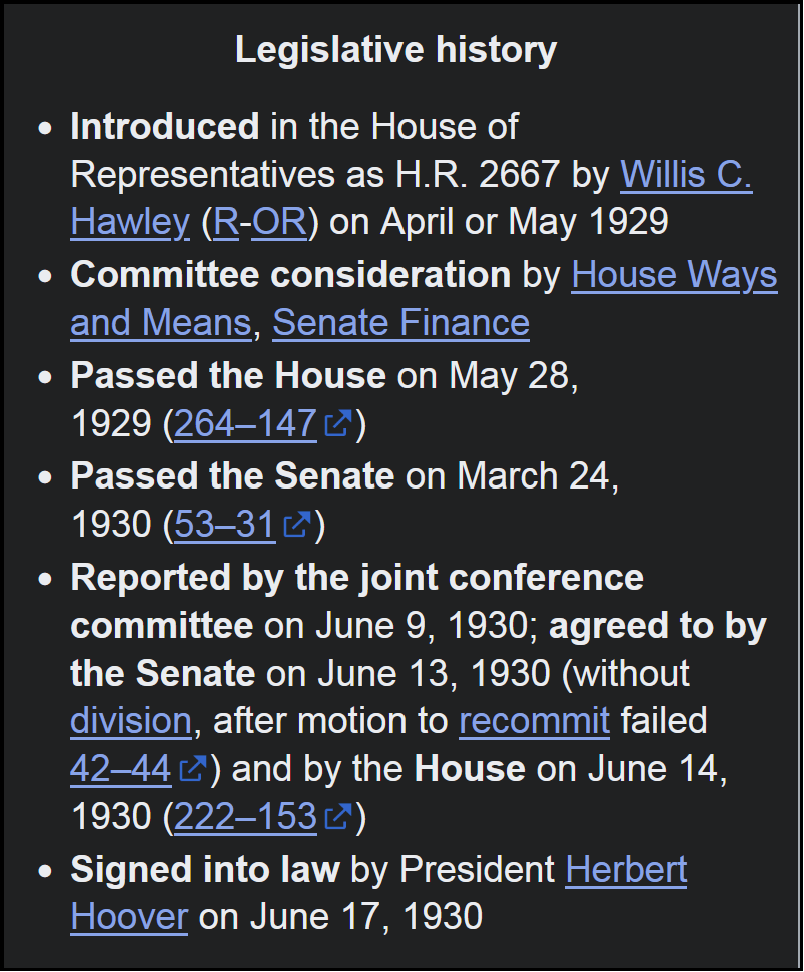
The prior period of squaring basically outlines the Great Depression, and we all know what else happened as that economic low point ushered in major political shifts, such as the Nazi takeover of Germany, the Spanish Civil War, and the Japanese invasion of China. So, take all of that for what it’s worth. The so-called Smoot-Hawley tariffs plan was introduced at the beginning of the squaring period:
The data reveals other interesting periods of history, such as the end of the Roman Empire:
Date – – – – – Neptune – – UR/PL
Mar 30 0476 – 14°Li16’R – 14°Li16’R
Aug 12 0476 – 13°Li26’D – 13°Li26’D
Feb 01 0477 – 17°Li40’R – 17°Li40’D
Also of note:
The period from May 1762 through January 1770 (opposition);
The period from August 1653 through March 1659 (square);
The period from June 1119 through February 1124 (square);
One partile conjunction in 1505.
Conclusion: we are technically already in the big 2026 shift, and the prior “zeroing out” of the cycle was the 1760s, which as we all know led up to the Revolutionary period in the USA.
# # #
———————————————-
More explainer:
In “combination theory,” we have a much wider parameter of cycles to investigate. This can seem daunting, but we have computers now to do the heavy calculations, so there isn’t much excuse to not study and interprete them.
In the standard Western model, the long-term “mundane” or “collective” cycles are simple. Planetary orbits, the basic cycles in the system are: Jupiter (JU) – 12 years, Saturn (SA) – 30, Uranus (UR) – 84, Neptune (NE) – 165, and Pluto (PL) – 248.
We also know that Jupiter/Saturn conjunctions happen about every 20 years, and that cycle was well-known by the ancients and the Arabs like Abu Masar. From there, we have Saturn/Uranus (SA/UR) at 45 years, and Uranus/Neptune (UR/NE) at about 171 years. The longest is Neptune/Pluto (NE/PL) at right around 500 years. Astrologers in the intermediate level should be familiar with these cycle lengths.
In combination theory, though, the midpoint cycles also need to be studied. As I laid out many years ago, the cycle of the Jupiter/Saturn midpoint meeting up with the three “modern” outer planets will yield noticeable results. There are three:
JU/SA = UR
JU/SA = NE
JU/SA = PL
Because Pluto moves slower than the others (unless near perihelion where it moves at a similar rate to Neptune), the JU/SA will “catch up” to it more frequently, whereas the JU/SA = UR takes longest.
Which brings us to the current situation where we have a conjunction of Saturn and Neptune at the midpoint of Uranus/Pluto, written as such: (SA-0-NE) = (UR/PL). Being within one degree of the Vernal Point, a “world axis” point, this takes on global significance. This situation is almost like having all four planets conjunct at the same time, and thus has serious ramifications for wild, radical change.
There are two more parts to follow.
►Ed

 Cosmos of Absurdity
Leave a comment