
Someone needs to stop this National Pi Day abomination. It has nothing mathematically or geometrically to do with π – the number of diameters that fit on a perfect circle’s perimeter. To me, this “Pi Day” is cringe. It needs to go into the circular file!

The kernel of the idea for this “Pi Day” nonsense is explained on the Wikipedia page for Larry Shaw, the (I’m sure) very nice person who started it all:
Larry Shaw, the “Prince of Pi”, invented the holiday Pi Day in 1988 while at the Exploratorium.[11] During an off-site staff retreat in 1988, he started talking with his co-workers, like Ron Hipschman, about the mysteries of mathematical constants. Shaw came up with the idea to link pi (3.14159…), which begins with 3.14, with the date 3/14 or March 14. Co-workers built on the idea and they had a mini-celebration with just the staff, starting with eating of pies. The next year, the holiday was held for all at the museum and every year since, even when the museum was closed during its move. The celebration includes a parade at 1:59 p.m. with visitors holding a sign with a digit of pi, a pi shrine, eating of pies (fruit and pizza), singing happy birthday to Albert Einstein, and more. Larry Shaw would lead the parade in his red cap with the digits of pi.
Wow, the “3.14…” matches the “3/14”!! We must all make this date the date that people are aware of the world’s most ubiquitous irrational number!! Oh, and pi sounds just like pie, so let the puns propagate!! Aren’t we so clever tee hee tee hee!!
Yes, somebody, please, shoot me now.
Even the great Isaac Asimov could not resist the punititive pun. He devoted an entire chapter in his enjoyable exploration of numb-ers, Asimov on Numbers, to π. It was a reprint of an essay he penned in 1960 about the subject, entitled … brace yourself … A Piece of Pi. (More on this later, as Azimov explored a bit of number magic with π.)
If this pi/pie thing is really so very clever, then these guys should be the mascots:

I understand that it’s Einstein’s birthday, and no doubt we should all know on what dates the most famous “men of science” were born, right?

Newton was born on Christmas! Galileo was born on February 15! Or the 16th! Euler was born on … wait, who the hell was he? Kepler was born on … … oh, who cares, sexy Albert is our god! And, he was a Pi-sces!
March 14 is the birthday of other notable mammals. My favorite is Roger Powell, who was instrumental in MIDI sequencing, and pioneered the use of Moog synthesizers in the early 1970s; he then played with Todd Rundgren for many years in Utopia, a band with a “pi” in the name – Utopia.
General Martin Dempsey, Chairman of the Joint Chiefs of Staff in the USA military from 2011-15, was born on March 14, 1952. Also born on March 14, 1952: the famous chimpanzee J. Fred Muggs. Make of that what you will.
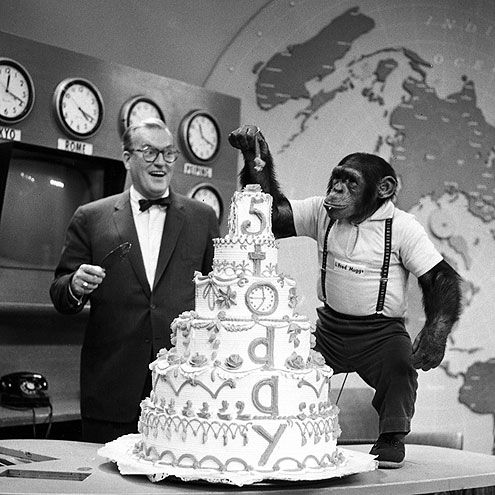
Yes, National Pi Day is, literally, monkey business. And, I think, potentially confusing to young students. Calendars are based on ordinal numbering of days and years. Calendar dates are simply labels with integers. π, on the other hand, resides in a decimal-based value system that includes non-integers as well. There is no “March 14.489th.” Conflating the ordinal and decimal is, to me, a big no-no to teach the youngins.
If we were really serious about the actual math and the yearly cycle, we could easily ask, “On what day of the year will the Sun have moved one diameter of orbit through the projected ecliptic circle since the spring equinox?”
Such a calculation is simple: 360°/π = 114.59155902616464175359630962821…°. On what day does the Sun attain that ecliptic longitude? July 16!
Or, July 17, depending on the year. Now we have an honest Pi Day – Pi Day that we can give to our kids with confidence. As they say in France, “Voilà!”
For the astrology people, that value is 24°35’30” of Cancer. All true Pi Day charts should be cast for the Giza Plateau:
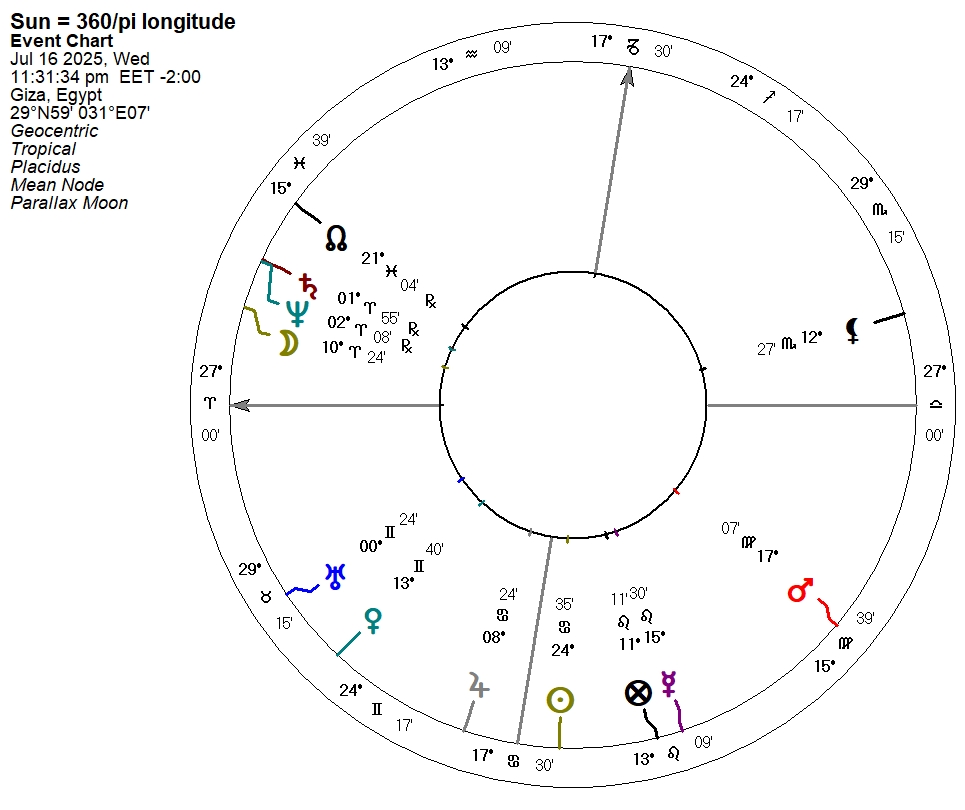
Any planet that attains that longitude should be honored with useless chants of circular logic, and of course a sacred banquet of Moon Pies. Were you born when the Sun was at 24°35′ Cancer? If so, you must surely love to eat pie. Or, throw pies. You deserve a special Birthday Pie. Put your thumb in it and make a wish.
Seriously, though – π is Serious Business
The quest to figure out the ratio of a circle to its diameter goes back into the mysts of history. I won’t bore you with the details, but the matter was important in terms of commerce and construction. An appoximation of the actual value – 22/7 – was commonplace for millennia. As Azimov wrote in Numbers,
“Decimally, 22/7 is equal, roughly, to 3.142857… [the 142857 repeats infinitely] while π is equal, roughly, to 3.141592…. Thus, 22/7 is high by only 0.04%, or 1 part in 2500. Good enough for most rule-of-thumb purposes.”
I attempted to demonstrate, in a five-part series on my other blog, how the mystery of π and the 22/7 is central to the tarot deck of 78 cards. 21 trump cards can be arranged in a rectangle of 3×7, or a 6×6×6 triangle.
But, add that 22nd card – The Fool – and we can only make one shape – a 2×11 rectangle. This can be arranged in a circle that shows a natural polarity in the cards:

It follows that the tarot is actually an outline of irrationality. But, so is the human experience, where the mind is a cosmos of absurdity unto itself.
What if the value of π was rational? Would this cosmos be entirely different? Would it be boring? Would mathematicians only make minimum wage?
Beckmann’s A History Of π (Pi) is a fun read, but the story of Beckmann may be that π makes people crazy. Beckmann postulated that *gasp* Einstein’s theory of relativity was incorrect. So much for being born on Pi Day!
Mathematicians have a difficult time dealing with infinity, and the value of π has an infinite number of digits on the right side of decimal point. Add any integer to π, and we end up with yet another irrational number. Therefore, an infinite amound of irrational numbers exist. That’s crazy!
22/7 or 355/113
Back to Azimov. Besides 22/7, a better ratio exists that approximates π: 355/113. Azimov’s A Piece of Pi recounts Archimedes’ method of calculating π with ever-more sided polygons, and that he
“…was able to show that the value of π was a little below 22/7 and a little above the slightly smaller fraction of 228/71… the average of those two fractions is 3123/994 and the decimal equivalent of that is 3.141851…. This is more than the true value of π by only 0.0082% or 1 part in 12,500.”
He continues,
“Nothing better than this was obtained, in Europe, at least, until the sixteenth century. It was then that the fraction 355/113 was first used as an approximation of π… 355/113 is higher than the true value by only 0.000008%, or by one part in 12,500,000.”
Azimov then goes on to explain the techniques of Vieta and Liebniz, which are basically an endless sequence of fractions, and asks how many such fractions would it take to find a better approximation of π than 355/113. More modern computing power was needed than was available in 1960, but the problem was worked out here.
I bring all of this up because 355/113 stands out as the only value that uses numerators and denominators of less than four digits. It’s like a little diamond in the rough of π approximations. And, wow, it has two 1’s, two 3’s, and two 5’s, and that has to mean something magical, and possibly, if navel-contemplated enough, could be the big portal to god himself herself themself.
You by now may have noticed that my 360/π calculation above that yields 114 and some change is very close to the 355/113 approximation. Could this be part of why our little planet is flourishing with life – some of which are mathematicians?
As I pointed out in my series on 2001: A Space Odyssey, the creator of HAL – Dr. Floyd – is wearing a badge with the number 355 on it, right underneath a little Monolith. 355 is a common number of days in certain luni-solar calendars, but it was also the number of days in the year of 1582, when the Gregorian Calendar adjustment of ten days was instituted by the holy institute of supernatural obsessions.

To his great credit, Kubrick did not include any pies in his greatest film. Nor, for that matter, any pie charts.
National ϕ Day
My solution to all of this is to make a National Phi Day that substitutes for the current National Pi Day. It only requires the addition of one letter, it sounds similar, and it makes much more sense than the current bad penny of punnery. Let me Ed-splain this to you…
In our modern Gregorian Calendar, March 14 is the 73rd day of a standard year, which means that by the end of that day, a full 1/5 of the calendar has elapsed: 73/365 = 1/5.
If we put all the dates of the calendar in a big circle, and put a marker on every 73rd day, we can etch out a pentacle:
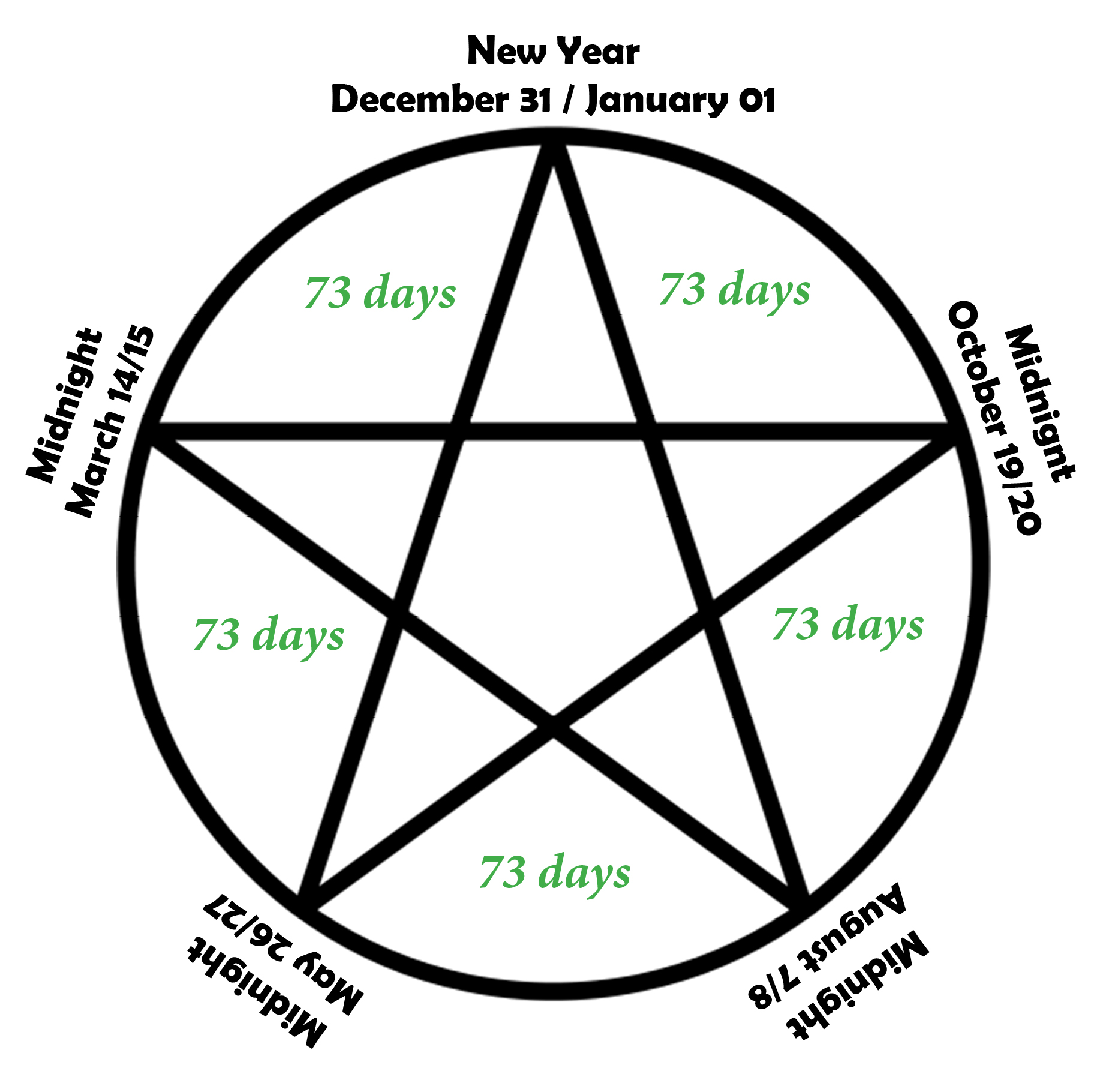
Pentacles are geometrically infused with the value of ϕ – Phi, the Golden Ratio:
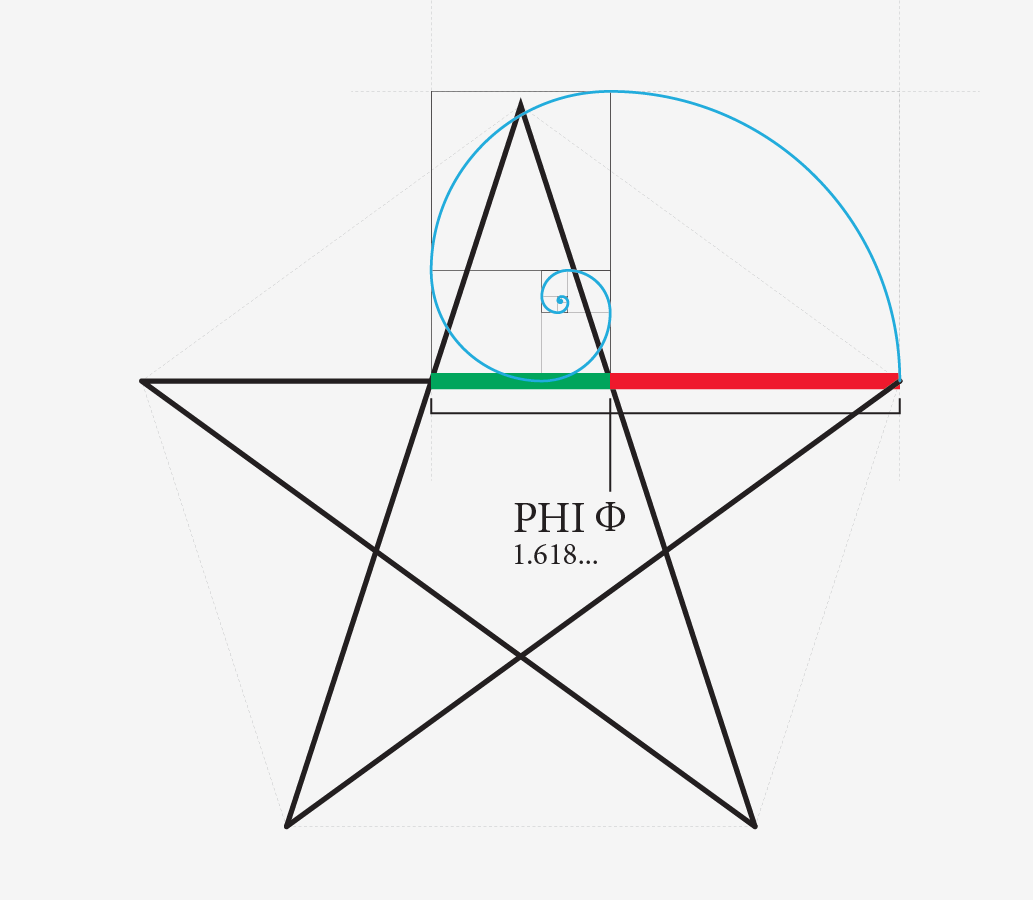
ϕ is also an irrational number: 1.61803398874989484820458683436…, and so we can keep on celebrating the irrational.
ϕ is based on the so-called Fibonacci Sequence of numbers, but was known to humans well into ancient history. This sequence also has some nifty double-numbers:
0, 1, 1, 2, 3, 5, 8, 13, 21, 34, 55, 89, 144, 233, 377, 610, 987, 1597, 2584, 4181, 6765, 10946, 17711….
What are the odds? 5/21, apparently.
More importantly, ϕ is actually found in nature – the real world. Perfect circles are ideals and do not exist outside of the imagination, but the ϕ is everywhere. We would not be here if not for the ϕ.
So, if we are to be true to the math, nature, and the calendar, March 14 should be National Phi Day, and this silly National Pi Day should be moved to a floating holiday in July, and then mostly ignored because it’s summer, and finally thrown in the circular file. (We’ve come full circle with that little joke, eh?)
In conclusion: Save mathematics! Write your Congressperson! Demand that they recognize National Phi Day! Tell them that Ed’s sanity depends on it! PLEASE! FOR THE LOVE OF GOD – MAKE THIS PI DAY THING END!!
►Ed

 Cosmos of Absurdity
Leave a comment