
Mercurial combinations in the natus are all about communication and mental processes. Mercury has traditionally been a neutered, non-gender planet, as opposed to Venus and Mars, for instance. It holds a unique place in the astrological lineup for that reason.
In combination with other planets, it will take on the nature of that other planet. With Saturn, the planet of rigidity, organization, and realism, the combination will show the area of rigid and organized communications. This would include mathematical prowess, as mathematics deals with abosolutes and strict rules. Here we have practial computational skills, syntax, and ordeliness. In short, the logical mind.
Kepler has this with the SO/JU (Sun/Jupiter) midpoint, which is not only fortunate, but also a great happiness and ability to gain an audience. Without Sun and Jupter, there would be no exuberance, and no desire for creating prolific works. This doesn’t need to be in mathematics specifically; it could also be a person who likes instruction manuals, or flow charts, or coding.
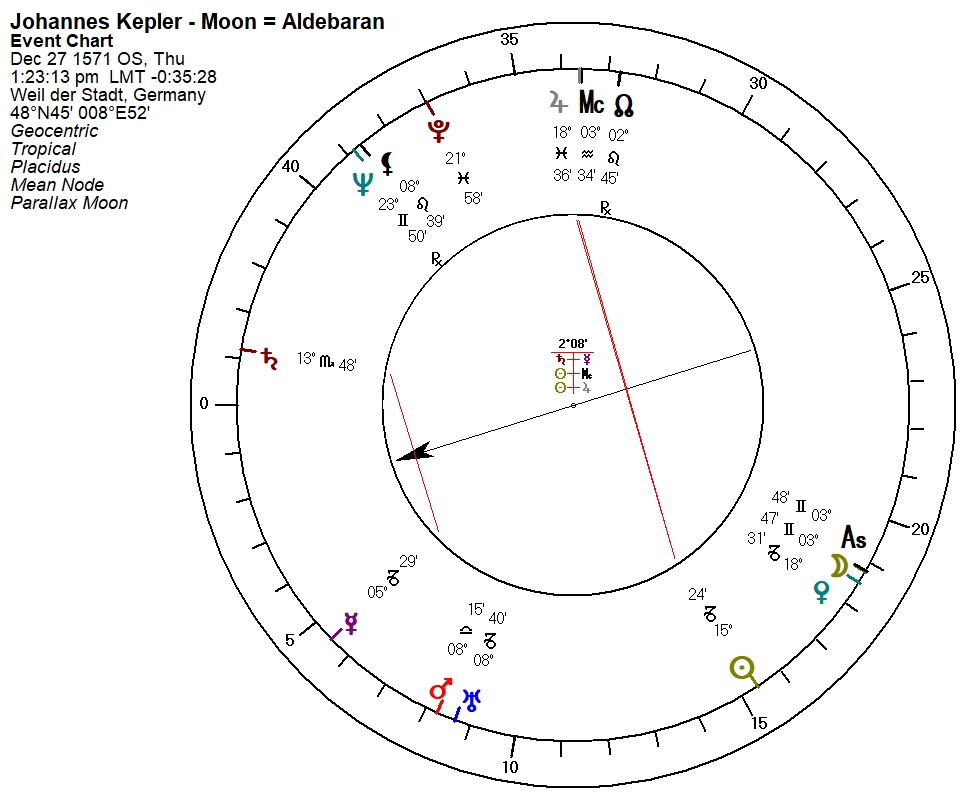
Ebertin keeps his view of SO/JU very simple: “Health, joy, recognition… Advancement in life, recognition, success in the material or spiritual sphere.”1 Thus, with Kepler, the mental joy was the logical processes.
That basic sweet spot is also bolstered by the other Mercury combination that deals with the straigh facts: Mars. Mars also grants some oompf, and so the mind here is forceful. Remembering that Kepler had Uranus square to Mars with a small orb, the combination with Merc will be colored by Uranus. Uranus deals with all things boundary-breaking; things that challenge convention. And so here we see Kepler’s unique approach to his work, trying to stand out as a revolutionary thinker. (Of course, Kepler did not know about Uranus, and by circumstance was robbed from seeing the a major facet of his own chart.)
As shown in the next 45-dial, Saturn again enters the picture, and again so does the Sun.

We write this as such: [ME/(MA-90-UR) = SO/SA]. Saturn represents the opposite principle of Jupiter’s expansiveness, and so Ebertin lays out the following: “inhibition, hereditary affliction, karma, separation… a difficult struggle with regard to advancement in life, little help through elderly people, working in the quiet or in solitude.”2
Kepler, therefore, when it came to his efforts, had a nice whirlpool of Mecurial influences to draw upon. Did this mean he was the smartest person alive at the time? Probably not. No doubt he had a high IQ, but we could say that the reason he was able to effectively change history was due to perseverence – a gritty determination – in the kinetic harmonic.
As for fame, Jupiter and Saturn are the pair of worldliness and reputation. Kepler in our historic mind is famous for only one thing – his laws of celestial motion. The Jupiter and Saturn are only carrying the Mercury and the Mars into our collective awareness.
The 72° Aspect
We might imagine Kepler, sitting around the house, casing charts, going over the calcultions, and then wondering why the obvious 1/5 divisor of the circle was not used, even though it will show up somewhere in the majority of natal charts.
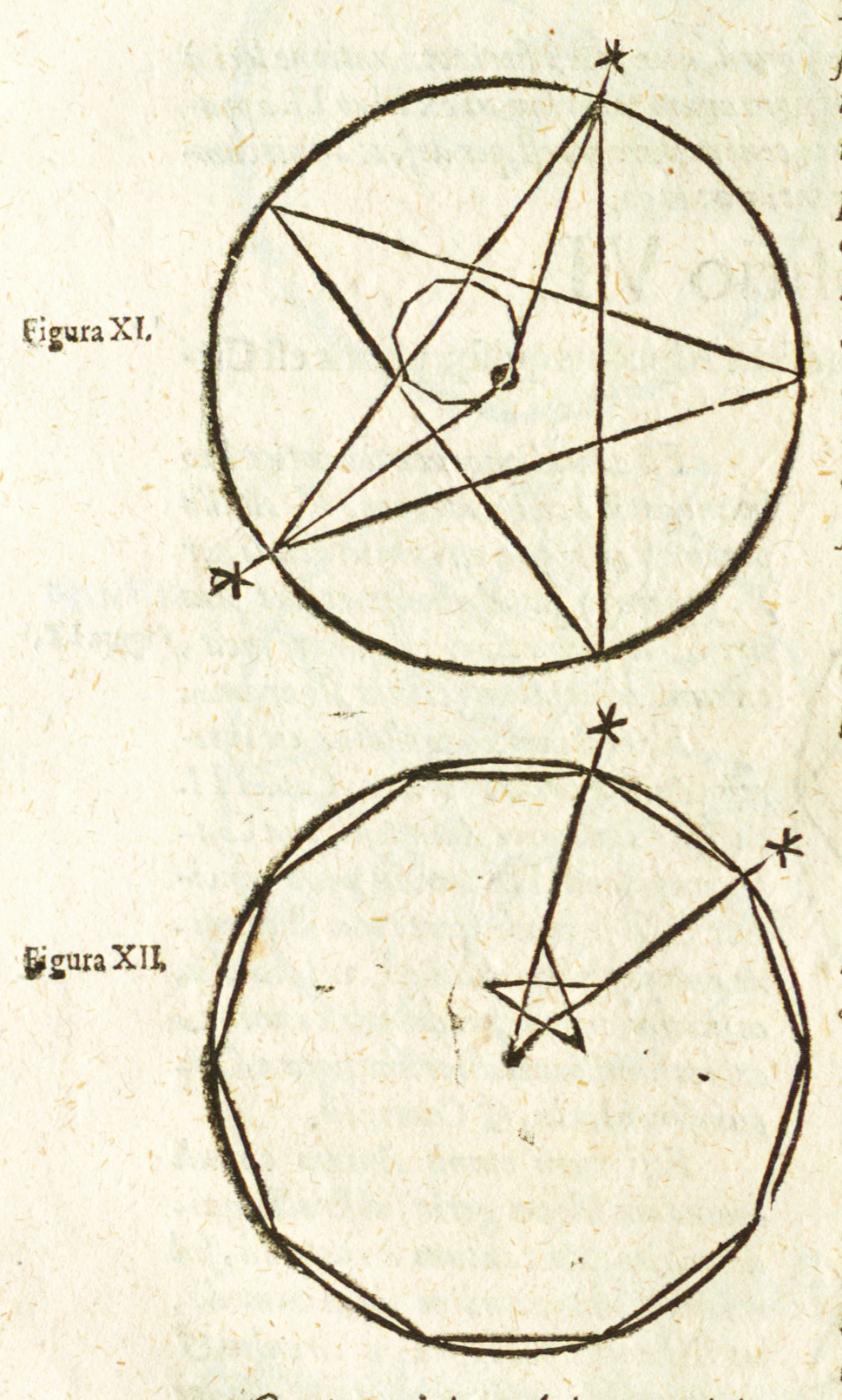

Kepler had only one quintile – Mercury and Jupiter – and one Decile – Mars and Saturn. (Pay no attention to the Black Moon.) He didn’t even mention the Decile in his treatise, but I suspect he figured it out.

When we add the three post-classical planets and the lunar points, we find a few more quintiles and a “quintile wedge.” As astrologer Elizabeth Hazel explained to me: “Two biquintiles linked by a quintile at the base – is a Finger of Destiny. A triangle formed by 2 quintiles linked with a biquintile is a Quintile Wedge, as opposed to a regular wedge formed by 2 sextiles & a trine.”
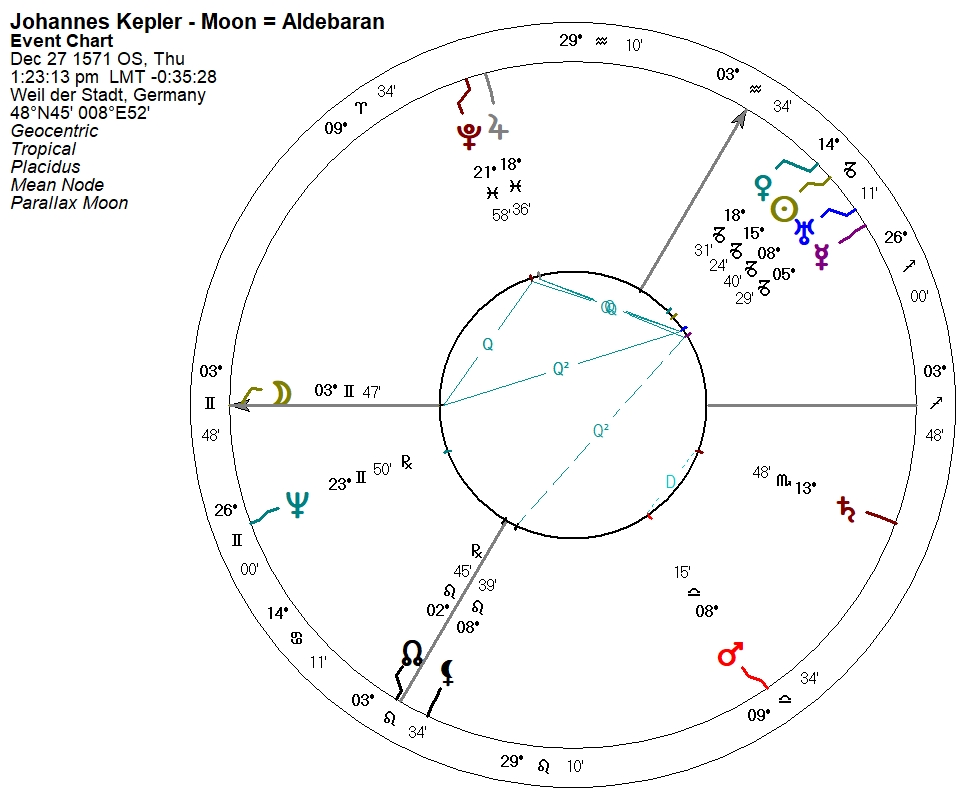
Here’s the list:
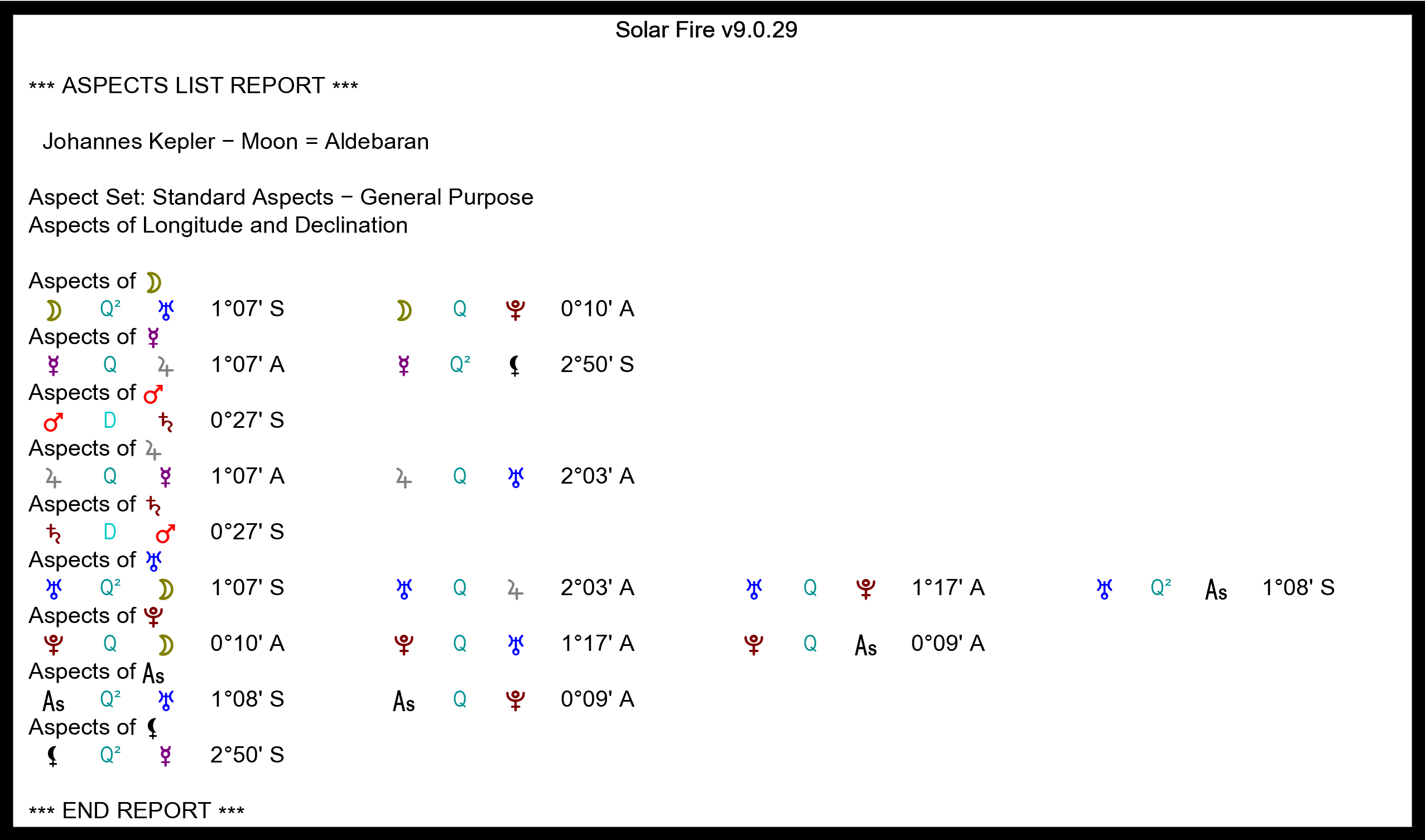
The 72-Dial shows a cluster of the five planets in the Quintile Wedge: Mercury, Jupiter, Uranus, Moon, and Pluto. Furthermore, the combination of SO = ME/SA (Sun = Mercury/Saturn) is revealed.

This enhances the combinations discussed above and shown in Figures 1 and 2, where we find the kinetic impulse driving the intellect. Was Kepler simply destined to be remembered also for this astrological contribution? Astrologers do refer to them as Keplerian Aspects, after all.
The big question remains: what do these quintiles mean? If squares are tension and trines are tranquil, where can we go from that essential polarity? Gettings simplified it by saying, “…this particular aspect does convey a quality of single-mindedness and power to those planets forming such an aspect.”3
Other astrologers will relate the aspect family to Venus, the planet that etches out a pentagram in the grid. I’m in agreement – it is an aspect that shows etheric qualities, artistic sensibilities, and romanticism. The creative instinct.

It takes copious amounts of fanciful creativity to come up with this:

But that creative step ended up leading to this very sensible discovery:

I’ll abstain from any punnery about Kepler being an eccentric or Saturnine.
►Ed

 Cosmos of Absurdity
Leave a comment