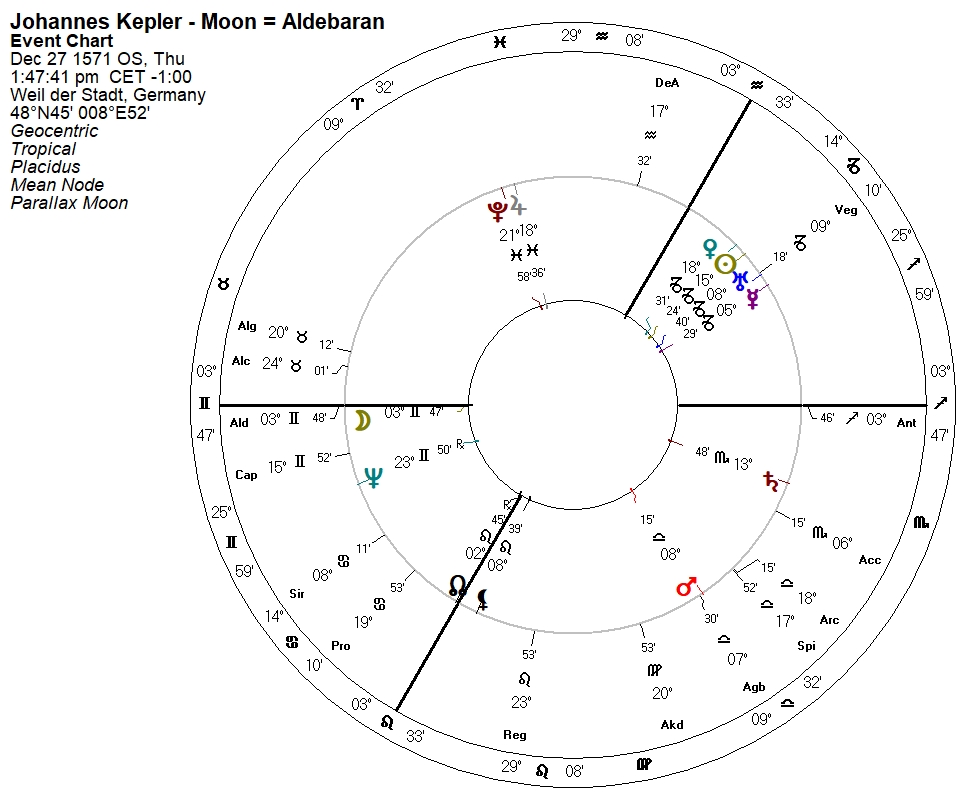
As Johannes Kepler was cutting his astrological teeth, he did spend some time on the aspects, and was credited with adding the 72° (quintile) and 144° (biquintile) aspects into the craft. How does that look in his own natal astrology?
To answer that, I want to first explain the background of his quintile thesis, and then do some standard astrological delineating before delving into the spooky pentacles.
JK was interested in musical harmonies, and he was certain that the heavens operated in some kind of musical format, because that’s what God would do, being the creator of pleasures and pains. The following are translations of his 1601 work, On The More Certain Fundamentals of Astrology:

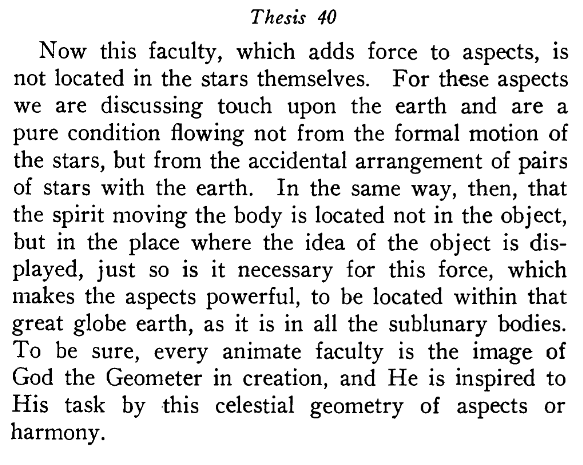
God gave us the astrological aspects and His nature seeks harmony. Music is pleasing, or not, depending on how well the instruments harmonize, with the notable exception of the first Mötley Crüe album, and so will be our astrological influences.
Aspect Theory
But, Kepler could have gone further, if he had only realized that harmonics were based on prime numbers.
In all of renaissance “just” tonations, a prime is part of the ratio:
- 2:1 – Octave
- 3:2 – Fifth
- 4:3 – Fourth
- 6:5 – Minor Third
- 5:4 – Major Third
- 5:3 – Major Sixth
- 8:5 – Minor Sixth
The limitation was that the largest prime in that group is 5. In modern astrology, we still tend slice up the 360° pizza pie in accession to the 12-signed zodiac, because 12 = 2 x 6 = 3 x 4, with the 2 being polarity (male or female, aggressive or passive, etc), the 3 being triplicities (cardinal, fixed, mutable), and the 4 being quadriplicities (fire, earth, air water). The 5 and the 12 are simply incompatible in the traditional scheme.
But, the math is bigger than the zodiac. Astrologers have added further aspects, and sometimes even dare to say so in public. A quick table shows how wild it gets:
| 1 | Conjunction – 0 | ||||
| 1/2 | Opposition – 180 | Sesqui-square – 135 | Square – 90 | Semi-square – 45 | Quartisquare – 22.5 |
| 1/3 | Trine – 120 | Sextile – 60 | Semi-sextile – 30 | Semi-semi-sextile – 15 | |
| 1/5 | Quintile – 72 | Bi-quintile – 144 | Decile – 36 | Semi-Decile – 18 | Semi-semi-Decile – 9 |
| 1/7 | Septile – 51.42857 | Bi-septile – 102.85714 | Tri-septile – 154.28571 | Semi-septile – 25.714285 | Semi-semi-septile – 12.8571425 |
| 1/11 | 32.727272… | 65.45454 | 98.181816 | 130.909088 | 163.63636 |
| 1/13 | 27.6923 | 55.3846 | 83.0769 | 110.7692 | 138.4615 |
| 1/17 | 21.17647 | 42.35294 | 63.52941 | 84.70588 | 105.88235 |
| 1/19 | 18.94737 | 37.89474 | 53.84211 | 72.78948 | 91.73685 |
If we extend this list on and on through more primes, the numbers become more and more cumbersome, and we start to see overlaps of harmonics in terms of “orb of influence.” For instance, a square aspect of 90° is considered “in play” if the angle is as many as four or five degrees more or less than 90, thus if the angle is 86°, it’s still a square.
Even if we bring that “orb” down to one degree, the Semi-Decile [1/20] and the 1/19 aspect are within the same orb. Also notice that 2/13 is only ~1.5° from 3/19. Astrologers get around all of this by mostly ignoring any aspect beyond the Quintile family of aspects, and just take for granted that only so many angels can dance on the head of a pin.
BUT… what we can do with harmonics is decrease the orb relative to the ratio. If a square is allowed a 4° orb, then a semi-square gets a 2° orb and a Quartisquare gets only 1° In Cosmobiology, we actually start off with a 1° orb for any standard aspect, and then slice it down from there – a Quartisquare would have an orb of only 15′.
Thankfully, though, the orbits of planets are so randomly skewed that things tend to not overlap too much. And, we can then simply use the innovative “dial” technique invented by the Uranian astrology gestalt that popped up in Germany (of course) in the late 1800s.
Because our three-dimensional world has a natural four-directional square nature, the Uranians figured out they could fold the zodiac over twice, and use a 90° template. In this sense, all conjunctions, oppositions, and squares would appear as conjunctions, and the charting becomes less cumbersome.
Many years later, the Cosmobiological school of astrology decided to make one more fold, and use a 45° dial. This particular dial allows for easy stacking of all planets in an H16 [Harmonic 16] mode. The H16, as it turns out, is superior. The H16 shows the kinetic energy output of the system.
Kepler’s Natus in Harmonics
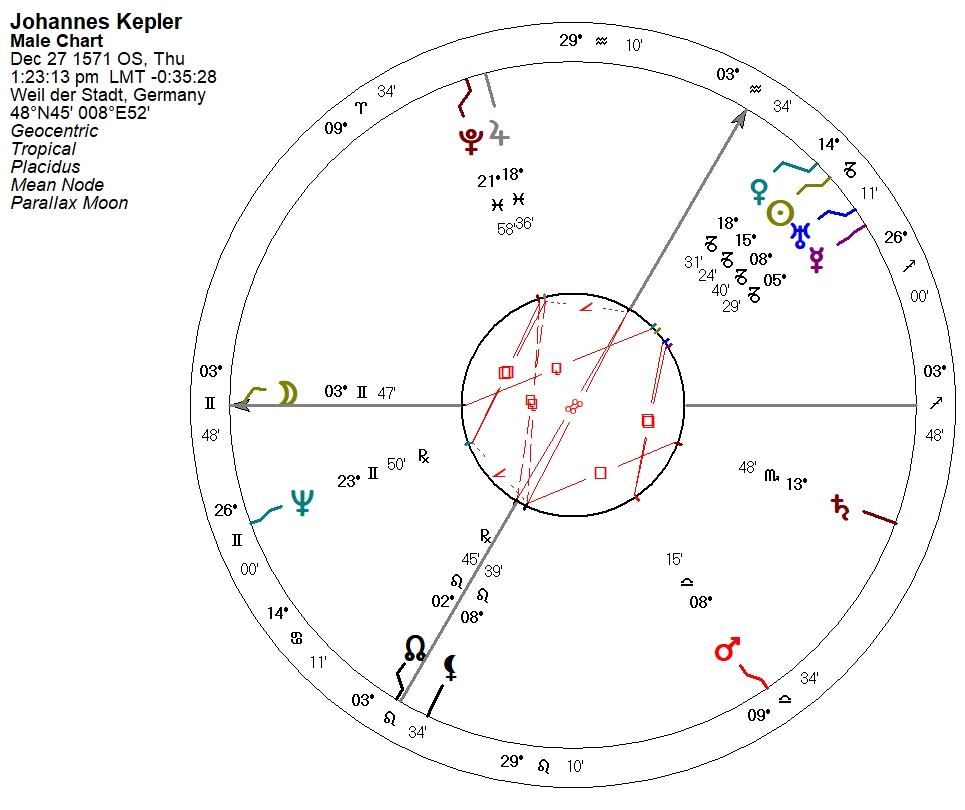
From there, the astrologer can spin the dial and see which planetary combinations were “infused” within the native’s starting point of life. If we take my rectified Kepler chart form the last blog post:

And then add all the aspects in the square family, we get this:
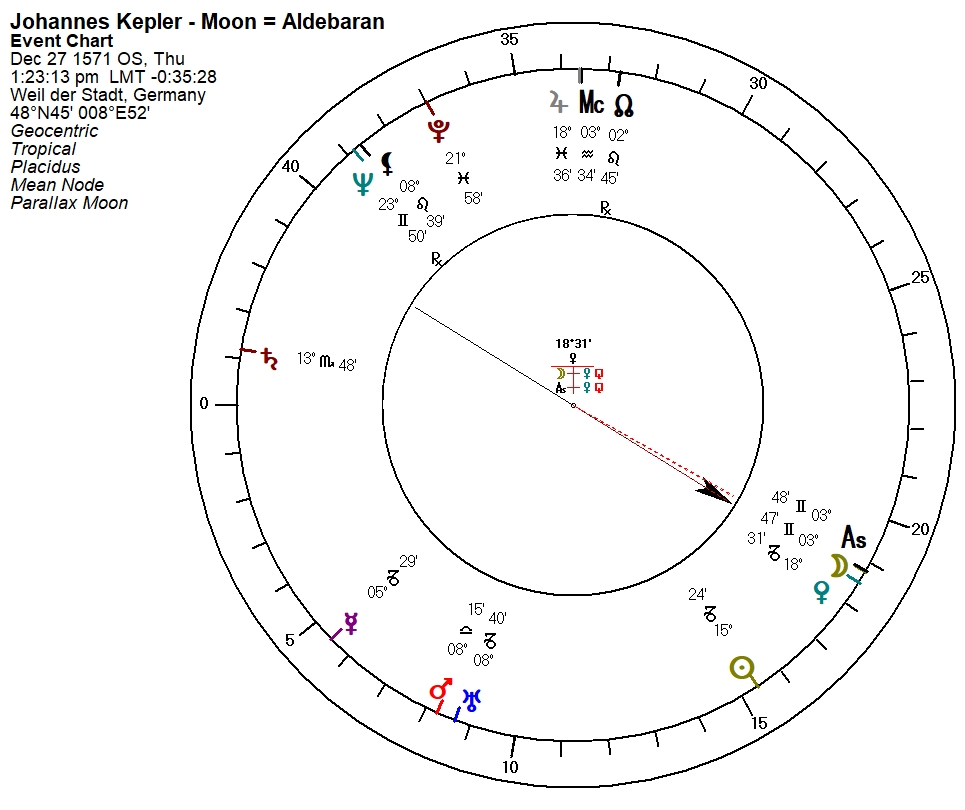
When we then go to the 45-dial format, we can see that the planetary values are the same, but the square family of aspects stand out as conjunctions:

From there, we can see how the harmonics work in the natus.
Sun and Moon
The first order of astro-analysis involves the luminaries – Sun and Moon. Kepler has a “tree” of Sun with the outers of Neptune and Pluto:

Neptune/Pluto represents the longest-term combination cycle in the heavens – ~500 years from conjunction to conjunction . This midpoint offers a connection to the collective at its highest potential in terms of lasting and enduring legacy. We might want to say that this is a kind of destiny, but there really is only a potential for such a major destiny; it is up to the native to actually do something.
The midpoint, which we label “NE/PL”, is the combined and reconciled influence of both planets. What does the godfather of midpoint theory, Reinhold Ebertin, say about this midpoint?

I think it’s safe to say that this fundamental Sun expression of the native fits Kepler to a tee. “The tendency to occupy oneself with unusual problems, the pursuit of peculiar hobbies and aspirations, a progressive spiritual evolution…” The Sun in astrology relates to the vitality of the human – what makes us tick, how we put ourselves out there in the world, our “will,” for lack of a better term. The nature of the individual will gets tweaked by such combinations with other planets.
Such solar variations are easy to see in charts that have a Sun conjunction to another planet, for instance, we all can see the agressive nature of a Sun/Mars conjunction in a natus. But, combinations like this one with Kepler are just as valid, meaningful, and pronounced. Therein lies the value of the 45-dial in astrology – it reveals the nuances of the square family of aspects.
The next two dials highlight the Moon and Venus; they are in a 135° aspect and show up as conjunct on the dial. Moon signifies how the world sees us, and also our relationship with Mom, which in this case is highly energetic. No doubt Kepler was loved by his Mom, though the relationship took lots of work.
Again, a luminary is in a combiation with the midpoint of two outer planets – Saturn and Neptune (again). Both luminaries having connection to Neptune tells us that Neptune colors the personality (Sun/Moon = personality) more than any other influence, and influenza is part of this influence.
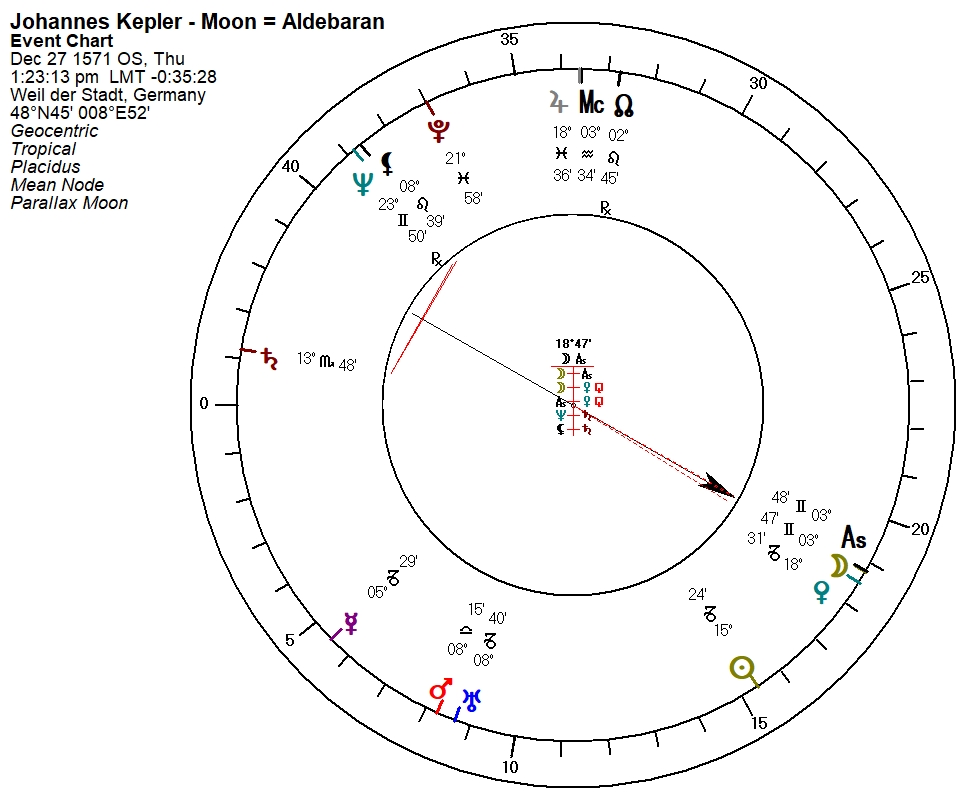
When we consider a midpoint, we must see it as a place where the divergent influences of two planets work themselves out, so to speak. Saturn, the always-practical, reality-based, cold hard facts, rule-based, boundary-defining planet, is an anathema to the Neptunian influence of boundary-lessness, dreamyness, delusional, idealistic, abstraction, mystical, sensitive, and surrealism. It’s like trying to be a the rule-maker and the rule-breaker at the same time.
However, Saturn always tends to win this one, as it is the more massive body, for one, but also because we are bound by our real-world limitations. Ebertin says simply that this pairing is about “Poor, sick, or oppressed people.” [COSI, p 176.] With Moon, he wrote, “Emotional depressions, pessimism, the inability to develop emotionally in a proper manner, a low character. Illness through soul-suffering, women’s diesases either chronic or otherwise.” [COSI, p. 177.]
I would say that Venus in the mix alleviates much of this, and brings more joy to the life, but only through the creative process and admiration from others. Kepler was driven by approval from others of his league. Neptune has been called the “higher octave” of Venus by astrologers, and we might find that these two planets are pushing the envelope more on the aesthetic side than if Venus were not in the scenario.
We can now see a clearer picture of the man at his Sun/Moon core – a sufferer, a loner, and bereft of the fortunate influence of Jupiter. It should be noted that he passed away 35 days before his second Saturn return at age 59. He was, in the end, hardshipped to death. There is much more to say about the death transits, but that’s for a future post.
Mars square Uranus
After Sun and Moon, I like to look at what planets are in the closest aspect, and we should not be surprised that Kepler’s natus boasts Mars in a sinister square to Uranus. “Sinister” is perhaps an obsolete term, but the point is that Mars, the faster planet, is moving toward the conjunction and away from the opposition, rather than the other way around. If we were to be perfectly technical, Mars and Uranus are in a 270° aspect here.
In any event, the precise midpoint has no tree:

But, Uranus does have a tree, and so I tend to include Mars in the “circuit.”
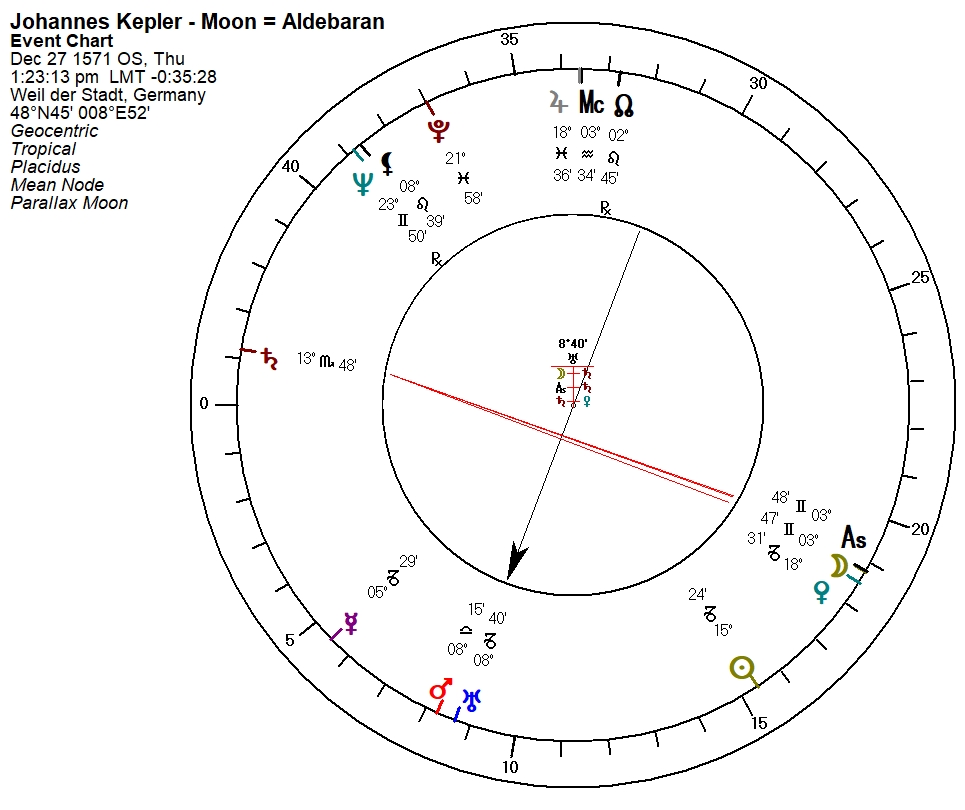
The equation for this: UR = [{(MO-0-AS)-135-VE}/SA]
There are many books on aspects, but one of my favorites is C.E.O. Carter’s The Astrological Aspects. Inside, he does the standard cookbook format, going through all the possible pairings of planets. (The book is from 1930, so no Pluto.) Carter divided his combinations between “harmonious,” “inharmonius,” and “conjunction.” (Very Keplerian, indeed!)
Harmonious aspects are the trine family – 120, 60, 30. Inharmonious are the opposition family – 180, 135, 90, 45. (He also included here the “quincunx” aspect of 150, but in my view that is part of the trine family; astrologers will argue with me about this until the cows come home, so take it for what it’s worth.)
In any event, Carter has this to say about the square of Mars and Uranus:

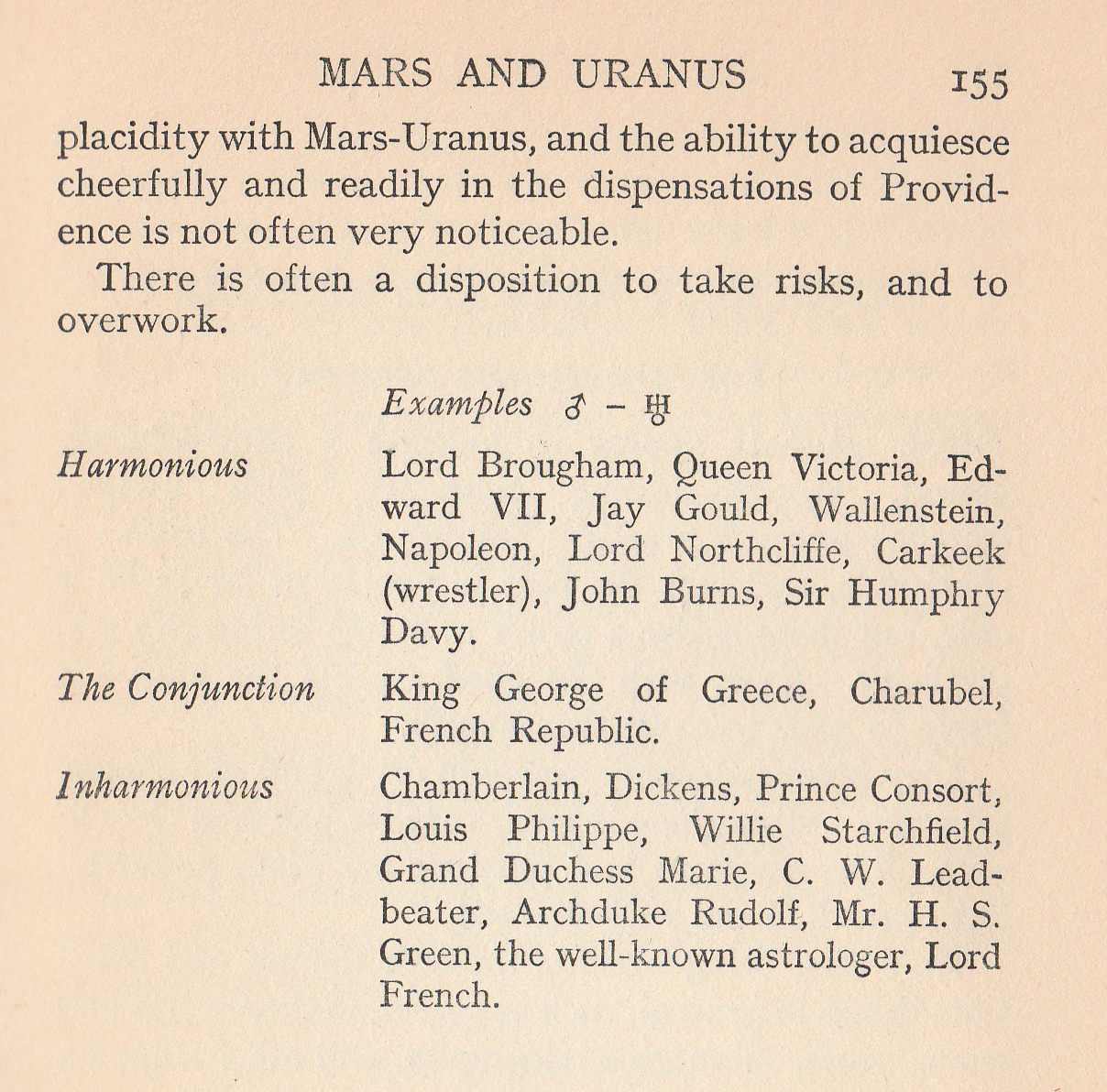
There is not much here that gets it wrong about Kep, though maybe the “at all costs” stuff is a bit overestimated. Uranus is the boundary-breaker, of boundaries set by Saturn, which in those days were the domineering church-state. Uranus is the iconoclast, and with Mars, a warrior-iconoclast.
But, there were some sacrosanct boundaries, as Venus/Saturn – the romance of rules – is part of the circuit. Kepler was a person who took his Lutheran religion seriously, and rather than denounce it for comfort, allowed himself to be exiled. “Hypocrisy I have never learned. I am in earnest about faith. I do not play with it,” was a quip that Carl Sagan included in Cosmos, in the scene where the Catholics told him to get lost.
Still, the driving quest for Kepler was to discover how his god made the world work. His championing of Copernicus had ruffled some feathers, and made his reputation that of a difficult person. He was in many ways intellectually beyond the safe and cloistered hive mindset of Tübingen, and after he lost that professional safe haven, he was truly out on a limb – right where the typical Mars/Uranus native always haphazardly puts himself, on the outside. But, without that outlaw status, he may never have had the correct path to prove what he had to prove.
It’s just what we True Bohemians do.
Next, we’re going to look at Kepler’s chart with the 72-dial and whether it’s worth a damn, but not before his other intellectual qualities (Mercury/XX) are discussed.
►Ed

 Cosmos of Absurdity
Leave a comment