

As a progressive, 21st Century astrologer, I don’t find much use for the fixed stars in interpretive work. However, there are instances that challenge my modern sense of what might be obsolete. Johannes Kepler’s natus may be one of those challenges.
Kepler was an iconoclast who shifted a paradigm in astronomy. Briefly, he was the guy who demonstrated that planetary orbits were not only all heliocentric, but also elliptical, rather than circular with epicyclic components.
He arrived at this conclusion, not by accident or by a wild guess, but by doing “the math,” and lots of it. There is no need for me to go into detail here, as plenty of histories are available on the Interwebs. He remains one of the most important individuals in Western science, and as such, deserves a thorough astrological appraisal.
Astrology is constantly under pressure to “prove” itself, and thus astrologers are required to look at horoscopes like this and show that the guy was some kind of super-rare genius. But, what is his actual horoscope?
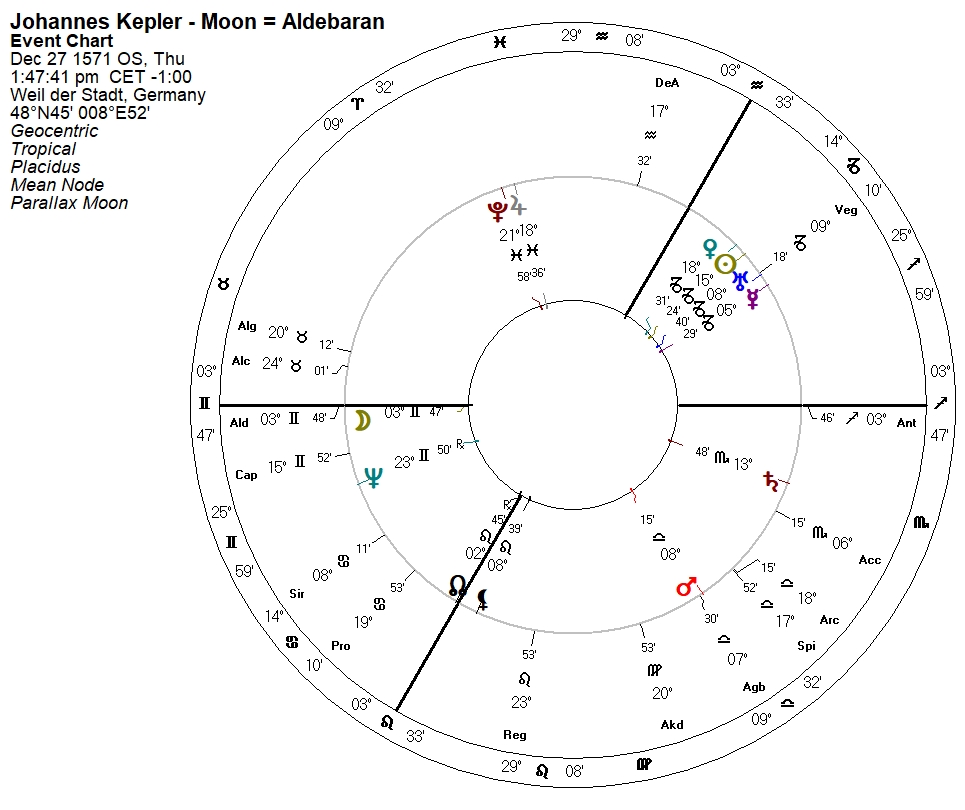
This chart comes with the software program Solar Fire. The source is Kepler’s own rectification:

But, there are other possibilities found in the records, such as one with the 29th degree of Taurus rising and the 30th degree of Capricorn culminating. This chart is a facsimile of one included in Kepler’s papers, courtesy of astrologer Anthony Lewis, who goes into detail here and here about the charts:

This chart has an ascendant in the 28th degree of Taurus and a midheaven in the last degree of Capricorn, as shown below:

But, I’m not here to make the case for either one. Instead, I want to point out that Kepler was born very close to a lunar occultation of the mighty fixed star Aldebaran. In fact, that occultation occursioned as the ecliptic value rose at his place of birth.
Using Sky Map Pro (because I’m lazy), I determined that the occultation was in effect from 1:30 pm – 2:07 pm CET on his date of entry. That means the occultaiton was “rising” at his place of birth, in terms of our standard two-dimensional astrology chart that does not take ecliptic latitude into consideration, only ecliptic longitude. In fact, the numbers line up with amazing precision. Here is that radix with an extra ring of the Behenian stars that include Aldebaran [Ald] and Antares [Ant]:
Astrologers get very very excited when all the numbers align like this, because such occurances are rare, and most of us are also OCD. A Sky Map Pro graphic for this, with the ecliptic grid in longitude of 1° spacing, shows that the occultation is more than 5° away from the ecliptic, but that the longitude intersects the horizon:
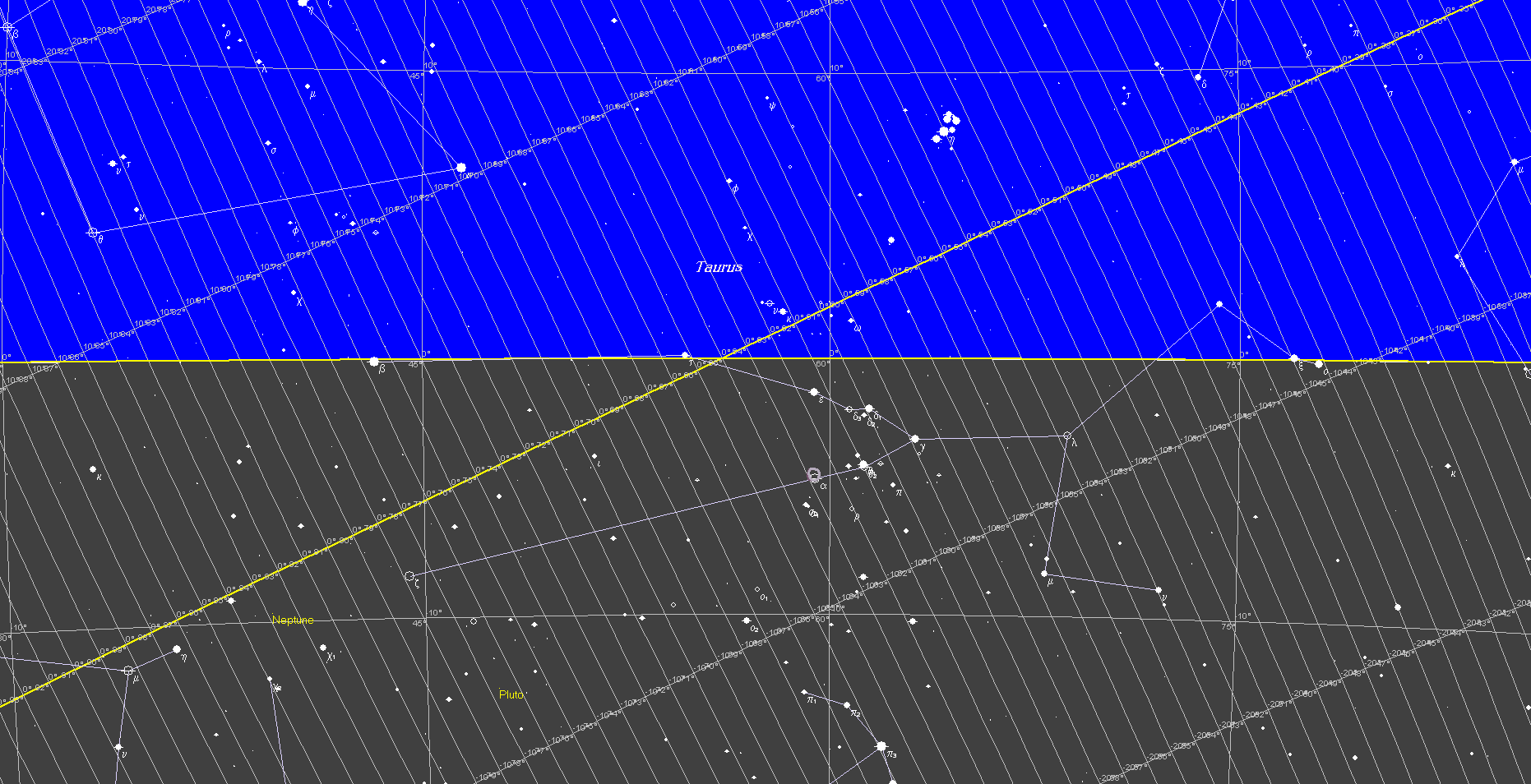
(In Sky Map Pro, the horizon line is adjusted for refraction. The “ascendant” in an astrology chart is not, thus the discrepancy.) A closeup:
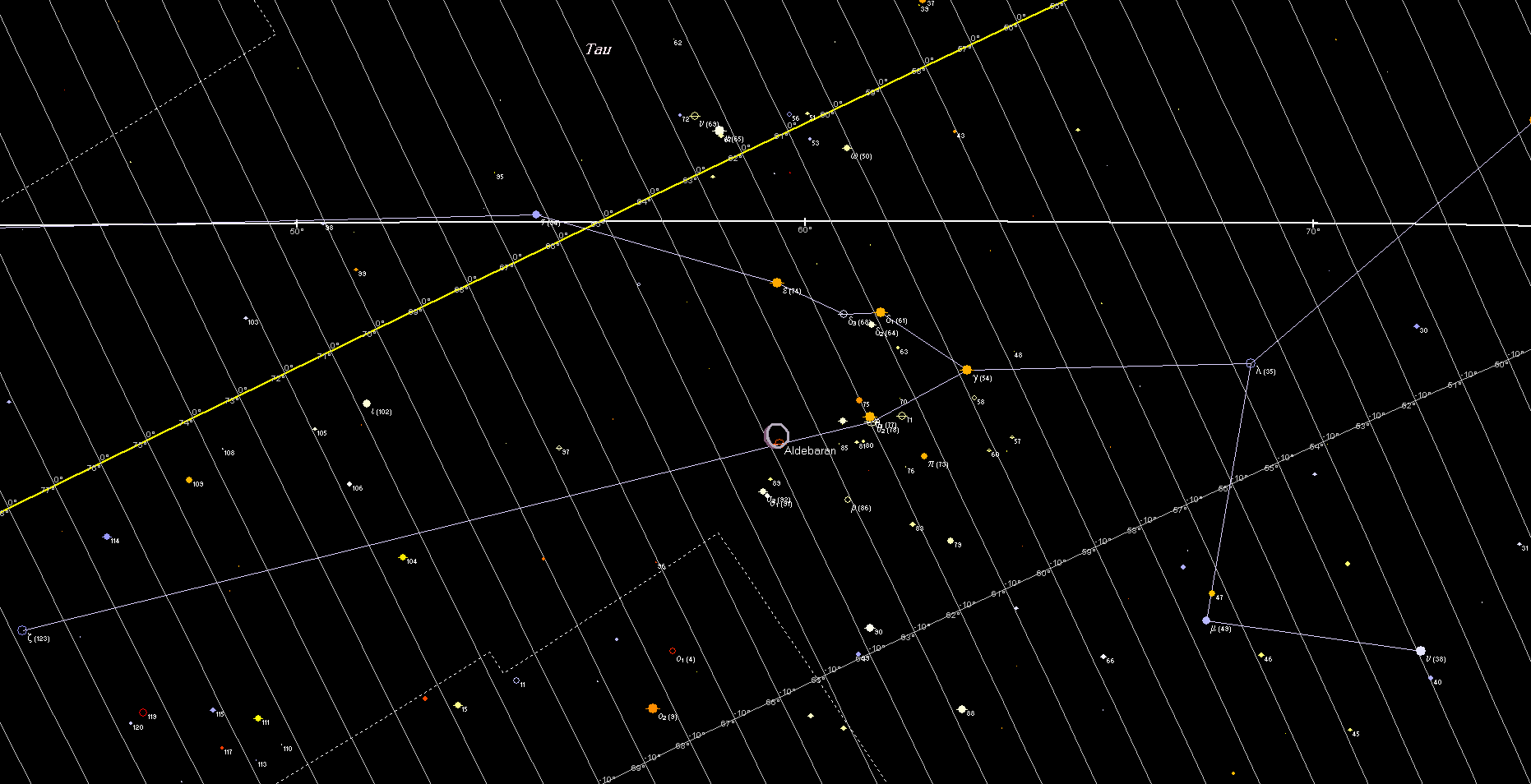
And a supercloseup:

30 minutes after the occultation was in this perfect mathematical alignment, the Moon and Aldebaran reached the horizon, in a “co-rising” where they rise as basically the same time:

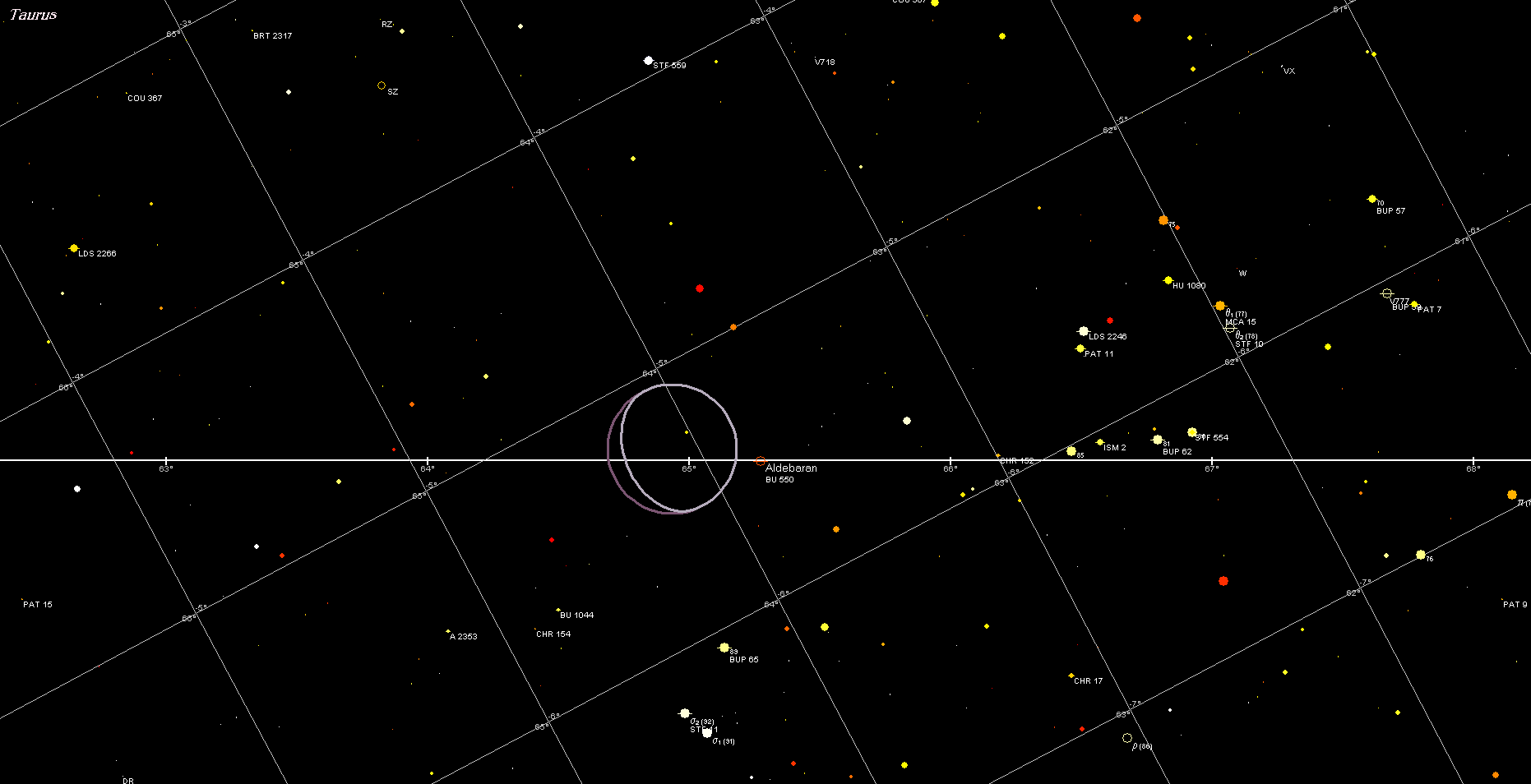
The Moon and Aldebaran one minute later than Figure 5:

So, why go through all of this?
In a perfect world, I would wish that, given we are talking about Kepler, this occultation was occurring when he was born. Aldebaran is, after all, one of the most famed and important fixed stars in the heavens. It was the star, along with its counterpart Antares, that anchored the ancient fixed zodiac, a la Cyril Fagan: Aldebaran @ 15° Taurus, and Antares @ 15° of Scorpio. The cardinal points, therefore, were only 45° in either direction. Easy-peasy for plotting the planets and slicing up the celestial pizza pie.
My guess is that these opposing stars were chosen by the ancients for the most obvious and practical reason: they are in a precise opposition to one another.
Such an opposition has practical value. When the Sun and its aura were in front of Aldebaran, the astronomer could get a “fix” on the grid with Antares, and from there determine the zodiacal value of any planet. When Antares was blocked by the Sun and its aura, Aldebaran could be used as that “fix.”
It helps that both Aldebaran and Antares are bright stars, easily discernable to the naked eye; from there an astrolable or any other astro measuring tool could be useful. This is probably how they became part of the “Royal Stars of Persia” lore that included Regulus (5° Leo) and Fomalhaut (9° Aquarius) to complete the “fixed” cardinal directions.
I say my wish because Kepler was obsessed with the science of the heavens. He was certain that he could decipher the reality of the heavens, which he was certain were in the Copernican heliocentric model. His initial attempts were idealistic but incorrect, but he learned from that, and kept evolving, trying to crack the code. Once he finally was able to work with precision measurements from Tycho Brahe, his mathematical and reasoned mind discovered the truth of celestial motion – all orbits are eccentric.
What about other parts of his natus?
Going back to the first chart above, Figure 1, we see that Neptune is on the ascendant. Neptune was not discovered until 1846, so all the guesses in the late 1590’s were made without the aid of the outer planets. (Contemporary astrologers rely almost completely on Uranus for rectification work.) However, the modern astrological view of Neptune is that it represents unusual obsessions and compulsive fixations, which we can easily see in Kepler’s work. Any planet right on the chart ascendant like that will dominate the life of the native, for better or for worse, depending on the rest of the chart blah blah blah.
Neptune also “rules” things like viral illnesses and myasma. Neptune is associated with the sea, but we don’t see much in the way of Kepler longing for a maritime life.
Therefore, the next blog will be a modern harmonics/combinations look at Kepler’s natus, using my own iterations of the techniques.
► Ed

 Cosmos of Absurdity
Leave a comment